
ECU Remapping for Low-Octane Fuel
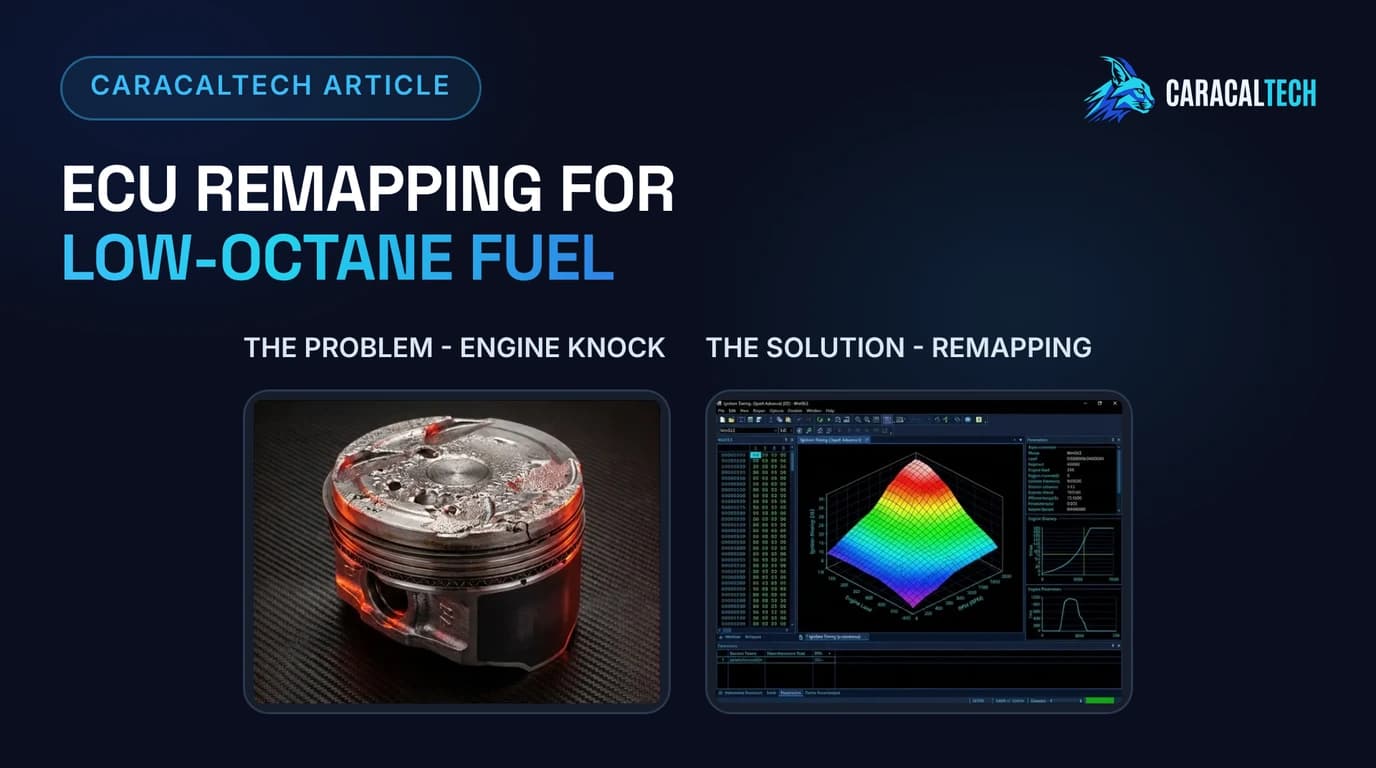
ECU Remapping for Low-Octane Fuel Operation
This article explores the detrimental effects of low-quality, low-octane gasoline on modern internal combustion engines and examines how targeted ECU remapping can mitigate these risks. We will dissect the underlying thermodynamics, combustion chemistry, and control logic to provide a comprehensive understanding of this critical subject.
Understanding Octane Rating and Its Functional Role
A four-stroke spark-ignition engine operates through a well-defined cycle: intake, compression, combustion (power), and exhaust. During the compression stroke, the cylinder charge (a homogeneous mixture of air and vaporized fuel) is subjected to a rapid reduction in volume. In many modern powerplants, this volumetric reduction reaches a ratio of 10:1 or higher. From basic thermodynamic principles, compressing a gas raises its temperature considerably; at idle speeds of roughly 750 RPM, a typical naturally aspirated engine already experiences in-cylinder temperatures approaching 400 °C.
The Research Octane Number (RON) quantifies a fuel's inherent resistance to autoignition. In practice, this means the fuel-air charge must remain stable and not ignite spontaneously under increasing pressure and temperature until the spark plug initiates the flame front. Should the end-gas ahead of the propagating flame autoignite, the resulting uncontrolled energy release manifests as an abrupt pressure spike—the phenomenon known as knock or detonation. These violent pressure oscillations place immense mechanical stress on the piston crown, ring pack, connecting rod bearings, and even the spark plug electrode. Extensive SAE literature confirms that knock resistance is the single most influential factor governing the calibration and mechanical design of spark-ignition engines.
Defining "Low-Quality" Fuel
Low RON is rarely the sole culprit behind poor fuel quality; refinery practices, additive chemistry, and how the fuel is handled downstream all are important. Refinery capability, for instance, sets the baseline-facilities operating with outdated technology frequently fail to produce base stocks with consistent anti-knock characteristics.
Contaminant load presents another significant concern. There is a strong possibility that an acceptable nominal octane number, high sulfur content and other trace impurities can inhibit proper flame propagation, robbing the combustion process of its efficiency. Supply chain degradation introduces further variability, as improper storage and distribution-aging tanks absorbing moisture or cross-contamination with diesel-introduce undesirable compounds that lower effective energy release.
Finally, additive selection plays a decisive role. Whether TEL (now largely obsolete), MTBE, ethanol, or toluene, each compound shifts the final blend's behavior under high-load conditions. Poor blending inevitably yields suboptimal results, undermining the fuel's performance despite an otherwise acceptable octane num.
The Combustion Triangle
it is evident that "low-octan fuel quality" encompasses more than just a low RON; contamination and inconsistent formulation produce analogous driveability symptoms. For a gasoline engine to achieve peak thermal efficiency, calibration engineers must maintain three interdependent variables in precise equilibrium. This triad is frequently conceptualized as the "Combustion Triangle":
Fuel Quality: Appropriate octane rating, purity , and cleanliness.
Air intake: Accurate to achieve the stoichiometric or lambda-targeted air-fuel ratio.
Ignition Timing: carry out the spark fot the optimal crank angle to maximum brake torque (MBT).
A disturbance in any one of these legs precipitates a decline in combustion quality, which in turn compromises power output, specific fuel consumption, exhaust emissions, and long-term engine lifetime.
Standard Octane Classification by Engine Architecture
Globally, RON requirements are dictated by engine design parameters such as compression ratio, boost pressure, and valve timing. The following table provides a general industry benchmark:
| Approximate RON Range | Typical Applicable Engine Platforms |
|---|---|
| < 90 | Low-octane fuel; suitable for low-compression, legacy engines |
| 91~95 | Standard naturally aspirated passenger car engines |
| 95~98 | High-compression, turbocharged, and direct-injection production engines |
| 98~101 | High-performance, tuned, and motorsport applications |
A critical observation emerges from this classification: for forced-induction engines, even 91 RON fuel can be considered inadequate. However, the focus of this discussion remains squarely on fuels with an octane rating of 85 RON or lower, which represent a significant departure from design specifications.
Diagnostic Indicators of Low-Octane Fuel Usage
The onset of poor combustion due to inadequate fuel can typically be identified through a distinct set of operational symptoms:
- Rough and unstable engine idle immediately following a cold start.
- Audible metallic pinging or rattling during initial tip-in acceleration.
- Pronounced knock events under moderate-to-high engine loads, particularly in the 3500–4500 RPM band.
- Noticeably elevated fuel consumption under steady-state driving conditions.
- Visible soot deposition or black carbon accumulation at the exhaust tailpipe.
- Delayed throttle response and perceptible hesitation relative to prior performance.
- Excessive exhaust smoke during boost onset, especially pronounced in turbocharged variants.
Calibration Limits for Low-Octane Accommodation
In production ECU calibration, engineers do not solely optimize for premium fuel. Instead, they develop a suite of ignition maps designed for various scenarios:
An MBT map for ideal fuel and ambient conditions.
A knock-limited map, where spark advance is constrained by the onset of detonation.
A default or emergency map, which serves as a fallback when fuel quality is significantly degraded.
The knock sensor provides real-time feedback, enabling the ECU to retard spark timing incrementally—typically by a few crankshaft degrees—whenever incipient knock is detected. This closed-loop strategy effectively protects the hardware. However, this adaptive range is finite. SAE studies consistently demonstrate that as fuel octane declines, the control unit progressively retards timing, leading to measurable drops in acceleration and peak torque. Crucially, if the in-tank fuel quality falls substantially below the minimum threshold anticipated in the base calibration, the ECU's corrective authority is exhausted. Under these conditions, spark retardation alone cannot prevent persistent knock, and the engine becomes highly vulnerable to catastrophic mechanical failure.
Mechanical Consequences of Sustained Low-Octane Operation
Prolonged operation on low-octane fuel invariably induces detonation. The end-gas, situated at the periphery of the combustion chamber, is subjected to the highest thermal loads and is therefore most prone to autoignition. Consequently, the first components to fail are the piston rings and the piston itself; they succumb to thermal fatigue, cracking, and, in severe cases, fracture. Once fragments break loose within the combustion chamber, the resultant secondary damage can progress to total engine destruction in a matter of seconds.
The Heightened Sensitivity of Modern Powerplants
It is a common misconception that older engines are more fragile. In reality, contemporary engines are considerably more vulnerable to poor fuel quality. To meet stringent CO₂ and emissions mandates, manufacturers have aggressively adopted technologies such as elevated geometric compression ratios, turbocharging, gasoline direct injection (GDI), variable valve actuation, and increased boost thresholds. All of these advancements raise peak in-cylinder pressures and temperatures, thereby intensifying the thermodynamic propensity for knock. Research originating from MIT and corroborated by SAE confirms that modern turbocharged GDI engines exhibit a far steeper dependence on fuel anti-knock quality than their naturally aspirated predecessors. The consequence of low-octane fuel in these systems is not merely a reduction in power; it is a marked increase in the probability of irreversible mechanical damage. Older, lower-compression engines, conversely, possessed a broader safety margin and typically survived poor fuel with only a minor loss in output.
ECU Remapping as a Mitigation Strategy
For markets and climates where high-octane fuel is either unavailable or economically unviable, remapping represents the most effective countermeasure. The objective is to recalibrate the ECU's fundamental operating parameters,specifically, the air-fuel ratio and ignition timing maps, to align with the fuel's actual characteristics. This approach requires a methodical and conservative methodology; adjustments must be data-driven and validated through rigorous testing. The training resources provided on this platform equip enthusiasts and professionals with the necessary protocols to perform these modifications safely.
Real-World Case Study: Jetour T2 Recalibration
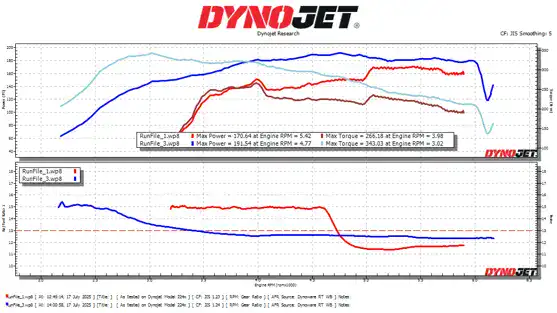
Consider the Jetour t2, equipped with the 1.5TGDi F4J15 engine. Data acquired from this platform revealed severe knock events at 4500 RPM when running on substandard fuel. The factory ECU responded by applying significant spark retard and enriching the air-fuel mixture to quench the knock. While this intervention prevented immediate component failure, it precipitated a pronounced increase in fuel consumption and a stark reduction in usable power. Following a comprehensive remap, which involved a careful revision of the ignition advance and fuel delivery tables, we not only eliminated the knock signature entirely but also realized a net gain in peak output, demonstrating the dual benefit of optimized calibration.
Test Configuration
- Vehicle: Jetour T2
- Engine Specification:1.5L SQRG4J15 turbo I4
- Fuel: Commercial gasoline with an estimated Research Octane Number (RON) of approximately 78
- Ambient Temperature: 35°C (95°F)
- Dynamometer: Dynojet chassis dynamometer
- Transmission Gear: 4th gear (DCT)
Test Method: Multiple full-load dynamometer runs were performed under consistent conditions using the Dynojet data acquisition system. The factory ECU calibration was tested first, followed by the recalibrated ECU using the same fuel and test procedure.
Test Results
Figure 1 compares the measured power and torque curves before and after ECU recalibration.
The optimized calibration produced a more stable power delivery throughout the engine's operating range while reducing the likelihood of knock-related ignition intervention under high-load conditions.
Although the primary objective of the calibration was engine compatibility with lower-octane gasoline rather than maximizing peak horsepower, the revised calibration demonstrated improved overall drivability and more consistent engine behavior during full-load operation
Key Calibration Areas for Low-Octane Fuel Optimization
Although every ECU strategy exhibits distinct characteristics, professional calibration for lower-octane fuel typically concentrates on several core control domains rather than a single map. Depending on the specific ECU architecture and engine design, these areas may include:
- Spark Advance Maps – Optimizing ignition timing to mitigate knock propensity while preserving combustion efficiency and thermal margin.
- Minimum Spark Advance Limits – Establishing safe ignition boundaries to prevent excessive spark retard under high-load, high-temperature operating conditions.
- Engine Load Calculation – Refining load models to enhance ignition scheduling precision and torque management responsiveness.
- Knock Sensor Signal Processing and Filtering – Refining detection algorithms to differentiate true combustion knock from mechanical background noise, where ECU hardware and software provide the necessary configurability.
- Requested Engine Torque Models – Recalibrating torque request strategies to ensure proper coordination among ignition timing, fueling rates, and electronic throttle control.

However, these calibration domains must never be adjusted in isolation. Modern ECUs deploy highly integrated control architectures; modifications applied to one subsystem invariably propagate effects across multiple dependent strategies. Consequently, robust calibration demands holistic validation of the complete engine management system rather than isolated optimization of discrete maps.
For further insights into knock elimination and to explore the proprietary Caracal Method in depth, please visit our dedicated courses page.
Concluding Remarks
The octane rating, while fundamental, does not singularly safeguard engine health. Fuel formulation and purity are equally critical; a contaminated or improperly blended batch can, in extreme cases, reduce an engine's operational lifespan by an order of magnitude. This underscores why fuel quality is a primary consideration in both initial engine design and subsequent ECU calibration—a principle that holds significant weight in the remapping discipline.
Modern control systems, facilitated by high-bandwidth knock sensors and advanced adaptive algorithms, offer a measure of compensation for fuel variability. Yet, this adaptability is inherently constrained. The more technologically advanced, boost-dependent, and thermally efficient the engine, the more it relies on a consistent supply of high-octane fuel. Consequently, fuel quality has become an increasingly non-negotiable pillar of reliability and sustained performance. Given that consistent premium fuel is not universally accessible, the strategic adaptation of the ECU through remapping emerges as an indispensable tool for safeguarding powertrain integrity and restoring lost performance.
References
- Heywood, J. B. Internal Combustion Engine Fundamentals, 2nd Edition.
- Bosch. Automotive Handbook, 10th Edition.
- Bosch. Gasoline Engine Management.
- SAE International Technical Papers (Knock Control, Spark Timing, and Combustion Optimization).
- ISO 5164 — Determination of Research Octane Number (RON).
- ISO 5163 — Determination of Motor Octane Number (MON).
- OEM Engine Management Service Documentation.
Enjoyed the content? Add us as a preferred source to see more of it in Search.