
ECU Cloning: What It Is, How It Works and Which Tools Do It
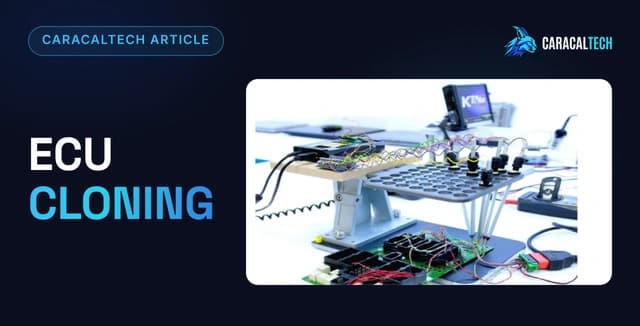
Short answer: ECU cloning copies the complete data of a vehicle's original engine control unit (software, calibration, immobiliser data, VIN and coding) to a replacement ECU of the same type, so the car starts without new immobiliser adaptation. Owners use it when an ECU fails but can still be read. It is common on Tricore ECUs such as Bosch EDC17 and MED17. Our IMMO data solution covers 9 VAG units, from $75 per file.
What does ECU cloning mean?
ECU cloning means making the replacement ECU an exact copy of the original one. A tool reads every memory area of the original ECU: the program flash with the software and maps, and the data flash or EEPROM with immobiliser data, VIN, coding and adaptations. It then writes this data to a second ECU with compatible hardware. The vehicle sees the replacement as its own ECU, so the immobiliser lets the engine run without dealer adaptation. Cloning does not change performance; it is a repair method for an ECU that is damaged but can still be read.
| What is copied or checked | What it means | Source |
|---|---|---|
| Program flash (PFlash / iFlash) | Bootloader, application software and calibration maps | Autotuner – ECU memory types |
| Data flash (DFlash) or EEPROM | Immobiliser data, VIN, coding and adaptations | Autotuner – ECU memory types; Abrites – MG1 and MD1 |
| Donor and recipient reads | For Tricore EDC17/MED17 units, the PFlash and DFlash of both ECUs are read in boot mode and combined into a new file | Abrites – EDC17/MED17 in VAG |
| Immobiliser match | If the immobiliser data does not match the vehicle, the immobiliser prevents the engine from running | Ross-Tech – Immobilizer II |
| Coding of a used ECU | A used replacement ECU should have the same coding; a VAG ECU swap without cloning needs the PINs of both ECUs | Ross-Tech – Immo III swapping; Immo IV swapping |
For supported VAG units, the CaracalTech IMMO data solution reads the immobiliser data from your ECU dump so it can be used for cloning or for resetting a unit.
What is “ECU CLONING”?
🚩What You Will Read in This Article:
- What does ECU cloning mean?
- What is ECU cloning?
- What is the purpose of ECU cloning?
- How is ECU cloning done?
- What are the pros and cons of ECU cloning?
- ECU cloning related software and tools
- ECU cloning – common ECUs and tool support
- ECU cloning training
- Frequently asked questions about ECU cloning
ECU cloning means copying all of the data in an ECU (program, calibration, immobiliser and coding data) to another ECU with compatible hardware. It is done for several reasons, but it is not as simple as it sounds: security locks, stored vehicle data and the immobiliser system make it harder.
Why is “ECU CLONING” Done?
Generally, ECU cloning is done so that a vehicle starts and runs with a replacement ECU without new immobiliser or coding work. Common reasons are a hardware fault in the original ECU (for example water damage or a failed output stage), keeping a second ECU with the same data for motorsport use, and moving the software to a used ECU of the same type. An ECU can also be damaged by a failed read or write during a remap, which is another case where the data is cloned to a replacement unit.
Symptoms such as the engine stalling or not starting can point to an ECU fault, but they have many other causes. Diagnose the ECU first: cloning only makes sense when the original unit can still be read completely.

How is The “ECU Cloning” Done?
Cloning can be used on cars, motorcycles, trucks, tractors, boats and other machines with an ECU. Each ECU is coded for one vehicle and its VIN, so cloning cannot be done with simple, general tools. The reading tool must read every memory area of the original ECU correctly, and the replacement must have compatible hardware before the data is written.
Technical Challenges in ECU Cloning: Beyond the Basics
Cloning an ECU is not simply a matter of copying and pasting a file. Modern ECUs are equipped with multiple layers of security that must be addressed carefully. The Immobilizer system, for instance, is often linked to the vehicle's Body Control Module (BCM) and key fob. If the cloned data does not perfectly match the original immobilizer code, the vehicle will not start, regardless of the ECU's condition.
Additionally, many ECUs use anti-tuning protection and checksum verification. If the checksum is not correct after cloning, the ECU may reject the file or lock itself. Some vehicles also store data such as the VIN and coding in both the ECU and other modules, so a mismatch can trigger warning lights or faults. For this reason, professional cloning needs a bench or boot tool that supports the ECU (for example Alientech K-TAG, which lists cloning as a function), and a good understanding of the ECU's memory layout and checksums.

ECU cloning challenges and solutions
| Challenge | Solution |
|---|---|
| 1. Immobiliser | Read the data flash or EEPROM of the original ECU and write it to the replacement, so the immobiliser data matches the vehicle. |
| 2. Mileage and other stored vehicle data | Copy the complete data flash or EEPROM, not only the calibration, so the stored data stays the same as in the original ECU. |
| 3. Anti-tuning protection | The tool must support the ECU's protection, usually through boot or bench mode. Some Bosch MD1/MG1 units built after mid-2020 need an unlock first or cannot be opened on the bench. |
| 4. VIN (vehicle identification number) | Read the full flash and data flash, not only the calibration area. |
Pros and Cons of The “ECU Cloning” Method:
ECU cloning is a repair method, not a performance upgrade. You usually need it because the original ECU has a problem. Its main advantage is that the vehicle often runs with the replacement ECU without new immobiliser adaptation or dealer coding, which usually costs less than a new ECU with online coding. Its limits: the replacement must have compatible hardware, the original ECU must still be readable, some newer ECUs need an unlock or cannot be cloned, and a clone copies the software exactly as it is, including any earlier modification.
"ECU Cloning" Related Software and Tools:
Cloning is done with a reading tool, not with map-editing software. Map editors such as WinOLS or ECM Titanium are used for calibration work, for example for ECU remapping, where WinOLS mappacks show where the maps sit in a file. For cloning you need a programmer that can read and write the full flash and the data flash or EEPROM in bench or boot mode; the table below lists what tool makers say. If you want to learn the workflow, see the ECU CLONING course.
🚨Cloning is possible on many ECUs, but not on all of them: support depends on the ECU family, its protection and the tool. Send us the ECU type and part number by email and we will check it before any work. For supported VAG units, you can also order our IMMO data solution file with your original read.
After the vehicle starts with the replacement ECU, other services such as a Stage 1 to 3 tuning file can be added if you want them; this is optional.
ECU cloning – common ECUs and tool support
Cloning support depends on the ECU family, its processor and its protection. The table lists what tool makers state on their own pages; it is not a complete list, so always check the exact ECU before you start.
| ECU family | Typical vehicles | What the tool maker states | Source |
|---|---|---|---|
| Bosch EDC17 / MED17 (Infineon Tricore TC1766, TC1767, TC1782, TC1796, TC1797) | VAG diesel and petrol cars | Abrites AVDI with VN004 clones supported ECUs from a complete boot-mode read of the donor and recipient ECUs | Abrites, 26 Jan 2024 |
| Bosch EDC17CP14 (TC1796) | VW Passat B6 2.0 TDI (2010), VW Bora 1K5 2.0 TDI (2009), Audi A5 8T3 2.7 TDI (2011) | Listed in the Abrites ECU tables as "EDC17CP14 TC1796" | Abrites ECU tables |
| Bosch EDC17CP27 and MED17 | Tricore-based cars | KT200II Full: automatic Tricore cloning with OTP zone adaptation | KT200II Full listing |
| Bosch MD1 (diesel) / MG1 (petrol) | Newer cars | Units made before 2020 can generally be read on the bench or by OBD; post-2020 units have a heavily locked bootloader. Autotuner: ECUs made after June 2020 include a new Bosch protection | Abrites, 15 May 2026; Autotuner – Bosch MDG1 |
| Bosch DCU17, Delphi DCM, Continental CPC3/4/5 and EMS S8 | Trucks and heavy-duty machines | Magicmotorsport FLEX can clone a damaged ECU, with access to internal flash, external flash and virtualised EEPROM | Magicmotorsport, 17 Feb 2023 |
| ECUs and TCUs with Infineon Tricore, MPC5xx, SH705x or ST10 processors | Cars, trucks and other vehicles | Alientech K-TAG reads, writes and clones ECUs and TCUs in boot mode and service mode | Alientech – K-TAG |
What CaracalTech can do: our solution files cover the software side of an ECU repair or replacement. The IMMO data solution lists 9 VAG units: Bosch IMMO 4, IMMO 5 and IMMO 6, Siemens PCR2.1 and Delphi DCM6.2 (these two on request), and the DQ200, DQ250, DQ381 and DQ500 MQB gearbox units, from $75 per file (1 credit). For an ECU that must run without the immobiliser during repair, the IMMO off solution lists 359 ECUs across 37 brands, and checksum correction lists 56 ECUs (counts checked 24 Nov 2026). CaracalTech sells the KESS3 Master (from $800) and the KT200II Full ($949) in its Tuning Shop.
"ECU CLONING" Training:
CaracalTech's ECU remapping courses cover reading and writing ECUs and working with ECU files, which are the basic skills behind cloning. Check each course outline for the tools and ECUs it shows.
❗You can watch our ECU remapping course.
❗If required, you can upload your files on the file service page, so we can make the changes you need on Bosch, Siemens, Denso, Delphi, Continental and other ECUs.
Immo off:
The engine immobiliser is an anti-theft system. During ECU repair or replacement it is sometimes necessary to disable it in the ECU software so the engine can start. To learn how this works, read the immo off article.
Frequently asked questions about ECU cloning
Can ECU cloning fix an immobiliser problem?
It can when the original ECU still holds the correct immobiliser data and the problem is a damaged ECU. Cloning copies that data to the replacement, so the vehicle recognises it. It does not help when the fault is in the key, the key reader or another module; those need diagnosis and the correct adaptation.
Does the replacement ECU need the same part number?
It needs compatible hardware: the same ECU family, processor and memory, and in practice usually the same hardware number. Ross-Tech also notes that a used replacement ECU should have the same coding. If the hardware differs, the copied data may not run, so check the label and the read file before writing.
Which tools can clone an ECU?
Tools whose makers list cloning include Alientech K-TAG, Magicmotorsport FLEX, Abrites AVDI with VN004 and the KT200II for Tricore units. Support is listed per ECU, so check the exact ECU and read mode (bench or boot) in the tool list before buying or starting a job.
Can Autotuner clone an ECU?
Autotuner defines cloning in its glossary as copying data from one ECU to another, and its tool reads internal and external flash and EEPROM. Its product page does not list cloning as a separate function, so check the Autotuner ECU list or ask the maker for the exact unit you want to clone.
Is ECU cloning the same as ECU coding?
No. Coding sets options in an ECU (equipment, variant, country) through a diagnostic tool. Cloning copies the full memory content from one ECU to another, including software, calibration, immobiliser data and coding. A cloned ECU normally needs no new coding, while a new or used ECU without cloning must be coded and adapted.
Can every ECU be cloned?
No. Cloning needs a tool that can read every memory area of the original ECU. Some newer units, such as Bosch MD1 and MG1 made after 2020, have a locked bootloader, and some ECUs need an unlock or soldering work first. If the original ECU cannot be read, its data cannot be cloned.
References
- Autotuner – Understanding the memory types in automotive ECUs – Supports: iFlash, EEPROM and dFlash contents (VIN, immobiliser data).
- Autotuner – A lexical guide to Autotuner – Supports: definition of cloning.
- Abrites – EDC17/MED17 in VAG (26 Jan 2024) – Supports: boot-mode cloning from donor and recipient PFlash and DFlash, Tricore types.
- Abrites – Bosch MG1 and MD1 ECUs (15 May 2026) – Supports: EEPROM holds immobiliser data; post-2020 locked bootloader.
- Autotuner – Bosch MDG1 – Supports: new Bosch protection after June 2020.
- Ross-Tech – Immobilizer II – Supports: immobiliser prevents running without adaptation.
- Ross-Tech – Immobilizer III ECU swapping – Supports: same coding, PINs of both ECUs.
- Ross-Tech – Immobilizer IV ECU swapping – Supports: coding and adaptation transfer.
- Alientech – K-TAG – Supports: read, write and clone ECUs and TCUs.
- Magicmotorsport – FLEX heavy-duty news (17 Feb 2023) – Supports: cloning of damaged truck ECUs.
- Abrites – ECU tables – Supports: EDC17CP14 TC1796 vehicles.
Usage note: ECU cloning, IMMO data and IMMO off work is intended only for repairing or replacing the ECU of a vehicle you own or are authorised to repair.
📍For more information and probable problems feel free to contact us: [email protected]
Enjoyed the content? Add us as a preferred source to see more of it in Search.