
How to Learn ECU Remapping for Free
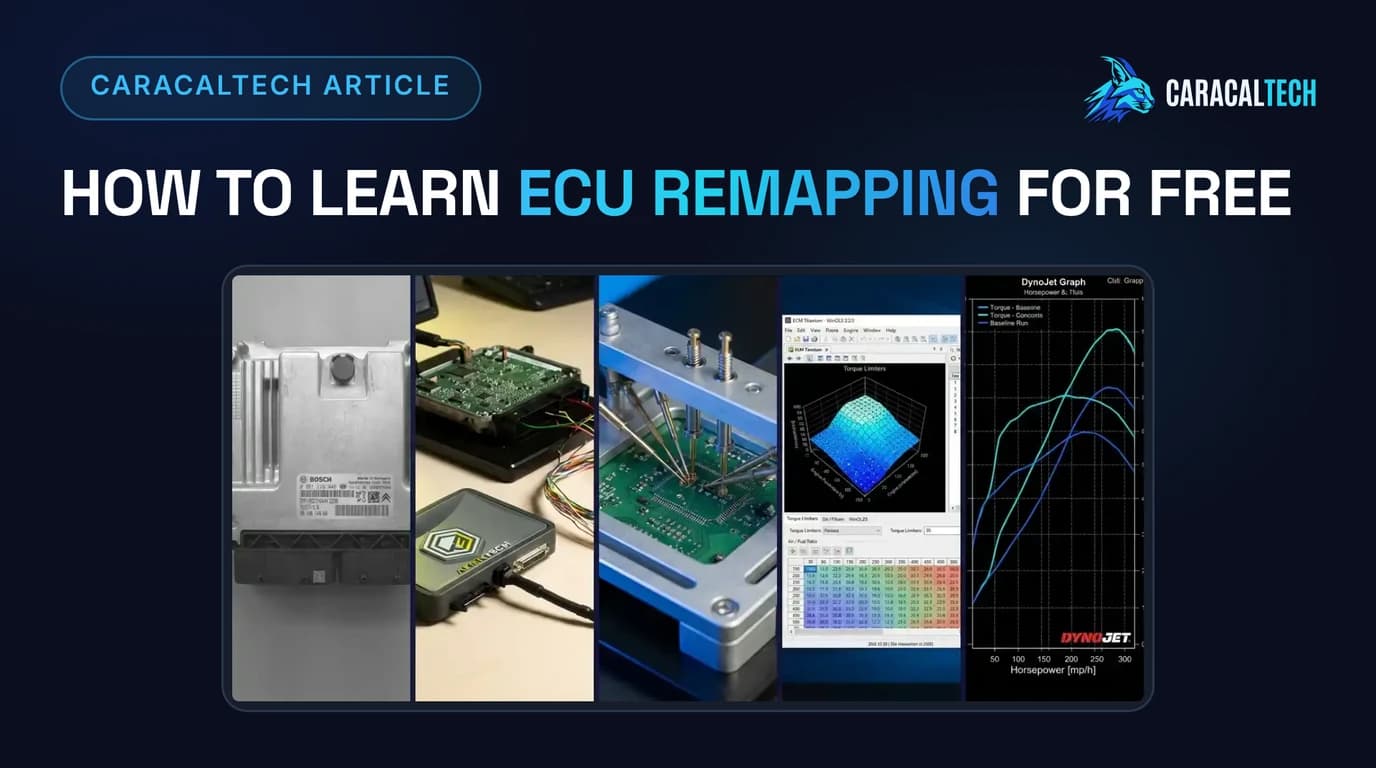
What is ECU Remapping and What is it Used For?
ECU remapping is the process of modifying the ECU software, which contains critical performance tables such as fuel maps, ignition timing, and torque limits, to influence vehicle performance and efficiency. This modification can be undertaken for various reasons, with the four primary objectives being:
1. Increasing engine power output.
2.Adjusting fuel consumption rates.
3.Ensuring ECU compatibility with new engine modifications (e.g., aftermarket performance parts)
4. Fixing factory software bugs or inherent issues (e.g., removing the speed limiter)
What is the Difference Between Remapping and Chip Tuning?
Both terms essentially refer to the same goal: software modification. However, in the early days of this field, performing a "remap" usually involved physically removing the flash ICs from the ECU and reprogramming them externally. Today, the process has become much easier. Depending on the ECU type, its hardware, and the programmer being used, the process can be performed in four main ways: OBD, OBD-Bluetooth, Bench, and JTAG.
Method | Status |
Chip Tuning | Discontinued |
JTAG | In Use |
Bench | In Use |
OBD | In Use |
OBD-Bluetooth | In Use |
Advantages and Disadvantages of Remapping
Achieving successful results and optimal efficiency from remapping is directly related to the engine's age and overall health. Therefore, before performing a remap, the engine must be analyzed via a compression test, and the intake and exhaust systems must be thoroughly checked for air leaks.
Advantages of Remapping
- Achieving significantly higher power and torque compared to factory settings.
- Readjusting the air-fuel ratio to increase efficiency or manage fuel consumption for reduced usage.
- Removing emissions-related restrictions (e.g., catalytic converters, EGR, DPF, etc for Off-Road and race.
- Increasing engine longevity, particularly by preventing knock (detonation) phenomena.
- Ensuring engine compatibility with aftermarket parts such as Stage 1, 2, and 3 camshafts, stroker crankshafts, and full exhaust systems.
- Reducing maintenance costs by disabling sensors that have a negligible impact on engine efficiency (e.g., the second oxygen sensor / post-cat O2 sensor).
- Optimizing throttle pedal response for sharper acceleration and reduced lag.
Disadvantages of Remapping
- If not performed by a specialist, there is a significant risk of severe engine damage.
- Power and torque-oriented remaps increase the demand for high-octane fuel.
- There is a risk of voiding the warranty or insurance policy.
- Increased exhaust gas temperatures, which may necessitate specific aftermarket upgrades like performance headers.
- Reduced lifespan of the catalytic converter and other emissions control systems.
- Increased overall stress on the engine.
Tools and Equipment Required for Remapping
Naturally, any technical work requires specific tools and equipment. For ECU remapping, you will need two main categories of equipment:
4.1. Software Equipment
The most famous software for performing remaps is WinOLS, produced by EVC. This software allows you to open an ECU file and apply your desired changes using your remapping knowledge. Other well-known software in this field includes ECM Titanium by Alientech. Its advantage over WinOLS is that by uploading the file, it automatically identifies and displays the relevant maps, whereas WinOLS requires manual map definition. Race EVO, produced by Dimsport, is another major player in this market. also you can check WinOLS VS ECM Titanium Software.
The table below compares these software options based on key criteria:
| Software Name | Beginner-Friendly (out of 5) | Support Quality (out of 5) | User-Friendliness (out of 5) |
| EVC WinOLS | 2 | 4 | 1 |
| ECM Titanium | 4 | 3 | 3 |
| Race EVO | 3 | 3 | 2 |
4.2.Hardware Equipment
Now, let's look at the essential hardware components, listed in order of importance:
- Programmer: This is the device that reads (Read) the ECU file and writes (Write) the modified file back onto the ECU. As mentioned earlier, this process is carried out by the programmer using one of the methods described above (OBD, Bench, etc.)
The table below compares popular programmers based on global sales, ease of use, support, and price:
| Programmer Name | Global Sales & Recognition(out of 5) | Beginner-Friendly (out of 5) | Support Quality (out of 5) | User-Friendliness (out of 5) | Price (out of 5) | |
| 1 | Kess3 | 4 | 3 | 4 | 4 | 3 |
| 2 | DimSport | 3 | 4 | 3 | 3 | 4 |
| 3 | AutoTuner | 4 | 3 | 4 | 4 | 5 |
| 4 | MagicMotor | 2 | 2 | 3 | 3 | 3 |
- Diagnostic Tool (Scan Tool): During the remapping process, it is crucial to first scan the vehicle and ensure no fault codes are stored in the ECU memory that could interfere with the programming or the new map. Issues such as first oxygen sensor errors, air-fuel ratio faults, or EGR faults must be resolved before proceeding with the remap.
- Wideband O2 Sensor Gauge: This tool is installed in the exhaust to display the real-time air-fuel ratio. It is particularly useful when you do not have access to a dynamometer. The most famous manufacturer of this essential tool is AEM.
- Dynamometer (Dyno): This device simultaneously measures engine power and torque, allowing you to compare different tunes. It also displays the air-fuel ratio in relation to the measured power and torque. In this field, Dyno Jet is the most renowned brand of dynamometer worldwide.
Step-by-Step Guide to Learning ECU Remapping
In this section, we will answer the question of what path an individual should take if they decide to learn ECU remapping.
Step 1: To begin this skill, having a genuine interest and perseverance is an absolute must.
Step 2: Gain familiarity with the technical concepts and components of gasoline or diesel engines (depending on the market you intend to work in). Having at least three months of experience in repairing or assembling gasoline or diesel engines is highly beneficial and will significantly accelerate your learning curve.
Step 3: Spend at least six months getting familiar with diagnostic tools. Understanding the importance of parameter reading, fault diagnosis, and analyzing the error codes stored in the ECU memory is crucial. You must have a precise understanding of ignition parameters such as BTDC (Before Top Dead Center) and fuel injection timing.
Step 4: Familiarize yourself with various ECU brands and the models used in different vehicles. To acquire this information, you don't need to inspect every car individually; it is sufficient to visit the websites of programmer manufacturers, as they typically list vehicle models, their corresponding ECU types, and even the method for reading their files.
Step 5: Understand the calibration number of each ECU and its distinction from the software number. Each ECU has two specific numbers:
- The Calibration Number is the identifier for the specific set of tuning data (maps and parameters) calibrated on that particular software version.
- The Software Number is the identifier for the main program version (firmware) of the ECU.
A single vehicle typically has one hardware number but may have several calibration numbers. Both numbers can be viewed using diagnostic tools and are also visible when a full ECU file is read.
Step 6: Become familiar with the most important fundamental concepts of ECU remapping: Power, Torque, and Air-Fuel Ratio. All these base parameters are modified by changes made within the ECU file. It is critical that these changes align with the specific goals of the tuner. From this point onward, participating in a reputable and advanced training course is essential to achieving your objectives.
Step 7: Become familiar with the main remapping tables used to modify the ECU file. Broadly speaking, the maps in various ECUs can be categorized as follows:
1. Ignition timing maps.
2. Fuel and oxygen regulation maps.
3. Intake air volume control maps.
4. Engine torque management maps.
5. Single parameters, such as cut-off settings or disabling the second oxygen sensor.
Step 8: At this stage, the learner must learn how to work with programmers and their associated hardware. It is advisable to first master the use of the programmer device. As mentioned earlier, this part does not require highly specialized knowledge; you just need to know which manufacturer the ECU belongs to, and the programmer's software will guide you step-by-step through the process. It is highly recommended that the trainee observes or performs the Read/Write process at least once to become fully acquainted with this phase. To learn more about the different types of programmers, you can read the following article: Top 10 ECU Tuning Tools
Step 9: By enrolling in reputable courses and classes that offer strong support, the learner can properly understand the concepts behind the tables. At this point, the trainee begins making changes and selects a vehicle for the remap. Generally, it is best for the trainee, after completing the course, to choose a vehicle as a Case Study and practice repeatedly to better understand the maps and their effects. Usually, at this stage, the trainee identifies the flaws in their work, which is why choosing a vehicle that allows for trial and error over an extended period is the best starting point for a beginner tuner.
If you want to learn ECU remapping at home, you can read about the best online ECU remapping course here:
Best ECU Remapping Courses | Compare WinOLS, ECM Titanium & Online ECU Tuning Training
Final Summary
Remember, the skill of remapping is composed of 40% foundational knowledge and 60% experience built upon that knowledge. Experience, combined with technical automotive knowledge, can serve as a powerful launchpad in this field.
At the beginning of your career in this arena, it is better to start with simpler vehicles (e.g., naturally aspirated gasoline engines with MPFI fuel injection), which have fewer maps, and gradually expand your scope to more complex engines.
For beginners, Bosch ECUs,which are highly developed across both gasoline and diesel engine families,are an excellent starting point. You will soon notice that the same fundamental principles apply similarly to ECUs from the Continental and Delphi groups.
In parallel, gaining knowledge about aftermarket parts and their effects will help you accurately evaluate an engine's potential for power increase. For example, installing a performance header on a naturally aspirated engine can add up to 5 horsepower, whereas the same component (often referred to as a downpipe on turbocharged engines) can easily provide a gain of 9 to 11 horsepower.
Enjoyed the content? Add us as a preferred source to see more of it in Search.