
Nissan Terra 2.0 TGDI Stage 1 ECU Remap (DynoJet-Verified)

Nissan Terra 2.0 TGDI (Mitsubishi 4K31) Stage 1 ECU Remap: +15 WHP / +18 Nm (DynoJet-Verified)
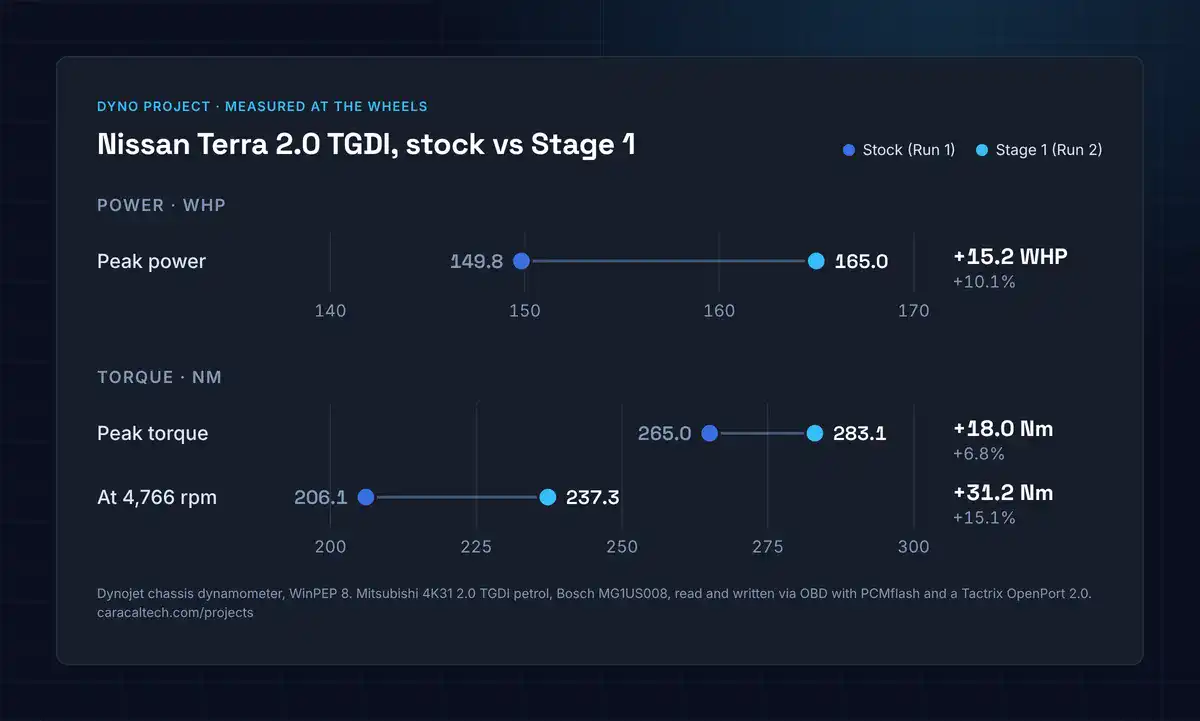
228 PS on the spec sheet, 149.8 WHP and a wavy curve on the Dynojet. This is how a Nissan Terra with Mitsubishi's 2.0 TGDI petrol engine left with a smooth Stage 1 curve, written to its stock Bosch MG1US008 through the OBD port: +15.2 WHP and +18.0 Nm at the peaks, and +31.2 Nm at 4,766 rpm, all measured at the wheels.
Fast View
- Baseline on the DynoJet: 149.83 WHP and 265.03 Nm, with power and torque oscillating from about 4,000 rpm.
- We read the Bosch MG1US008 over OBD with PCMflash and a Tactrix OpenPort 2.0, corrected the fuel and ignition tables and changed the air-fuel ratio target.
- Stage 1 result: 164.99 WHP (+15.16) and 283.06 Nm (+18.03), with smooth curves from start to finish.
- The biggest change landed where the stock curve wobbled: +31.2 Nm (+15.1%) at 4,766 rpm.
- Software only, engine ECU only: no hardware changes, and the ZF gearbox software stayed at factory settings.
Part 1: A Nissan Terra with a Mitsubishi petrol heart
The car that rolled onto the Dynojet was a black Nissan Terra 4WD. Under the bonnet sits a 2.0-litre turbocharged direct-injection petrol engine from Mitsubishi, the 4K31, built in China by Shenyang Aerospace Mitsubishi. The same engine and the same ZF 8-speed automatic power the Dongfeng (Oting) Paladin in China and the LEO MX8 assembled in Iran.
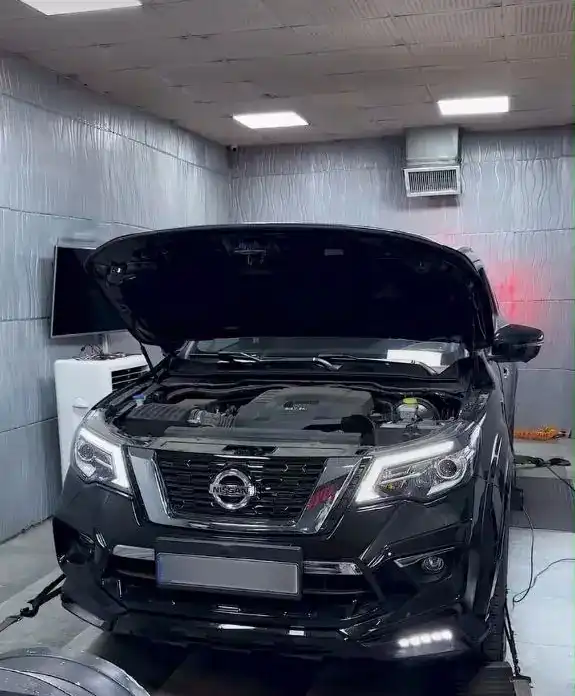
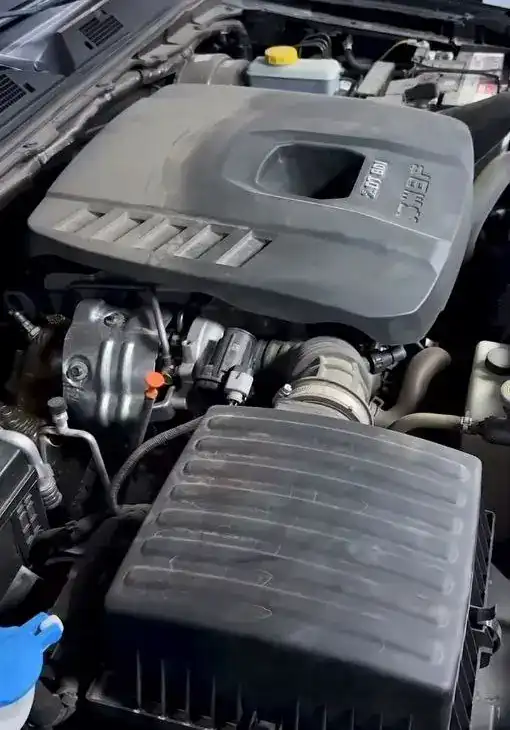
Its full factory code is 4K31TD, and that suffix confuses a lot of owners. This is not a diesel: Chinese-market specification data lists the 4K31TD as a turbocharged direct-injection petrol engine rated for 92-octane fuel. In this story we call it what it is, the Mitsubishi 2.0 TGDI.
The car at a glance:
| Specification | Value |
|---|---|
| Vehicle | Nissan Terra 2.0 TGDI 4WD |
| Engine | Mitsubishi 4K31, 2.0 TGDI petrol (factory code 4K31TD), built by Shenyang Aerospace Mitsubishi |
| Fuel system | Petrol, gasoline direct injection, turbocharged and intercooled |
| Layout | Inline 4-cylinder, DOHC 16-valve, aluminium block and head, longitudinal |
| Displacement | 1,997 cc |
| Bore × stroke | 81.5 × 95.7 mm |
| Compression ratio | 10.5 : 1 |
| Rated power (factory, at the crank) | 168 kW / 228 PS @ 5,600 rpm |
| Rated torque (factory, at the crank) | 360 Nm @ 1,400–4,000 rpm |
| Factory fuel rating | 92 RON (Chinese-market specification) |
| Transmission | ZF 8-speed torque-converter automatic (8HP family) |
| Drivetrain | Part-time 4WD with transfer case |
| Engine ECU | Bosch MG1US008 |
| Read / write | PCMflash via OBD, Tactrix OpenPort 2.0 (J2534) |
| Dyno | Dynojet chassis dynamometer, WinPEP 8 |
Factory figures are crankshaft ratings from Chinese-market Paladin 2.0T specifications; some markets quote 160 kW (218 PS) for the same engine. ECU, tool and dyno details are from this job.

Part 2: 228 PS on paper, 149.8 WHP on the rollers
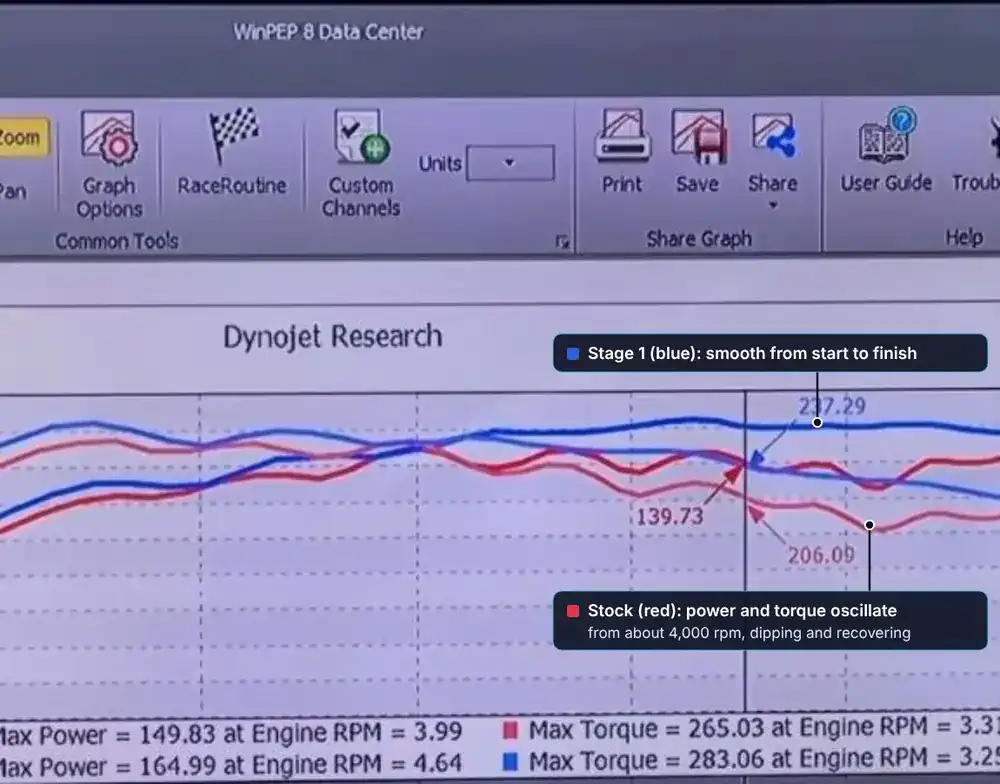
Before touching the ECU, we strapped the Terra down and made a baseline pull. The stock run, the red trace in WinPEP 8, peaked at 149.83 WHP at 3,990 rpm and 265.03 Nm at 3,310 rpm.
What caught our eye was the shape of the curve rather than the peak. From about 4,000 rpm upward, both red traces zig-zag: power and torque dip and recover several times within a single pull instead of following a clean line. On an engine at full load, a trace like that usually means the ECU keeps correcting itself during the pull, trimming ignition, fuelling or torque from one moment to the next.
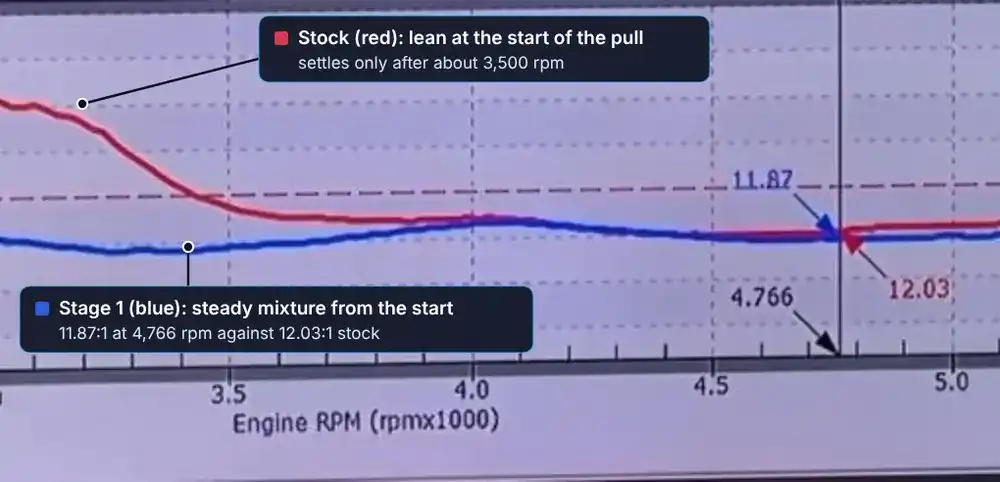
The air-fuel ratio panel added a second clue. The stock mixture started the pull noticeably leaner than the rest of the run and only settled after about 3,500 rpm.
Why the wheel figures sit below the 228 PS rating
Crank vs wheels: 228 PS and 360 Nm are crankshaft ratings, measured on an engine dyno under standard test conditions.
Driveline losses: A chassis dyno measures after the torque converter, the 8-speed gearbox, the transfer case, the propshafts and the axles. A body-on-frame 4WD driveline loses a large share of crank output before it reaches the rollers.
Dynojet torque: Dynojet calculates torque from wheel power and engine speed, so its Nm figure includes those losses and cannot be compared with the 360 Nm crank rating.
Test conditions: Air temperature, fuel quality and the dyno's correction factor all move the result. Compare runs made on the same dyno under the same conditions, which is how these two runs are meant to be read.
Part 3: Reading the Bosch MG1US008 through the OBD port
The Terra's engine runs on a Bosch MG1US008, a member of the MG1 family that Bosch supplies for many Chinese-market petrol engines. We connected a Tactrix OpenPort 2.0 J2534 interface to the OBD port and read the ECU with PCMflash, so the unit never left the car.
PCMflash covers these ECUs in its "China MG1" module (module 89), with read, write and checksum support for MG1US008 units on Changan, Chery, Dongfeng, FAW, Great Wall and JAC engines. The Mitsubishi 4K31 Terra is not named on that list, but on this car both the read and the write ran over OBD.
The first job after the read was to archive the original file. We then checked the hardware and software numbers so the calibration would match this exact software version.
| Tool | Used for |
|---|---|
| PCMflash | Reading and writing the Bosch MG1US008 over OBD, checksum correction |
| Tactrix OpenPort 2.0 | J2534 pass-thru interface between the laptop and the OBD port |
| Dynojet chassis dyno, WinPEP 8 | Baseline and Stage 1 power, torque and air-fuel ratio |
Part 4: Fuel, ignition and the air-fuel target
Bosch MG1 is a torque-based engine management platform. The pedal position becomes a torque request, the ECU checks that request against a chain of limits, and only then sets air mass, boost, ignition and fuel to deliver it. A clean Stage 1 works inside that structure, so every part of the ECU agrees with the new targets.
Fuel and ignition tables: We corrected the fuel and ignition tables. The aim was a calibration the ECU can hold steadily through the whole pull, so it no longer has to keep correcting itself on the way up the rev range. Knock control stays fully active, and the timing has to suit the fuel the car actually runs.
The air-fuel ratio target: We changed the air-fuel ratio target as well, and the lower panel of the dyno graph shows the difference. The Stage 1 mixture is steady from the start of the pull, with no lean start, and at 4,766 rpm it sits at 11.87:1 against 12.03:1 stock. Running slightly richer at full load helps keep combustion and exhaust temperatures under control.
Torque structure: Because MG1 is torque-based, the torque limits were brought into line with the new calibration, so requested, permitted and delivered torque agree. When they don't, the ECU or the gearbox controller trims the extra torque back.
Gearbox: The ZF 8-speed has its own transmission control unit. This project covered the engine ECU only; the gearbox software stayed at factory settings.
With the file finished, we wrote it back over OBD with PCMflash, which corrects the checksums on write.
Part 5: Back on the Dynojet, the blue curve
Same car, same Dynojet, Stage 1 file loaded. The blue trace answered the question we started with: the oscillation is gone. Power and torque now follow clean lines from one end of the pull to the other.
Peak power rose to 164.99 WHP at 4,640 rpm, a gain of 15.16 WHP, and it now arrives 650 rpm later than in the stock run. Peak torque rose to 283.06 Nm, a gain of 18.03 Nm. The biggest change landed exactly where the stock curve had been wobbling: at 4,766 rpm the Stage 1 run makes 237.29 Nm against 206.09 Nm. Because the stock curve oscillates in that zone, the size of the gap depends on where you read it; the WinPEP cursor at 4,766 rpm shows +31.2 Nm.
| Measurement | Stock (Run 1) | Stage 1 (Run 2) | Change |
|---|---|---|---|
| Peak power | 149.83 WHP @ 3,990 rpm | 164.99 WHP @ 4,640 rpm | +15.16 WHP (+10.1%) |
| Peak torque | 265.03 Nm @ 3,310 rpm | 283.06 Nm @ 3,250 rpm | +18.03 Nm (+6.8%) |
| Torque at 4,766 rpm | 206.09 Nm | 237.29 Nm | +31.20 Nm (+15.1%) |
| Air-fuel ratio at 4,766 rpm | 12.03 : 1 | 11.87 : 1 | −0.16 (slightly richer) |
| Curve shape | Oscillates from about 4,000 rpm | Smooth through the pull |
Values as read from the WinPEP 8 overlay (legend and cursor at 4,766 rpm). Dynojet chassis dynamometer, figures at the wheels.
Stage 1 gain: +15.16 WHP and +18.03 Nm at the wheels, a 10.1% power increase, with +31.2 Nm at 4,766 rpm.
Part 6: What it means behind the wheel
A smooth curve matters as much as a bigger one. Torque that dips and recovers during a pull can be felt as uneven acceleration, especially in an automatic that holds one gear through a long kickdown.
On a heavy body-on-frame SUV with an 8-speed automatic, the upper mid-range is where the engine works during a kickdown for an overtake, on long motorway gradients and with the car loaded. The ZF holds the engine in that band during those manoeuvres, which is why the steadier, stronger curve above 4,000 rpm matters more in daily driving than the peak figures alone suggest.
Checks for a 2.0 TGDI Terra
- Identify the ECU first. This Terra had a Bosch MG1US008. ECUTools' PCMflash list also shows a Dongfeng/Oting 2.0T running a Delphi MT95.1, so read the ECU ID before you choose a tool, module or file.
- Software version. MG1US008 files are specific to the software version in the ECU. Use a file built from your own car's read, never one copied from another vehicle.
- Fuel. On poor fuel, knock control pulls timing and the gain shrinks with it. The calibration has to match the fuel the car actually uses.
- Heat. In hot climates, intake air temperature after the intercooler limits repeatable power. Allow cool-down between dyno pulls and check the intercooler and radiator first.
- Mechanical health. A remap does not fix existing faults. Clear stored fault codes, check for boost leaks and confirm spark plugs and coils are healthy before tuning.
- Direct-injection deposits. Like other GDI engines, the 2.0 TGDI can build carbon on the intake valves over time, which costs power whatever the calibration.
- Legal and warranty. ECU modifications can affect the manufacturer's warranty and may not be permitted for road use in every jurisdiction. Check local rules before tuning.
FAQ
Is the 4K31TD in the Nissan Terra a diesel?
No. The 4K31TD is Mitsubishi's 2.0-litre turbocharged direct-injection petrol engine (2.0 TGDI), built by Shenyang Aerospace Mitsubishi and rated at 168 kW (228 PS) and 360 Nm in Chinese-market specifications. "TD" is part of the factory code, not a diesel badge.
Which ECU does it use, and can it be tuned through the OBD port?
This car uses a Bosch MG1US008. We read and wrote it through the OBD port with PCMflash and a Tactrix OpenPort 2.0, so the ECU did not need to be removed. Some Dongfeng/Oting 2.0T versions are listed with a Delphi MT95.1, so confirm your ECU and software version before starting.
Why was the stock dyno curve wavy, and what fixed it?
In the stock run, power and torque oscillated from about 4,000 rpm and the mixture started the pull lean. After we corrected the fuel and ignition tables and changed the air-fuel ratio target, the Stage 1 curve came out smooth from start to finish.
How much does a Stage 1 remap add?
On this car: +15.2 WHP and +18.0 Nm at the peaks, and +31.2 Nm at 4,766 rpm, all measured at the wheels on a Dynojet. Results depend on the car's condition, the fuel and the dyno used.
Why does the dyno show about 150 WHP when the brochure says 228 PS?
The brochure figure is measured at the crankshaft. The dyno measures at the wheels, after the gearbox, transfer case and axles. Part 2 explains the difference.
Does the same file fit a Dongfeng Paladin or LEO MX8?
These models share the Mitsubishi 2.0 TGDI and the ZF 8-speed, but ECU hardware and software versions can differ between markets and model years. A file has to be built on, or matched to, your own car's read.
Sources
- China Car Specs Library: Dongfeng Paladin 2.0T 8AT: engine code, displacement, bore and stroke, compression, rated power and torque, fuel rating
- 163.com: Paladin launch coverage: Mitsubishi 4K31TD petrol, 168 kW, 360 Nm, ZF 8AT, part-time 4WD
- Wikipedia: Nissan Terra: Shenyang Aerospace Mitsubishi, LEO MX8 with 4K31 and ZF 8-speed
- Dongfeng Panamá: Paladin: 4K31TD with ZF 8-speed automatic
- ECUTools: PCMflash module 89 "China MG1": MG1US008 read, write and checksum support
- ECUTools: PCMflash: J2534 adapters, tested with OpenPort 2.0
- ECUTools: PCMflash module 51 "China ECUs": Dongfeng/Oting 2.0T with Delphi MT95.1
More 2.0T turbo petrol dyno projects
- GAC Empow 2.0T Stage 1 & Stage 2 (+21 WHP / +31 Nm)
- Tank 300 2.0T Stage 1 & Stage 2 (+26 WHP / +26 Nm)
- Changan UNI-V 2.0T Stage 1 & Stage 2 (+24 WHP / +19 Nm)
Tuning a Terra, Paladin or LEO MX8 with the 2.0 TGDI?
Send the original read from your MG1US008 through File Service, or ask the calibration team about your car on WhatsApp +36 70 604 8339.
Author: CaracalTech Calibration Team
Last Updated: October 2026
Keywords:nissan terra remap-nissan terra 2.0 tgdi tuning-mitsubishi 4k31 remap-4k31td petrol-bosch mg1us008-pcmflash mg1us008-dongfeng paladin remap-leo mx8 tuning-nissan terra dyno
Enjoyed the content? Add us as a preferred source to see more of it in Search.