
SPARKADV on OBD2: Spark Advance Meaning and Timing Maps
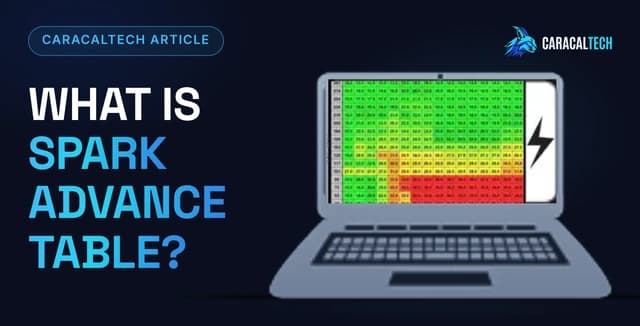
Quick answer: SPARKADV (spark advance) is the ignition timing your engine's ECU is using at that moment, measured in crankshaft degrees before top dead center (BTDC). Generic OBD2 scanners read it from Mode 01 PID 0E, which can show values from -64° to +63.5°; a negative value means the spark fires after TDC. The ECU takes a base value from a spark advance table (engine speed × load) and then corrects it for temperature, idle speed control and knock, so the reading changes all the time.
What does SPARKADV mean on an OBD2 scanner?
When a code reader shows SPARKADV, SPARK ADV or Timing advance, it is showing the same OBD2 value: the spark timing that the ECU is commanding right now. It is the final, total value after all corrections, not the number stored in one map. The table below shows how the value is defined in the standard OBD2 parameter list.
| Item | Value | Source |
|---|---|---|
| OBD2 parameter | Mode (service) 01, PID 0E – timing advance | Wikipedia, OBD-II PIDs |
| Unit | Degrees before TDC | Wikipedia, OBD-II PIDs |
| Range | -64° to +63.5° | Wikipedia, OBD-II PIDs |
| Formula | A ÷ 2 – 64 (one data byte, 0.5° steps) | Wikipedia; CSS Electronics PID table |
| Positive reading | Spark fires before TDC (advanced) | Wikipedia, Ignition timing |
| Negative reading | Spark fires after TDC (retarded) | Wikipedia, Ignition timing |
There is no single normal SPARKADV number. The correct value depends on the engine, rpm, load and temperature, and it moves constantly at idle because many ECUs use spark timing to hold idle speed. To judge a reading, compare it with the manufacturer's service data or with a known-good car with the same engine, at the same coolant temperature and idle conditions.
What is a spark advance table
A spark advance table is a set of values that tells the engine control module (ECM) when to fire the spark plug. These values are determined based on several factors, including the engine load, RPM, and engine temperature. By adjusting the spark timing based on these variables, the engine can be tuned for optimal performance and fuel efficiency.
How does a spark advance table work
In order to understand how a spark advance table works, it's important to first understand the concept of ignition timing. Ignition timing refers to the timing at which the spark plug fires in relation to the position of the piston in the cylinder. Ideally, the spark plug should fire just before the piston reaches top dead center (TDC) on its compression stroke. The timing of the spark plug firing is controlled by the ECU. As the engine operates, the ECU continuously monitors various sensors to determine the engine load, RPM, and other variables. Based on this information, the ECU looks up the appropriate value in the spark advance table and adjusts the timing accordingly. As a general pattern, the table gives more advance as engine speed rises, because the mixture has less time to burn, and less advance as engine load rises, because a dense charge burns faster and is more likely to knock. At light load the mixture burns more slowly, so the ECU can use more advance to improve efficiency. The ECU then corrects this base value for coolant and intake air temperature, idle speed control and knock control.

Identification of spark tables
The easiest way to identify spark tables is to know their pattern, as you can see in the image above. In most spark tables, with engine load (relative air charge) on the horizontal axis and engine speed on the vertical axis, the values increase as engine speed increases and decrease as engine load increases. Negative values, usually at low rpm and high load, mean the spark fires after TDC. In WinOLS map editing software this pattern is easy to see in the 2D table view, and a ready-made WinOLS mappack can show where the ignition maps are in a known ECU file. To learn the full workflow, see the WinOLS petrol tuning course or the ECM Titanium petrol course.
Spark advance, knock and MBT
Engineers call the timing that gives the most torque at a given speed and load MBT (minimum spark advance for best torque). If the spark fires too early, combustion pressure pushes against the piston while it is still rising, which causes knock (also called pinking or pinging) and can damage the engine. When the knock sensor detects this, the ECU retards the timing for that cylinder. At idle, many ECUs deliberately run a little less advance than MBT, so they can add torque quickly when a load such as the A/C compressor switches on.
| Condition | Typical effect on spark advance | Source |
|---|---|---|
| Engine speed rises | More advance | Wikipedia, Ignition timing |
| Light load or deceleration | More advance | Wikipedia, Ignition timing |
| Knock detected | Timing retarded | Wikipedia, Ignition timing; UTI |
| Idle speed control | Timing kept below MBT and adjusted continuously | US patent US7418943B2 |
| Coolant and intake air temperature | ECU correction added or removed | UTI |
For tuners, this means extra advance only helps up to MBT. Beyond that point torque does not rise, but knock risk does, so any change to the ignition maps should be checked with datalogging of knock retard. Fuel mixture matters too: read our guide to AFR vs lambda for petrol and diesel engines.
Spark advance FAQ
What does SPARKADV mean on an OBD2 scanner?
SPARKADV is the spark (ignition) timing the ECU is using at that moment, in crankshaft degrees before top dead center. Scanners read it from OBD2 Mode 01 PID 0E, with a range of -64° to +63.5° in 0.5° steps. It is the final value after the ECU has applied temperature, idle and knock corrections.
Is spark advance the same as timing advance?
Yes. Scan tools use different labels such as SPARKADV, Spark Adv, Ignition timing or Timing advance, but on a petrol engine they all show OBD2 PID 0E. Do not confuse it with injection timing on a diesel engine, which is a different value in the ECU.
What is a normal spark advance at idle?
There is no single correct figure, because it depends on the engine and its calibration. The value also moves constantly at idle, because many ECUs adjust spark timing to hold idle speed. Compare your reading with the manufacturer's service data or a known-good car with the same engine, fully warm and with no electrical or A/C load.
Why does my spark advance jump around at idle?
At idle the ECU uses spark timing as a fast way to control engine speed. It keeps the timing a little below MBT, so it can add advance, and torque, very quickly when the A/C, power steering or alternator load changes. A reading that moves by several degrees at a steady idle is therefore usually normal behaviour.
What does a negative spark advance reading mean?
A negative value means the spark fires after top dead center, which is retarded timing. ECUs use retarded timing for short periods, for example during knock control or when they need to reduce torque quickly. A large negative value that stays at a warm idle can point to a fault, such as wrong timing after engine work or a problem with crank or cam signals, and should be checked.
Sources
- Wikipedia – OBD-II PIDs (PID 0E timing advance: unit, range, formula)
- CSS Electronics – OBD2 PID table (SAE J1979) (PID 0E scale 0.5, offset -64)
- Wikipedia – Ignition timing (advance with speed, light-load advance, knock)
- US patent US7418943B2 – Spark advance for engine idle speed control (MBT, torque reserve at idle)
- UTI – Ignition timing explained (advance, retard, knock, ECM inputs)
📍For more information and probable problems feel free to contact us: [email protected]
Enjoyed the content? Add us as a preferred source to see more of it in Search.