
Bosch EDC15, EDC16 and EDC17: Differences and Tuning Guide
Quick answer: Bosch EDC15, EDC16 and EDC17 are three generations of Bosch Electronic Diesel Control ECUs. EDC15 (late 1990s) uses injection quantity-based control; EDC16 (early 2000s, Euro 3 and 4) and EDC17 (mid-2000s onward, Euro 5 and 6) are torque-based, so the driver's wish, torque limiter and torque-to-fuel maps have to be changed together. Bosch has built EDC systems for passenger cars since 1986.
🚩We concentrate on the Bosch company because it is the most prominent and well-known among the others. Every ECU in the market has certain particular codes inscribed on its cover that reflect distinct meanings. The electronic control of a diesel engine provides for precise and selective adjustment of the fuel-injection settings. A new diesel engine can only manage all of the demands placed on it in this manner.
Bosch EDC has had several generations since 1986. This guide covers the three that tuners meet most often:
- EDC 15
- EDC 16
- EDC 17
EDC15 vs EDC16 vs EDC17 at a glance
| Generation | Approx. introduction | Control strategy | Typical features |
|---|---|---|---|
| EDC I | 1986, rotary distributor pumps | Fuel quantity | First electronic governor; replaced the mechanical governor |
| EDC15 | Late 1990s, early common-rail engines | Injection quantity-based | Microprocessor ECU; integrated immobiliser and CAN bus; OBD-II diagnostics |
| EDC16 | Early 2000s, Euro 3 and Euro 4 | Torque-based | 32-bit processing; multi-stage injection; integrated EGR, turbo and DPF control |
| EDC17 | Mid-2000s onward, Euro 5 and Euro 6 | Torque-based | Controls injection, EGR, boost and after-treatment; scalable computing power |
EDC15:
Bosch EDC15 is an injection quantity-based diesel engine control system from the late 1990s; common variants include EDC15P, EDC15V, EDC15VM+, EDC15C2 and EDC15C7. The ECU reads data from many sensors, converts the pedal request into an injection quantity and drives the injectors at the right moment. It also controls the rail pressure regulator, the EGR valve and the boost pressure control valve.
EDC16:
Bosch EDC16 was the first generation of this family to use a torque-based structure, and EDC17 kept it. As with petrol engines, all torque demands are gathered, assessed, and coordinated in the engine control unit in the EDC16 system. This provides the advantage of improved flexibility across individual vehicle systems (engine management, braking system, automatic transmission, air conditioning, and so on).
Bosch introduced the new Electronic Diesel Control EDC16 engine management system in the V10-TDI and R5 TDI engines. The Bosch EDC 16 engine management system is also intended to work as a single or dual control unit system. The actual notion employed is determined by the number of cylinders in the engine.
EDC17:
EDC17 is the Bosch diesel ECU generation used for Euro 5 and Euro 6 engines. The EDC17 engine management system expands on the EDC16. The EDC17 differs from the EDC16 in terms of performance and memory capacity. Furthermore, it enables the integration of control functions for future technologies.
The Electronic Diesel Control (EDC) monitors all critical parameters for efficient, low-emission combustion. Because the new EDC17's computational capability and functional scope can be tailored to specific requirements, it can be deployed in any vehicle category in worldwide markets. It not only controls the precise time and quantity of injection, exhaust gas recirculation, and manifold pressure management, but it also has numerous other choices, such as regulating particle filters or nitrogen oxide reduction systems. Furthermore, the Bosch EDC17 calculates the injection parameters for each cylinder and, if necessary, performs individual adjustments.
Can you remap the Bosch EDC ECUs?
Yes, you can. But it takes training and hours of study and practice to make a good remap. After that, you can read and write these ECUs with most of the programmers on the market, such as KESS3, Autotuner, Magicmotorsport Flex and Dimsport tools (older tools such as KESS V2 and K-TAG are also still in use). ECM Titanium and WinOLS are software for editing the file, not reading tools.
After reading the file from the car, you have to find the tables that belong to the engine calibration area and modify them. When using WinOLS, it is critical to know how to locate the correct table and select it with the right size in the hex dump. To remap precisely, you must first understand what the X axis and Y axis of each table are.

For Instance:

This is The “Injection Time” Table:
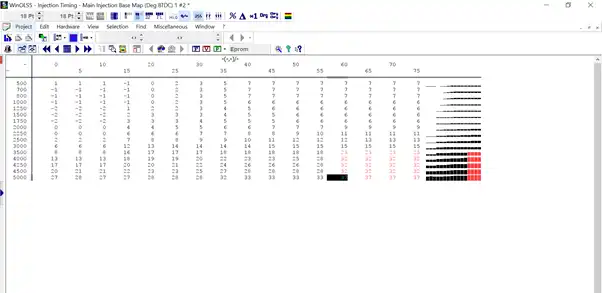
And this is the “Injection Timing” table.
To have a decent remapping, you must first comprehend the differences between them. Otherwise, your remapping is worthless.
In simple terms: injection time (injector on-time) is how long the injector stays open to deliver the requested fuel quantity at a given rail pressure, while injection timing (start of injection) is when injection begins, in degrees of crank angle before top dead centre. On EDC17, the on-time tables are usually the largest maps in the file and work as a reference that converts fuel quantity and rail pressure into an injector command, rather than a main tuning target.
Is this the end of the story?
To be honest, the answer is “No”. Torque Request and Torque Request Limiters, Torque to Injection Quantity, Turbo Pressure and its Limiters, and other tables may be found in the ECU Files and you have to be aware of their use and how they process.
Remapping is simple, but only if you have a good education. Otherwise, it might cause you a lot of difficulty and potentially be dangerous to the engine.
You can order the mappack for any ECU on the CaracalTech mappacks page or any other company's website, but you must pay for it each time you need to remap a new ECU.
Key maps in a torque-based EDC16 or EDC17 file
| Map group | What it does |
|---|---|
| Driver's wish | Turns pedal position and engine speed into a torque request; there can be one per gear or drive mode |
| Torque limitation | Caps the torque request, for example by engine speed, gear or protection conditions |
| Torque to fuel mass | Converts the torque request into a fuel quantity |
| Smoke limitation | Limits fuel quantity by the measured air so the engine does not make excessive smoke |
| Start of injection | Sets when injection starts; there can be more than 40 versions, for example for cold start and DPF regeneration |
| Boost and rail pressure | Set the target charge pressure and fuel rail pressure, with their own limiters |
| Injection on-time | Converts fuel quantity and rail pressure into injector opening time |
🔥Or You Can Learn How to Remap any ECU File on your own!
= = = = = = = = = = = = = = = = = = = = = = = = = = = = = = = = = = = = = = = = = = =
The CaracalTech Team has spent years on studying to learn how to read and write on an ECU or it is better to say how to learn “ECU programming”.
It's been 9 years since we've gathered a highly valuable information about this field, and after many years of experience and projects in ChipTuning, ECU source code studying, doing trials and errors with tools and software, and also experiencing working with dynamometer and remapping a wide range of car ECUs, we came into an idea…
We decided to prepare a useful ECU Tuning tutorial course for people who are interested in and the ones who are ready to start their own ECU Tuning business. We have provided a course which is not only simple and understandable, but also a valuable and centralized course. It is worth saying that most of the tutorial courses on the internet would not cover all the topics from basic parts. They would not be an A to Z course, which would not be useful for you.
In other words, what we learn in theory is different from reality. There is no other course that would explain the ECU remapping step by step with practical evidence. Instead of teaching you how to catch fish, they give you the fish instead!
Some of the online tutorial sessions are only about 4 hours! But who can become a chip tuner in such a short period of time?
In our courses, we will principally educate you with step-by-step and simple guides on ChipTuning and remapping. Our courses are available by two of the best and the most famous softwares in the world.
WinOLS and ECM Titanium
You will also see other diesel ECUs, such as Siemens SID, Delphi and Denso, in our courses; check each course page for the ECUs it covers.
📍If you are curious about what you will learn in these courses, you can contact us: [email protected]
Related courses and guides
- Step-by-step EDC course: EDC16 and EDC17 tuning guide basics
- Full diesel courses: diesel ECU tuning with WinOLS and diesel ECU tuning with ECM Titanium
- Trucks: HGV / truck ECU tuning course
- Map definitions: WinOLS Damos, mappack and A2L files
- Reading tools: top 10 ECU tuning tools compared
- Ready files: tuning file service
Bosch EDC FAQ
What is Bosch EDC15?
Bosch EDC15 is a diesel engine ECU from the late 1990s, used on many pump-injection and early common-rail engines. It works on an injection quantity basis: the pedal request is turned into a fuel quantity. Common variants are EDC15P, EDC15V, EDC15VM+, EDC15C2 and EDC15C7. It includes immobiliser and CAN bus functions and OBD-II diagnostics.
Is EDC15 torque-based?
No. EDC15 and earlier Bosch diesel ECUs use injection quantity-based control. The torque-based structure started with EDC16 and continued in EDC17. This is why EDC15 remaps focus on fuel quantity, smoke and boost maps, while EDC16 and EDC17 remaps also need the driver's wish, torque limiter and torque-to-fuel maps.
What is the difference between EDC16 and EDC17?
Both are torque-based. EDC16 arrived in the early 2000s for Euro 3 and Euro 4 engines. EDC17 followed from the mid-2000s for Euro 5 and Euro 6, with more computing power and memory and control of after-treatment systems such as the DPF and SCR. EDC17 files are larger and have many more maps and limiters.
Which software is used to tune EDC16?
EDC16 files are usually edited in WinOLS or ECM Titanium. WinOLS gives full access to the hex data and works well with Damos or mappack map definitions, while ECM Titanium uses ready drivers that show the main maps by name. The file itself is read and written with a programming tool such as KESS3 or Autotuner.
Which tools can read Bosch EDC17?
Current tools such as Alientech KESS3, Autotuner, Magicmotorsport Flex and Dimsport tools support many EDC17 ECUs by OBD, on the bench or in boot mode. Support depends on the exact EDC17 variant and software version, so always check the tool maker's vehicle list before reading the ECU.
Sources
- CaracalTech solution lists (checked 15 Nov 2026) – EDC15 variant names.
Enjoyed the content? Add us as a preferred source to see more of it in Search.