
Pops and Bangs Tune: How a Pop and Bang Remap Works
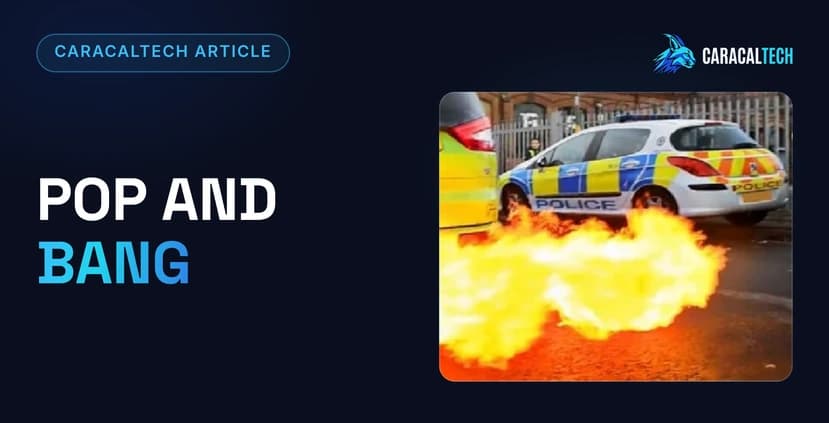
Short answer: Pops and bangs (also called a burble or crackle map) is an ECU remap that keeps a small amount of fuel flowing on overrun and fires the spark very late, so part of the mixture finishes burning in the exhaust and crackles. Owners add it for sound on turbo petrol engines such as the BMW B48 and B58. Our solution card lists 795 ECUs across 87 brands, from $75 per file.
How does a pops and bangs map work?
On a standard car, the ECU cuts injection when you lift off the throttle (overrun fuel cut-off), so the exhaust goes quiet. A pops and bangs map changes two things in the overrun area: it lets a little fuel through for a short time, and it retards the ignition so the spark fires well after top dead center. The mixture is still burning when the exhaust valve opens, and it finishes burning in the hot exhaust, which makes the pops. The effect raises exhaust and catalyst temperatures, and it only works on spark-ignition (petrol) engines. You can check whether your ECU is supported on our pops and bangs solution file page.
| Item | What happens | Source |
|---|---|---|
| Overrun fuel cut-off | Standard map stops injection on overrun; a burble map keeps a small amount of fuel (80 ms after a shift in our B48 example) | CaracalTech BMW F30 case study (this page) |
| Ignition on overrun | Spark retarded to fire after TDC (-27° in our B48 example) | CaracalTech BMW F30 case study (this page) |
| Where the fuel burns | Mixture leaves through the exhaust valves and burns in the hot exhaust – the same principle as motorsport anti-lag | Wikipedia, Anti-lag system |
| Catalyst | Unburnt fuel with oxygen raises catalyst temperature and can age it early | Wikipedia, Catalytic converter |
| Diesel engines | Compression ignition, no spark to retard, so no true pops and bangs map | Wikipedia, Diesel engine |
| Supported ECUs | 795 ECUs, 87 brands (Bosch 416, other 200, Siemens 108, Marelli 56) | CaracalTech pops and bangs solution card |
What you will Read in This Article:
- How does a pops and bangs map work?
- What is pop and bang (pops and bangs)
- Burble, popcorn, shift pop or pop and bang: the differences
- How do burble, crackle and pops occur
- Do you need a decat for pops and bangs?
- Pros of pops and bangs
- Cons of pops and bangs
- Pops and bangs software and kits
- Overrun fuel cut-off maps
- Real-world case study: BMW F30 burble tune and shift pop
- Pops and bangs – common turbo petrol engines
- Pops and bangs cost by remap
- Pops and bangs training tutorial
- Fault codes linked with pops and bangs
- Pops and bangs FAQ
What is pop and bang (pops and bangs)
Pop & Bang is one of the fascinating phenomena in the world of car tuning. Of course, if we summarize the definition of Pop & Bang only in the exit of fire and noise, then we should say that this phenomenon is not limited only to the automotive world; We have seen it when firing firearms, and the moment the fire exits the barrel. However, to put it in simple terms, we call the fire coming out of the exhaust, accompanied by a burble, explosion -like noise- Pop & Bang.
Pop & Bang is generated by the combustion of fuel and unburned hydrocarbons in the exhaust path, which we will discuss in more detail in the following lines.
Burble, popcorn, shift pop or pop and bang: the differences
Pop & Bang:
Loud, sharp explosion sounds that come out of the exhaust. Flames are usually visible as well.
Burble Tune:
Softer popping sounds with less intensity. These pops are more frequent and continuous. Normally, there are no flames.
Popcorn:
A continuous popping sound that happens when the engine hits the rev limiter (cut-off). It sounds like a machine gun firing. Depending on the exhaust system, small flames may also appear.
Shift Pop / Gearshift Crackle:
A single popping sound that occurs during gear changes at high RPMs, near the cut-off point. This effect is most commonly found on cars with DCT or DSG transmissions, where the fast gear shifts allow it to happen
How do burble, crackle and pops occur

Pops and bangs do not only happen on remapped cars. Some sports cars are calibrated to crackle on overrun from the factory. A car can also pop because of a fault: the main cause of pops is unburnt fuel and air reaching the hot exhaust. That is why a planned pop and bang calibration is different from pops caused by a malfunction, which can damage the engine and catalyst over time.
Faults such as a worn spark plug or wrong ignition timing can cause a misfire: incomplete combustion that sends unburnt fuel and air out of the cylinder, which can then pop in the exhaust. A pops and bangs remap creates the effect on purpose. It changes the overrun fuel cut-off so the injectors keep delivering a small amount of fuel for a short time after you lift off the accelerator, and it retards the spark advance so the spark fires well after TDC (top dead center). The mixture is still burning when the exhaust valve opens and finishes burning in the exhaust.

This is why you hear pops when you lift off the accelerator suddenly, or when you press and release it several times.
Do you need a decat for pops and bangs?
Pops and bangs come in different levels. A mild map gives a softer sound with little or no flame. Louder pops with more flame are usually linked with a DeCAT or a high-flow sports catalyst, because a standard catalyst both muffles the sound and suffers when fuel burns in front of it: unburnt fuel with oxygen overheats the catalyst and can age it early. Removing or changing the catalyst affects emissions and is for motorsport use only.
Pros of pops and bangs
There is no real technical advantage to pops and bangs; the benefit is the sound and the feeling of driving a sports car, which is why this function is so popular.
Pops and bangs do not reduce turbo lag on their own. Motorsport anti-lag systems use a similar idea – retarded ignition and extra fuel burning in the exhaust manifold to keep the turbo spinning – but they are a separate, much more aggressive strategy that puts heavy stress on the engine, turbocharger and exhaust manifold.
Cons of pops and bangs
Fuel burning in the exhaust raises exhaust and catalyst temperatures. An aggressive map can overheat or age the catalyst, add heat load to the turbocharger and exhaust valves, and increase noise. Poor work by inexperienced tuners adds to these risks, so the overrun area, fuel time and temperature conditions should be kept moderate on a standard exhaust.
Pops and bangs software and kits

Pops and bangs can also be made with a hardware backfire kit instead of a remap.

These kits are fitted to the car with a button and an igniter in the exhaust. When the button is pressed, fuel reaches the exhaust and the igniter lights it, which creates the pop and flame.
Overrun fuel cut-off maps
In ECU remapping terms, Overrun Fuel Cutoff (OFC) refers to the feature that cuts fuel injection when the throttle is fully closed and the engine is above a certain RPM threshold. This is primarily done to improve fuel efficiency and reduce emissions during deceleration.
1. How overrun fuel cut-off works
When the driver lifts off the throttle, the ECU stops injecting fuel into the cylinders.
This happens above a calibrated engine speed, and fuel injection starts again as the rpm falls towards idle.
During this time the engine is turned by the wheels through the drivetrain, not by combustion.
2. Overrun fuel cut-off in ECU tuning
2.1: Performance Tuning (Hard Cut / Pop & Bang Remap)
Tuners may disable or modify OFC to create pops and bangs on deceleration by allowing unburnt fuel into the exhaust.
Used in sports cars and aggressive tuning setups.
2.2: Economy Tuning (Enhanced OFC)
Some remaps adjust OFC parameters to cut fuel at lower RPMs, increasing fuel savings.
Often seen in eco-mapping for better fuel efficiency.
2.3: Turbocharger Considerations
In turbocharged engines, fuel burning in the exhaust adds heat at the turbine, so the overrun fuel and timing should stay moderate on a standard turbo.
Some tuners use “anti-lag” strategies instead of disabling OFC.
Cons of pop and bang kits
- They can affect the vehicle warranty, because they are a hardware modification.
- They focus on the flame, and do not give the same overrun sound as a well-made burble map.
- They add wiring and parts that can cause electrical faults.
🚨Some people think only turbocharged cars can produce pops and bangs. This is not true: naturally aspirated petrol cars can produce them too when the remap is done correctly.
🚨Pops and bangs are a petrol-engine function, because the effect depends on retarding the spark. A diesel engine uses compression ignition and has no spark to retard, so it cannot produce the same overrun crackle from a remap.
Real-world case study: BMW F30 burble tune and shift pop
In this section, we look at a real job done by the CaracalTech team: adding a burble tune and shift pops to a BMW F30 with a B48 engine.
To begin, we need to go to the ignition tables. There are two main groups: Basic Ignition Tables and Optimum Ignition Tables. The working principle, however, is the same for both. We decide to change the ignition timing for the overrun (deceleration) area -from cut-off point until down to the 4000 RPM- to -27 degrees, as shown in the image (the red arrow shows the overrun area). Remember, -27 degrees means the spark is fired 27 degrees after the piston passes Top Dead Center (TDC). You can see this in the first image below.

In the second image, you can see the changes we made to the Overrun Fuel Cut table in the cut-off area. This table shows how long (in milliseconds) the fuel injection continues after a gear shift, based on the engine temperature. As you can see, when the engine is warm, the fuel injection time is set to zero during shifting. To get a pop sound during gear changes, we need to increase these numbers. In this example, we chose 80 milliseconds. Combining this table with the retarded ignition values from the previous table allows us to have a pop sound during gear shifts.

Pops and bangs – common turbo petrol engines
Burble maps are most often added to turbo petrol engines. The table shows example engines, the cars that use them and what to watch. Engine data comes from the sources in each row.
| Engine | Example vehicles | Design | What to watch / fault code | Source |
|---|---|---|---|---|
| BMW B48 | F30 320i and 330i (2015–2019) – our case study engine | 2.0 L (1,998 cc) inline-4, single twin-scroll turbo | Catalyst and turbo heat; P0420 if the catalyst is damaged | Wikipedia, BMW B48 |
| BMW B58 | F30 340i (2015–2019), G20 M340i (2019–2024) | 3.0 L (2,998 cc) inline-6, single twin-scroll turbo | Catalyst and turbo heat; P0420 if the catalyst is damaged | Wikipedia, BMW B58 |
| Ford 2.3 EcoBoost | Ford Mustang EcoBoost (from 2015) | 2.3 L turbo inline-4 | Catalyst and turbo heat; P0420 if the catalyst is damaged | Wikipedia, Ford EcoBoost engine |
| Fiat 1.4 T-Jet | Abarth 500 (from 2008) | 1.4 L (1,368 cc) turbo inline-4, 145–190 PS by version | Small catalyst close to the engine heats quickly; keep the map mild | Wikipedia, Fiat FIRE engine |
CaracalTech can solve the software side for these and many other petrol engines. Our pops and bangs card lists 32 BMW ECUs (Siemens MSD80/MSD81 and Bosch MEVD17.2 and MG1 families), 14 Ford ECUs, 29 Fiat ECUs and over 100 ECUs each for Volkswagen (108), Skoda (108), Seat (106) and Audi (103).
Pops and bangs cost by remap
A pops and bangs file from CaracalTech starts from $75 per file (1 credit). Check your ECU and order on the pops and bangs solution page; the final price depends on the ECU and the vehicle.
Whether you own an automotive business or simply want your own ECU programmer for personal projects, check out CaracalTech Tuning Shop. We offer some of the best ECU programming tools on the market, along with exclusive bundles and special deals.
Pops and bangs training tutorial
If you want to learn how burble maps are built in petrol ECU files, these lessons show the process in two tuning programs.
1- If you want to learn how to make pop and bangs in petrol engines in WinOLS and ECM Titanium software, you can enter to our ECU training course.
🚨 Direct link to pop and bang training video in WinOLS Software.
🚨 Direct link to pop and bang training video in ECM Titanium Software.
2- If you only need a pops and bangs file, upload your original ECU file to our Tuning File Service, and our team will send you the modified file.
3- If you already use remapping software like WinOLS, a CaracalTech WinOLS mappack makes it faster and more accurate to find the right maps.
Fault codes linked with pops and bangs
A burble map should not set fault codes by itself. These generic OBD-II codes can appear when the catalyst has been damaged by too much fuel burning in the exhaust, or when a real misfire is the cause of unwanted pops. Fix the cause first.
| Code | Title | Link with pops and bangs | Source |
|---|---|---|---|
| P0420 | Catalyst System Efficiency Below Threshold (Bank 1) | Catalyst aged or damaged by heat | obd-codes.com |
| P0430 | Catalyst System Efficiency Below Threshold (Bank 2) | Same as P0420, second bank of a V engine | obd-codes.com |
| P0421 | Warm Up Catalyst Efficiency Below Threshold (Bank 1) | Warm-up catalyst aged or damaged by heat | obd-codes.com |
| P0300 | Random/Multiple Cylinder Misfire Detected | A misfire sends unburnt fuel to the exhaust and can cause unwanted pops | obd-codes.com |
| P0301 | Cylinder 1 Misfire Detected | Misfire on one cylinder (P0302, P0303 and so on for other cylinders) | obd-codes.com |
Pops and bangs FAQ
What is a pop and bang map?
It is a modified ECU calibration for the overrun area. It keeps a small amount of fuel flowing after you lift off the throttle and retards the ignition so the spark fires after top dead center. Part of the mixture burns in the exhaust and makes the crackle. In our BMW B48 example the overrun timing was set to -27° and the shift fuel time to 80 ms.
Can you put pops and bangs on a diesel?
Not in the same way. A diesel engine uses compression ignition and has no spark plugs, so there is no ignition timing to retard on overrun. Our pops and bangs solution card lists spark-ignition ECUs such as Bosch MED17, MEVD17 and MG1, Siemens MSD80 and Marelli units, not diesel ECUs.
Do pops and bangs damage the engine or catalyst?
A mild, well-made map is low risk, but fuel burning in the exhaust always adds heat. Unburnt fuel with oxygen raises catalyst temperature and can age it early, and aggressive maps add heat load to the turbocharger and exhaust valves. Keep the overrun area and fuel time moderate on a standard exhaust and catalyst.
Do you need a decat for pops and bangs?
No. A mild burble map works with the standard catalyst. Louder pops with flames are usually linked with a decat or high-flow sports catalyst, but removing or changing the catalyst affects emissions and is for motorsport use only, and heavy pops can damage a standard catalyst.
Pops and bangs kit or remap: which is better?
A remap changes the ECU's overrun fuel and ignition maps and gives a natural overrun sound. A backfire kit is extra hardware with a button and an igniter in the exhaust; it focuses on the flame, adds wiring and can affect the warranty. Most tuners prefer the remap because no parts are added.
How much does a pops and bangs remap cost?
At CaracalTech a pops and bangs file starts from $75 per file (1 credit). The solution card lists 795 supported ECUs across 87 brands, including Bosch (416), Siemens (108) and Marelli (56) units. The final price depends on the ECU and the vehicle; you upload the original file and receive the modified file.
What is the difference between a burble tune and pops and bangs?
A burble tune gives softer, more frequent popping on overrun, usually with no flame. Pops and bangs is louder and sharper and can show flames. Popcorn is popping at the rev limiter, and a shift pop is a single pop during fast gear changes, most common on DCT and DSG gearboxes.
References
- CaracalTech pops and bangs solution card (linked above). Supports: 795 ECUs, 87 brands, maker and brand counts, price from $75 per file.
- Wikipedia – Anti-lag system. Supports: retarded ignition and extra fuel burning in the exhaust manifold; stress on engine, turbocharger and manifold.
- Wikipedia – Catalytic converter. Supports: unburnt fuel with oxygen raises catalyst temperature and ages the catalyst.
- Wikipedia – Diesel engine. Supports: compression ignition instead of spark ignition.
- Wikipedia – BMW B48 and BMW B58. Supports: engine size, turbo, F30 and G20 model years.
- Wikipedia – Ford EcoBoost engine and Fiat FIRE engine. Supports: 2.3 EcoBoost in the 2015 Mustang; Abarth 500 1.4 T-Jet 1,368 cc, 145–190 PS.
- obd-codes.com. Supports: titles of P0420, P0430, P0421, P0300 and P0301.
Usage note: pops and bangs maps are supplied for motorsport and track use only. They raise exhaust and catalyst temperatures, and local noise and vehicle rules always apply on public roads.
📍For more information and probable problems feel free to contact us: [email protected]
Enjoyed the content? Add us as a preferred source to see more of it in Search.