
EGR Delete- EGR Off Service
What You Will Read in This Article:
- How is EGR deleted from the ECU? The short answer
- What is the EGR System and What is the Purpose of EGR?
- How EGR system works
- How Does EGR Reduce Emissions?
- Various Types of EGR Systems
- EGR system failure symptoms
- Pros and Cons of Removing/Delete EGR Systems
- EGR Removal/Delete software
- How to Delete EGR from ECU (training)
- Common EGR fault codes
- EGR delete: frequently asked questions
- References
How is EGR deleted from the ECU? The short answer
EGR off is a change to the engine ECU calibration, not only a blanking plate. The ECU drives the EGR valve and checks that the commanded exhaust flow actually arrives. If the valve is blocked or removed while the software still expects it, the ECU stores fault codes such as P0401 or P0403 and turns on the warning light. The change is therefore made in the original file read from the ECU, with a tool such as WinOLS or ECM Titanium. CaracalTech supplies it as an EGR off solution file for off-road and motorsport vehicles; see the usage note at the end of this article.
EGR at a glance (checked November 2026)
| Item | Detail | Source |
|---|---|---|
| What it does | Returns part of the exhaust gas to the intake. This lowers the oxygen concentration and absorbs heat, so peak combustion temperature and NOx formation fall. | DieselNet, Pierburg |
| Why temperature matters | Thermal NOx becomes significant only above about 1,800 K (about 1,530 °C) | Ansys Fluent theory guide |
| System types | High-pressure EGR (taken before the turbine, gas up to about 950 °C), low-pressure EGR (taken after the DPF, fed in before the compressor, up to about 800 °C), and internal EGR through valve overlap | Pierburg |
| EGR cooler | Engine coolant cools the recirculated gas, which lowers peak combustion temperature further | Pierburg |
| Why valves clog | Soot from the exhaust mixes with oil in the intake air and forms carbon deposits; frequent short journeys make it worse | MS Motorservice, Pierburg tech tip |
| CaracalTech coverage | 868 ECUs across 95 brands; largest named ECU makers: Bosch 482, Siemens 109, Delphi 85 | CaracalTech solution data |
Exhaust Gas Recirculation System (EGR):
Emission limits for new engines have become tighter over the years, and EGR is one of the main technologies engine makers use to meet them. This article explains how EGR works, why it fails, and how EGR off is handled in the ECU software.

The Role of Nitrogen Oxides in Air Pollution:
Exhaust emissions include many pollutants, and nitrogen oxides (NOx), as a group of these pollutants, pose the most severe environmental risks. Exhaust pollutant compounds of diesel engines include carbon monoxide, sulfur dioxide, soot particles, unburnt hydrocarbons (UHCs), and nitrogen oxides.
Exhaust gas recirculation (EGR) is one of the main measures for reducing nitrogen oxide (NOx) emissions from car engines, especially diesel engines.
The Formation of Nitrogen Oxides:
In both diesel and petrol engines, the hottest zones of the flame reach temperatures at which nitrogen and oxygen from the intake air combine. This thermal NOx becomes significant above about 1,800 K (about 1,530 °C), and its formation rate rises steeply as the temperature climbs.Considering the conditions for the formation of nitrogen oxides and the unfeasibility of preventing nitrogen from entering the engine, the best preventative measure against the formation of this dangerous compound is to control the composition conditions by reducing the combustion chamber temperature. Obviously, reducing the combustion temperature comes with consequences since controlling the temperature results in output power loss due to preventing the release of maximum energy of the fuel. Subsequently, if maintaining power output is needed, more fuel should be consumed in each cycle.Depending on the engine and its calibration, EGR can cost some fuel economy on a diesel, while on many petrol engines it can even reduce fuel consumption.
How To Control Combustion Temperature:
Now that we have discussed and realized NOx, as one of the main families of engine pollutants, are formed at ultra-high combustion temperatures, the ideal preventative measure for reducing pollutants is seemingly reducing the combustion temperature of the engine, which is not so easy since combustion occurs instantaneously. Therefore, some solutions such as cooling the cylinder body do not help reduce the combustion temperature.
One way to reduce combustion temperature is to dilute the intake charge by recirculating part of the exhaust gas into the engine.As part of the exhaust gas enters the intake and then the combustion chamber, the oxygen concentration falls, and the recirculated gas also absorbs heat. Both effects lower the peak combustion temperature. This process is the basis of EGR. The amount of recirculated gas depends on engine speed (rpm), residual oxygen in the exhaust, ambient temperature, engine temperature and altitude.
As mentioned above, EGR should be able to reduce the combustion temperature, but because of the high temperature of the exhaust gas, if the engine's output gas directly returns to the combustion chamber, not only will it not reduce the temperature, but also it will raise the temperature of the combustion chamber. As a result, a cooling system is installed in the path of the gas flow to lower the exhaust gas temperature before recirculation into the manifold to lower the risk of overheated gas entering the engine.
🚨In some cases, the EGR maps in the ECU are adjusted or EGR is switched off, for example on off-road machinery and motorsport vehicles, or after the EGR valve or cooler has been removed.
💬EGR System Failure Symptoms:
| 💬The Benefit of EGR Delete/ EGR off
|

EGR OFF Software - EGR OFF Service:
If you own a diesel vehicle, you may already have had EGR problems: a check engine light, lower engine performance, rough running and repair costs. On off-road and motorsport vehicles, these are handled by switching EGR off in the ECU software..
To remove EGR by software, you can use software such as WinOLS, Swiftec, RaceEvo, and ECM Titanium (only for certain vehicles). If you use the right software for the vehicle and correctly identify the EGR tables, the ECU stops commanding the EGR valve and no longer stores EGR fault codes.
So if you need EGR off, first check that your ECU is listed on our EGR delete solution page, then upload your original ECU file to the Tuning File Service.
Disadvantages of Using an EGR Delete Kit:
There are also drawbacks to using an EGR delete kit.
1. Peak combustion temperature and NOx emissions rise, because the intake charge is no longer diluted with exhaust gas. On petrol engines, knock tendency can also increase, because EGR improves knock tolerance.
2. Without a matching ECU calibration, the warning light stays on and EGR fault codes such as P0401 or P0403 are stored.
3. It can cause your engine to start knocking
4. Only allowed for off-road trucks.
🏁With years of experience in ECU calibration and remapping, we at CaracalTech identify and adjust the EGR tables in the 868 petrol and diesel ECUs on our EGR off list. In CaracalTech, resetting EGR maps or EGR REMOVAL can be done with different techniques. Besides, CaracalTech offers EGR system performance full training courses incorporated in ECU so that only by a single piece of training you can identify and select EGR control tables in ECM Titanium or fully perform EGR DELETE.
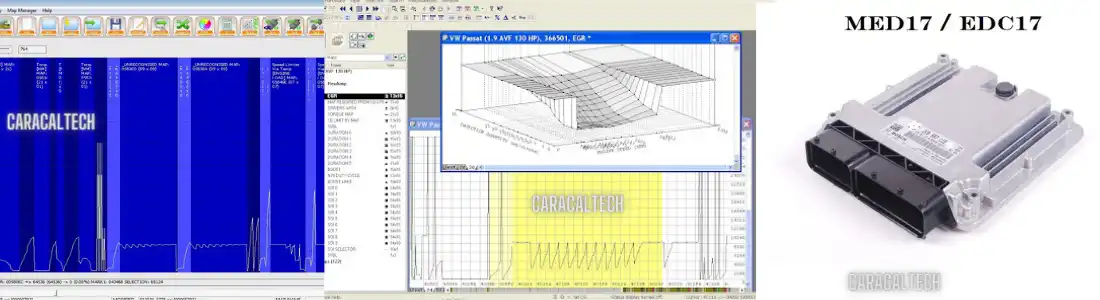
🚨Below, you can see 2d and 3d images of EGR control tables in two software: Swiftec and WinOLS.
EGR Delete Cost?
The EGR off price depends on the vehicle and the ECU; current prices are listed on our Tuning File Service page.Here, you can learn once, fully and for good, the adjustments or removal of EGR in gasoline and diesel engines. Below is a link to an EGR training video in various SOFTWARES and ECUs.
1- If you want to learn EGR removal in petrol and diesel ECUs, start with our free WinOLS EGR delete course (Bosch EDC16); for the other tool, see our ECM Titanium guide.
2- If you need only EGR OFF file, upload original ECU file in Tuning File Service, after short time our experts send you remapped file.
3- If you know remapping software like WinOLS or Swiftec, for ease and accuracy of work you can use CaracalTech Mappack.
DPF Delete:
The DPF is one of many technologies used to reduce air pollution. The DPF system's performance is related to its ability to absorb particulate matter (soot).
High mileage vehicle, EGR valve problems & Poor performance tuning and etc. are causes of DPF failure.
Under such scenarios, so much particulate matter can accumulate and clog the exhaust gas passage out of the engine. You can remove DPF and after deleting you must modify ecu software. On off-road and motorsport vehicles, the ECU software is then changed to match, so that regeneration and DPF monitoring stop.
🚨NOTE: Most people are looking for EGR, DPF, SCR/ AdBlue Delete training course but we must say for any ECU and any car EGR, DPF, AdBlue/SCR has a different algorithm, and it is not possible to find the same way and method for this work.
For example, if you want to find a turbo pressure map in EDC17 ECU, we can say that it has the same 2d, 3d, or text view in all EDC17 ECUs but EGR, DPF, AdBlue/SCR for any EDC17 ECUs is different. So, what should we do? We need A2l files or Damos files for that especial ECU then try to find the EGR, DPF, AdBlue/SCR area in the file.
We use Swiftec software to do EGR, DPF, AdBlue/SCR OFF because it has some more working solutions.
You can see this link if you want to know some training examples.
Common EGR fault codes
These generic OBD-II codes follow SAE J2012 and are the ones most often stored for EGR faults. Manufacturers also use their own fault numbers, so read the full fault memory with a scan tool before deciding on a repair.
| Code | Meaning | Common causes | Source |
|---|---|---|---|
| P0400 | EGR flow malfunction | General EGR flow fault; check the valve and EGR passages | TaT |
| P0401 | EGR "A" flow insufficient detected | Clogged or faulty EGR valve, carbon build-up in the intake, faulty DPFE sensor, damaged wiring | KBB |
| P0402 | EGR "A" flow excessive detected | More exhaust gas returned than commanded, for example a valve that does not close fully | RepairPal, Pierburg |
| P0403 | EGR circuit malfunction | Electrical fault in the EGR valve control circuit | TaT |
| P0404 | EGR circuit range/performance | Valve position or flow does not match the expected value | TaT |
| P0405 | EGR sensor "A" circuit low | Low signal voltage from the EGR position sensor, or its wiring | TaT |
For how fault codes are built and read, see our guide to diagnostic trouble codes.
EGR delete: frequently asked questions
What does an EGR delete do?
An EGR delete stops exhaust gas from being returned to the intake. Mechanically, the EGR valve is closed, blanked or removed; in the ECU software, valve control and EGR monitoring are switched off so no faults are stored. The engine then burns a fresh, undiluted charge, so peak combustion temperature and NOx emissions rise and the intake stays cleaner.
Is EGR delete software enough, or must the valve be removed?
Both routes need the software change. With EGR off in the calibration, the ECU stops opening the valve and stops checking EGR flow, so the valve can stay in place closed. If the valve is only blanked without a matching file, the ECU still expects flow and stores codes such as P0401 or P0403 and turns on the warning light.
Can ECM Titanium do EGR off?
Yes, for some ECUs. ECM Titanium works through drivers written for each ECU, and EGR maps can only be edited where the driver identifies them. WinOLS gives full access to the file, but the EGR tables still have to be found for each ECU type, because the EGR logic differs even within one family such as Bosch EDC17. Where no driver covers it, a solution file is the practical route.
What are the pros and cons of an EGR delete?
Pros: no soot and oil deposits in the EGR valve, cooler and intake, and no EGR valve or cooler repairs. Cons: peak combustion temperature and NOx emissions rise, petrol engines can lose knock tolerance, and without a matching ECU calibration the warning light and EGR fault codes remain. The change is also limited to off-road and motorsport vehicles, as noted below.
Which fault codes point to an EGR problem?
The most common generic codes are P0400 (EGR flow malfunction), P0401 (flow insufficient), P0402 (flow excessive), P0403 (control circuit), P0404 (range or performance) and P0405 (position sensor circuit low). P0401 is often caused by a clogged valve or carbon in the intake. Manufacturers add their own fault numbers, so read the full fault memory first.
Which ECUs support EGR off?
As of November 2026, our EGR off solution covers 868 ECUs across 95 brands. Most are Bosch (482), followed by Siemens (109) and Delphi (85). Examples include Bosch EDC17C46, EDC17C64 and MD1CS004 on Volkswagen, EDC17C06, EDC17C50 and MD1CS001 on BMW, Siemens SID208 on Ford, and Cummins CM2350 on Isuzu trucks. You can search your exact ECU on the solution page.
How much does an EGR delete cost?
The price depends on the ECU. On our tuning file service, a solution file such as EGR off is listed at 75 USD (1 credit), and Stage 1 or ECO tuning combined with solutions at 100 USD (1.5 credits), as of November 2026. Prices can vary with ECU type and complexity, so check the current tuning file prices before you order.
Does an EGR delete make more power?
EGR off on its own is not a performance tune. It changes what the engine breathes where EGR was active, but the ECU still limits torque, boost and fuel through its other maps. Any measured power change comes from a Stage 1 or Stage 2 calibration, which can be ordered together with EGR off in the same file.
References
Technical statements in this article were checked against these sources in November 2026.
- DieselNet, Exhaust gas recirculation. Supports: EGR reduces NOx by lowering oxygen concentration and through heat absorption; EGR improves knock tolerance in spark-ignition engines.
- Pierburg / MS Motorservice, Exhaust gas recirculation (brochure). Supports: lower combustion temperature, high- and low-pressure EGR, internal EGR, the EGR cooler, and lower fuel consumption on some petrol engines.
- MS Motorservice, EGR systems. Supports: where high- and low-pressure EGR take and return the exhaust gas.
- MS Motorservice Technipedia, Troubleshooting in EGR systems. Supports: soot and oil forming carbon deposits; irregular idling, jerking and lack of power.
- Pierburg, Electrical EGR valve: deposits on the valve (tech tip). Supports: causes of deposits, including short journeys, and a valve that does not open or close fully.
- Ansys Fluent theory guide, Thermal NOx formation. Supports: thermal NOx is significant only above about 1,800 K.
- RAC, EGR valve replacement. Supports: EGR fault symptoms such as rough idle, reduced power, higher fuel consumption, warning lights and knocking.
- Hitachi Astemo Aftermarket, EGR valve product overview. Supports: stumbling, engine stall, reduced power and the malfunction indicator light.
- Kelley Blue Book, P0401. Supports: the definition and common causes of P0401.
- TaT scan data, generic code definitions and SAE J2012 (revised September 2025). Supports: the definitions of P0400 and P0403–P0405 and the standard behind generic OBD codes.
Usage note: CaracalTech EGR off solution files are supplied for off-road machinery and motorsport vehicles only, where local regulations permit. They are not intended for vehicles used on public roads.
🚨You can read an article on DPF Delete for more information on how this system works and the pros & cons of removing it.
📍For more information and probable problems feel free to contact us: [email protected]
Enjoyed the content? Add us as a preferred source to see more of it in Search.