
MAF Sensor Delete: Pros, Cons, Fault Codes and MAF Off
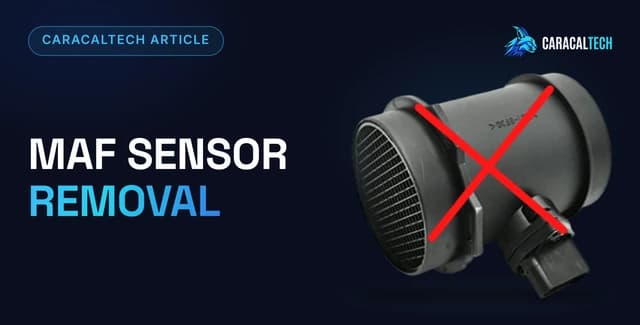
Short answer: MAF off, or MAF sensor delete, is an ECU software change that stops the engine control unit from relying on the mass air flow sensor signal, so the engine runs on stored and calculated values instead. Owners usually ask for it after repeated MAF faults or intake changes on turbo-diesel engines. The CaracalTech MAF solution covers 198 ECUs across 34 brands, from $75 per file (1 credit).
What does MAF delete mean?
A MAF (mass air flow) sensor measures the mass of air entering the engine, and the ECU uses that signal to calculate how much fuel to inject; on diesel engines it also controls exhaust gas recirculation (EGR). A MAF delete changes the ECU calibration so this signal and its fault monitoring are no longer used in the normal way. Unplugging the sensor without a software change usually sets fault codes such as P0100 to P0104 and can put the engine in limp-home mode. A MAF delete does not fix the cause of a sensor fault, so intake leaks, a blocked air filter or EGR faults should be checked first.
| Point | Details | Source |
|---|---|---|
| What the MAF measures | Intake air mass; the signal is used to calculate injected fuel quantity | MS Motorservice |
| Extra role on diesels | Also used to control exhaust gas recirculation (EGR) | MS Motorservice |
| Sensor types | Older hot-wire (burns off dirt after switch-off); newer hot-film heated about 120–180 °C above intake air, no burn-off | MS Motorservice |
| Signs of a faulty sensor | Black smoke, lack of power, limp-home mode | MS Motorservice |
| Typical fault codes | P0100, P0101, P0102, P0103, P0104 | AutoCodes |
| CaracalTech MAF solution | 198 ECUs, 34 brands; Bosch 125, Siemens 27, Marelli 24, Delphi 17; from $75 per file | CaracalTech MAF solution card |
To check whether your control unit is supported, see the CaracalTech MAF off solution files list.
🚩In This Article, You Will Find Out:
- What does MAF delete mean?
- What the MAF sensor is?
- How the MAF sensor works?
- Why “MAF sensor delete” is done?
- Case study: turbo conversions on BMW six-cylinder engines
- How “MAF sensor removal” is done?
- MAF sensor fault codes
- Pros and cons of MAF sensor delete
- What is a VAF sensor?
- MAF sensor removal software
- MAF sensor removal cost
- Common causes of MAF sensor faults
- MAF sensor FAQ
What is a MAF Sensor?
The MAF (mass air flow) sensor measures the mass of air that flows into the engine. It sits in the intake between the air filter box and the intake manifold (see the image below) and sends its signal to the ECU, which uses it to calculate the injected fuel quantity and keep the mixture from running rich or lean. On diesel engines, the same signal is also used to control exhaust gas recirculation (EGR).
How Does The MAF Sensor Work?
Modern engines use fuel injection, and the ECU needs to know how much air enters the engine to work out how much fuel to inject. Older MAF sensors use a heated platinum wire; newer ones use a heated film. The sensor's own electronics keep the element hotter than the intake air – on hot-film sensors about 120–180 °C above it, depending on the vehicle maker. Air flowing past cools the element, and the electronics raise the heating current to hold its temperature. That heating current is the measure of the air mass, and the sensor turns it into a signal for the ECU. Because the method measures mass, changes in air density are taken into account. When the intake is modified, tuners can also rescale the MAF signal in the ECU – this article shows how this is done.
A faulty or dirty sensor sends wrong values to the ECU, which can lead to black smoke, lack of power and limp-home mode. Because the ECU uses air mass for other functions too, systems such as EGR can be affected.
❓But despite the MAF sensor’s huge advantages, why is it removed in some cases?
Why “MAF Sensor Delete” is Done?
Most MAF delete requests come from two situations. The first is a sensor that keeps failing. Dirt that enters through intake leaks can destroy the delicate sensing element, oil mist from the crankcase ventilation can coat it, and on turbo-diesel engines the high air flow and air speed put extra stress on the sensor. Older hot-wire sensors burn off dirt by heating the wire briefly after the engine is switched off; newer hot-film sensors have no burn-off process. Cleaning can help on some designs, but a damaged element has to be replaced.
The second situation is a modified intake or turbo system where the original sensor no longer matches the airflow; here the MAF signal is usually rescaled or the calibration changed. Before you delete a MAF, check for intake leaks, a blocked air filter, a faulty EGR valve or turbo problems, because these can make a healthy sensor send wrong values.
Case study: turbo conversions on naturally aspirated BMW six-cylinder engines
A typical reason for a MAF delete is a custom turbo build on an engine that left the factory without forced induction. BMW's M52 and M54 straight-six engines were naturally aspirated, and their MAF sensors and calibrations were sized for that air flow. Owner and tuner reports on BMW and tuning forums show the same pattern again and again: once a turbo is added, the stock MAF reaches the end of its range, and the builder has to fit a larger MAF, move it to a blow-through position, or remove it and let the ECU calculate load from manifold pressure (speed density) or throttle position (alpha-N).
| Engine code | Example car and build | Engine ECU | What happened to the MAF | Source |
|---|---|---|---|---|
| M52B20 (2.0 L) | E36 320i with a Garrett GT28R turbo and 350 cc injectors | Not named in the thread | Stock MAF map maxed out at about 4,500 rpm (the B20 sensor is quoted at up to 518 kg/h); solved by fitting a different MAF | RomRaider forum |
| M52 (2.8 L) | E36 328i turbo build with a Garrett GT35R, aiming at 350–400 bhp | Siemens, OBD2 (flash-tunable) | Forum advice: the stock 328i MAF will not be enough; a larger slot-type MAF in a blow-through set-up was recommended | Bimmerforums |
| M52TU B25 (2.5 L) | 2000 Z3 with a centrifugal supercharger (forced induction, not turbo) | Siemens MS42 | Blow-through stock MAF hit its limit at 777 kg/h; a larger Bosch MAF was planned | Renovelo forum |
| M54 (2.2–3.0 L) | E46, E39, E53 X5, Z3 and Z4 models | Siemens MS42 / MS43 | Plug-in standalone ECU used for boosted builds runs without the OEM MAF; load comes from a MAP sensor | MaxxECU M54 plug-in guide |
| M54 | Engine swapped into an E36 | Siemens MS43 | MAF disconnected and the ECU run in alpha-N mode; forum members note this needs more than a simple patch | RomRaider forum |
In CaracalTech's work on this kind of conversion, the decision depends on the target power and the ECU. Where a larger or blow-through MAF can still measure the new air flow, rescaling the MAF curve keeps the most accurate fuel control. Where the air flow is beyond any practical sensor, or a MAP sensor already gives a reliable load signal, the MAF is removed in the software and the calibration is moved to pressure- or throttle-based load, together with new fuel, ignition and boost maps. A MAF delete on its own is not a turbo tune: the rest of the calibration has to be built and checked on the dyno or with data logs.
How “MAF Sensor Removal” is Done?

MAF off is done in the ECU software: the MAF signal and its fault monitoring are changed so the engine control unit works with stored and calculated values instead. Physically removing or unplugging the sensor without a matching software change usually sets fault codes and can put the engine in limp-home mode. Cleaning or replacing the sensor is described in the vehicle manual; the sensing element is fragile, so leave this work to a technician if you are not sure.
MAF Sensor Trouble Codes:
🚨Trouble codes such as:
| Code | Generic description | Source |
|---|---|---|
| P0100 | Mass air flow sensor (circuit) | AutoCodes P0100 |
| P0101 | Mass or volume air flow circuit range/performance problem | AutoCodes P0101 |
| P0102 | Mass or volume air flow circuit low input | AutoCodes P0102 |
| P0103 | Mass or volume air flow circuit high input | AutoCodes P0103 |
| P0104 | Mass or volume air flow circuit intermittent | AutoCodes P0104 |
All are relevant to the MAF sensor, which causes the check light to be turned on and leads to future problems.
📍At CaracalTech, we help you to DTC OFF either using car scan tools or directly from the ECU and rid yourself of the check lights.
MAF Sensor Pros and Cons:
We listed some of the pros and cons of the MAF sensor earlier, so we can come up with a conclusion. A healthy and clean sensor not only is vital for efficient performance but can also bring the following advantages:
- The correct value of air to fuel ratio
- Reduction in fuel consumption
- Increase in acceleration and power
A broken sensor will have the following consequences:
- An increase in fuel consumption
- Triggering the check engine light to “ON” and other trouble codes
- Poor performance of the vehicle in inclines
- Slow response of the vehicle when the gas pedal is pushes down.
- Decrease of engine efficiency
A broken sensor has the following symptoms:
- Changes in fuel consumption
- Lean or rich idling
- Black smoke exiting the exhaust
- Lack of power
- Lack of acceleration
- Triggering the check engine light to “ON”
- Stalling engine after starting
🚨A MAF delete is usually considered only on modified or competition engines, or where the sensor keeps failing after the causes above have been checked. On a standard vehicle with a healthy intake, a working MAF sensor gives the most accurate fuel and EGR control, so repair or replacement is the better first step.
What is The VAF Sensor?
Other sensors also help the ECU work out the air entering the engine, such as the intake air temperature (IAT) sensor and the manifold absolute pressure (MAP) sensor, while the oxygen sensor measures the exhaust after combustion. The VAF (vane air flow) sensor is the older, mechanical way to measure intake air: a spring-loaded flap in the air stream is attached to a potentiometer, so the flap angle produces a voltage that rises with air flow. In some older systems, such as Bosch K-Jetronic, the vane moved the fuel metering directly.
Hot-wire and hot-film MAF sensors have replaced VAF meters on modern engines.

MAF Sensor Removal Software:
CaracalTech prepares MAF off files for the control units listed on the MAF solution card; the ECU is read and written with ECU Programming Tools. Depending on the ECU, the change can include the MAF signal, its fault codes and related maps. In some vehicles, unplugging the sensor alone is not enough, because it sets fault codes; the software has to be changed as well.
MAF Sensor Removal Cost By Remap?
On the MAF off solution page, a MAF off file starts from $75 per file (1 credit); the final price depends on the ECU. The card lists the supported ECUs by maker and brand, so you can check your control unit before you order.
1- If you want to learn diesel ECU calibration in WinOLS or ECM Titanium, see our ECU training course list.
2- If you need a MAF sensor off file, a DTC Off service or any other service, upload the original ECU file in the Tuning File Service; our team sends the modified file back after checking it.
3- If you work with WinOLS, a CaracalTech WinOLS mappack helps you find the MAF-related maps of your ECU faster.
AdBlue Off:
AdBlue, also called DEF (diesel exhaust fluid), is the urea solution used by selective catalytic reduction (SCR) systems on diesel vehicles to reduce NOx emissions. For how AdBlue systems work, their common faults and the AdBlue off solution, read the AdBlue Off article.
Common causes of MAF sensor faults
Not every MAF fault code means the sensor itself is broken. The air mass sensor specialist MS Motorservice lists these causes:
| Cause | What happens | Source |
|---|---|---|
| Intake air leaks | Dirt particles enter and hit the sensing element at high speed | MS Motorservice |
| Oil mist from crankcase ventilation | Oil coats the hot-film element and falsifies the signal | MS Motorservice |
| Blocked air filter | An undamaged sensor sends incorrect values | MS Motorservice |
| Faulty EGR or tank ventilation valve | Air flow no longer matches what the ECU expects | MS Motorservice |
| Turbocharger fault (for example a wrongly set wastegate) | Incorrect air flow readings | MS Motorservice |
| High air flow on turbo-diesel engines | Extra stress on the sensor | MS Motorservice |
MAF sensor FAQ
What does MAF delete mean?
A MAF delete is an ECU software change that stops the engine control unit from relying on the mass air flow sensor. The ECU then runs on stored and calculated values instead of the measured air mass, and the related fault codes are handled in the software. Simply unplugging the sensor without this change usually sets P0100 to P0104 codes.
What are the pros and cons of a MAF delete?
The main advantage is that a repeatedly failing or mismatched sensor no longer causes faults or limp-home mode. The main drawback is less precise fuel and EGR control, because the ECU no longer measures the real air mass. On a standard engine with a healthy intake, repairing or replacing the sensor is usually the better choice.
Can you drive without a MAF sensor?
With the sensor unplugged and no software change, most engines set fault codes, light the check engine lamp and may go into limp-home mode with reduced power. With a MAF off calibration, the ECU uses calculated values instead. MAF off files are supplied only for the uses described in the usage note below.
How do I know if my MAF sensor is bad?
Typical signs are black smoke from a diesel exhaust, lack of power, limp-home mode and codes P0100 to P0104. Lean or rich mixture codes and EGR flow codes can also appear, because the ECU uses the air mass signal for these systems. Check intake leaks and the air filter before you replace the sensor.
Should I clean or replace a MAF sensor?
Older hot-wire sensors clean themselves by burning off dirt after the engine is switched off. Newer hot-film sensors have no burn-off process, and an oiled or damaged element gives wrong values. Careful cleaning can help with light dirt, but a damaged sensing element has to be replaced.
Which ECUs support MAF off at CaracalTech?
The CaracalTech MAF solution card lists 198 ECUs across 34 brands: 125 Bosch, 27 Siemens, 24 Marelli and 17 Delphi. The brands with the most entries are Mercedes (22), Audi, Seat, Skoda and Volkswagen (15 each), and Fiat and Ford (14 each). Prices start from $75 per file.
What is the difference between a MAF and a VAF sensor?
A VAF (vane air flow) sensor uses a spring-loaded flap connected to a potentiometer, so it measures air flow mechanically. A MAF sensor uses a heated wire or film and measures air mass electronically, which also accounts for air density. VAF meters are found on older engines; modern engines use MAF sensors.
References
- MS Motorservice: Air mass sensors – faults, causes and testing – Supports: sensor function, hot-wire and hot-film types, fault causes, symptoms, EGR role.
- Wikipedia: Mass flow sensor – Supports: VAF design, hot-wire principle, burn-off circuit.
- AutoCodes: P0100–P0104 – Supports: generic fault code descriptions.
- CaracalTech MAF solution card (linked above) – Supports: 198 ECUs, 34 brands, ECU maker counts, price.
Usage note: MAF off files are supplied for off-road machinery and motorsport vehicles only, where local regulations permit. They are not intended for vehicles used on public roads.
📍For more information and probable problems feel free to contact us: [email protected]
Enjoyed the content? Add us as a preferred source to see more of it in Search.