
Bosch ME17 ECU guide: versions, cars, read methods and tuning

By Sina, Senior technical specialist, CaracalTech
Short answer: Bosch ME17 is a family of Motronic petrol engine ECUs with electronic throttle control, built on Infineon TriCore microcontrollers. ME17 units are mostly fitted to port-injection engines; the direct-injection sibling is MED17. Like every Motronic, ME17 software is torque-based. Whether you read it over OBD, on the bench or in boot mode depends on the exact variant, such as ME17.8.8 or ME17.9.21.
"ME17" is not one ECU. It is a generation of Bosch petrol controllers that runs from the ME17.0.3 in small Ford engines to the ME17.8.33 in McLaren's 4.0-litre twin-turbo V8, with Chinese, Korean, Japanese and European cars in between. The sub-version after "ME17" decides almost everything a tuner cares about: the microcontroller, the read method, which tools support it, and how much there is to gain.
This guide decodes the name and the terms, compares ME17 with MED17, MEV17, MEVD17 and EDC17, lists the main versions with the cars and microcontrollers documented for them, explains how ME17 security works and which programmers read it (with indicative prices), and walks frame by frame through a real boot-mode job on a TC1796-based Bosch MED17.1. It then shows what is inside our own ME17 mappacks, which ME17 solutions we list, and where we teach ME17 in WinOLS and ECM Titanium.
Fast view
- ME17 = Motronic + electronic throttle, generation 17. No "D" in the name usually means a port-injection application.
- Microcontrollers: Infineon TriCore TC17xx (TC1724, TC1728, TC1762, TC1767, TC1782, TC1793, TC1796, TC1797), depending on the variant.
- Read methods: OBD on supported variants such as ME17.0.3, ME17.9.11 and ME17.9.21; bench or boot on others, as listed by the tool makers.
- Software logic: torque-based. Requests are coordinated as torque and turned into throttle, boost, ignition and injection commands, while a separate monitoring level checks the result.
- CaracalTech data (checked 24 November 2026): 3,016 ME17-family original files in 64 variant names, 23 ME17 WinOLS mappacks with 6,243 named maps, ME17 entries on four solution pages, and ME17 lessons in our WinOLS and ECM Titanium courses.
What is a Bosch ME17 ECU?
A Bosch ME17 ECU is a Motronic engine control unit for petrol engines with electronic throttle control, from Bosch's generation 17. Bosch part numbers for ME17 units start with 0 261, as on other Bosch petrol ECUs; examples in Bosch's own repair catalogue include 0261S04613 (ME17.5, VW Jetta 2.5) and 0261S07502 (ME17.5.20, SEAT Mii 1.0) [8].
Bosch does not publish a public decoder for every letter, but the main ones are well documented by tool makers [1][2]:
Table 1. How to read a Bosch ME17 name (example: ME17.9.21.1).
| Part | Meaning | Source |
|---|---|---|
| M | Motronic: Bosch's name for its combined petrol engine ECU | Autotuner [1] |
| E | Electronic throttle control (no throttle cable) | Autotuner [1] |
| 17 | Bosch ECU generation | Autotuner calls it the "Bosch version" [1] |
| .9 | Sub-family; in practice it groups related applications (for example many ME17.9.x units are Asian-market applications) | Interpretation from the version lists below |
| .21 | ECU type within the sub-family, often reserved for one carmaker | Autotuner [1] |
| .1 | Hardware or software revision of that type | Interpretation; confirm with your tool's ID read |
So "ME17" tells you the family, and only the full name (ME17.9.21.1, not "ME17.9") tells you which tool, method and file layout apply.
Bosch ME17 terminology
These are the terms you will meet in tool menus, mappacks and the rest of this guide.
Table 2. Bosch ME17 terms in plain language.
| Term | What it means on an ME17 | Source |
|---|---|---|
| Motronic | Bosch's petrol engine management that controls ignition, injection and air from one ECU | Bosch [10] |
| E-Gas (electronic throttle) | The throttle is moved by a motor; the ECU decides the opening, not a cable from the pedal | Autotuner [1], EGAS concept [13] |
| TriCore | Infineon's 32-bit microcontroller family; ME17 uses the TC17xx generation | Infineon [20] |
| Program flash (PFLASH) | Holds the software and the calibration (the maps) | Infineon [20] |
| Data flash (DFLASH) | Used for EEPROM emulation: learned values and coding data that change during use | Infineon [20] |
| Calibration area | The part of the flash that holds maps and values; this is what an OBD "calibration" read covers | Autotuner [4][22] |
| Checksum | Check values the ECU verifies; they must be recalculated after any change | General practice; see the case study |
| Bootstrap loader | A start mode built into the TriCore that talks to a tool over serial or CAN without running the ECU software | Infineon [20] |
| TPROT | Bosch tuning protection inside the ECU software; the version decides how a tool can read and restore the unit | ChipSoft [21] |
| OTP sector | One-time-programmable flash area that cannot be erased or rewritten | ChipSoft [21], case study |
| Indexed torque | The torque target after all requests are coordinated by priority (MDKOG in Bosch's function sheets) | Bosch ME7 Funktionsrahmen [12] |
| Driver wish | The pedal-to-torque request (MDFAW) | Bosch ME7 Funktionsrahmen [12] |
| Torque monitoring (level 2) | A separate calculation of permissible torque that is compared with actual torque | EGAS concept [13] |
| Damos / A2L | Description files that name maps and their addresses | See our WinOLS Damos guide |
ME17 vs MED17 vs MEV17 vs MEVD17 vs EDC17
The extra letters describe the hardware the ECU controls, so they also predict where the tuning headroom is.
Table 3. Bosch generation-17 families compared.
| Family | Fuel | What the letters add | Examples | Source |
|---|---|---|---|---|
| ME17 | Petrol | Motronic, electronic throttle; usually port injection | ME17.9.21 (Hyundai/Kia 1.2 to 1.4 MPI), ME17.3.0 (Abarth 1.4 T-Jet) | [1][4] |
| MED17 | Petrol | D = direct injection | MED17.1 (Audi 2.0 TFSI, the case study below), MED17.9.8 (Hyundai/Kia 1.6 GDI) | [1][4] |
| MEV17 | Petrol | V = Valvetronic or variable valve control | MEV17.2 (MINI 1.6), MEV17.4 (PSA 1.4 and 1.6 VTi) | [2][6] |
| MEVD17 | Petrol | Valvetronic and direct injection | MEVD17.2.x (BMW N13, N55; MINI) | [6][7] |
| MEG17 | Petrol | G: meaning differs between sources (Actronics: "gearbox" for MEG1; Autotuner: "gasoline" for MG1) | MEG17.9.12/13, MEG17.9.21 (Hyundai/Kia) | [2][1][4] |
| EDC17 | Diesel | Electronic Diesel Control | EDC17C46, EDC17CP14 | see our Bosch EDC15, EDC16 and EDC17 guide |
The letters describe what Bosch built a type for, not a strict hardware rule, so confirm the injection system from the vehicle data rather than from the ECU name alone.
Bosch designed generation 17 as a common platform: a 2003 Bosch paper describes one software architecture for the EDC17 and ME(D)17 systems, with the hardware, sensors and actuators encapsulated in layers [9]. That is why ME17, MED17 and EDC17 share microcontrollers, flash layouts and, in many tools, the same bench and boot modules.
How ME17 software works: the torque-based structure
ME17 software is torque-based. Bosch describes Motronic as a system in which torque is the key criterion for implementing every requirement on the engine [10]. Every function that wants something from the engine (the driver, idle control, cruise control, the gearbox, ESP, the rev limiter, component protection) states its wish as a torque, and the ECU decides which wish wins before it moves any actuator.
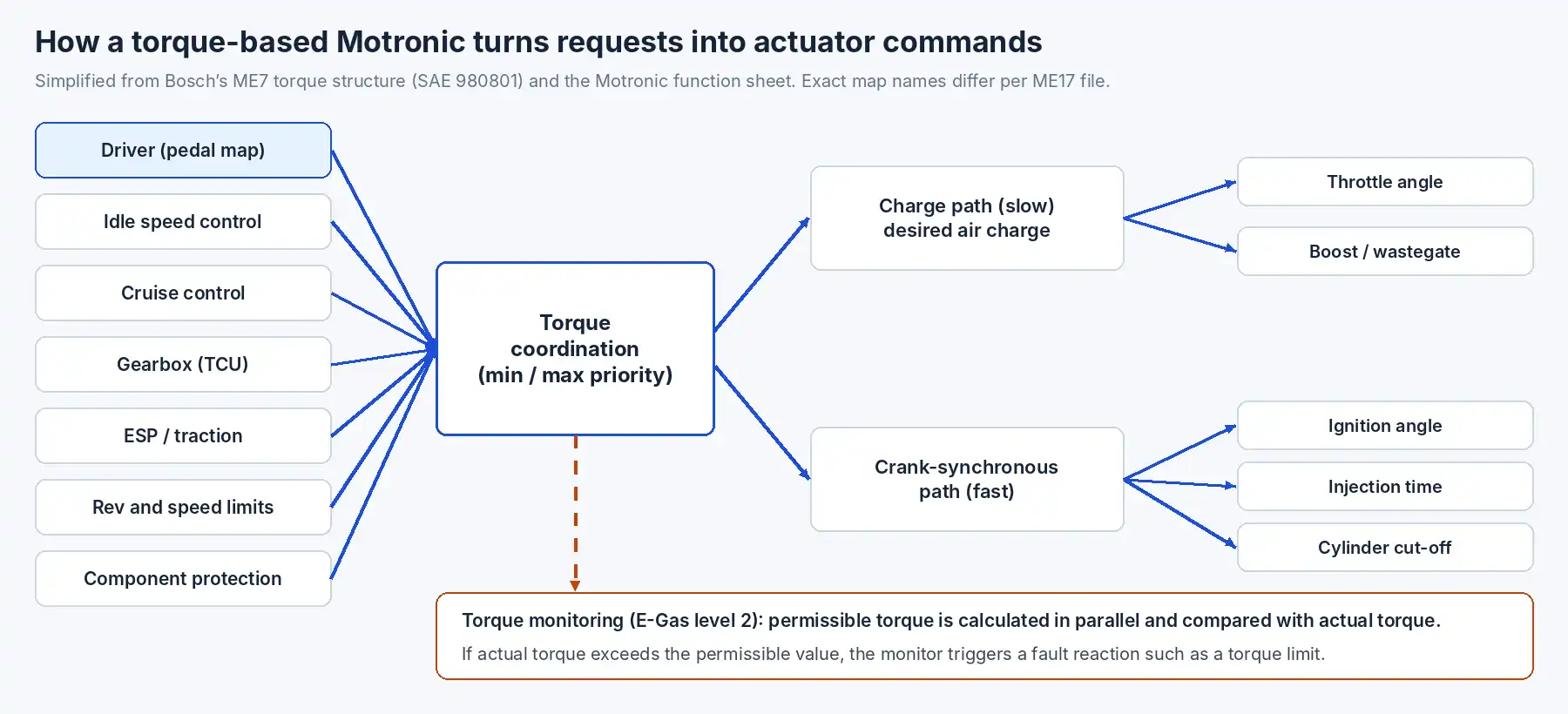
Bosch introduced this structure with ME7 and documented it in SAE paper 980801 [11]. The paper splits the work into two steps:
- Torque demand manager. Internal demands (start, idle, rev limit, engine protection, catalyst heating) and external demands (driver, cruise control, vehicle dynamics, gearbox) are prioritised by minimum and maximum selection, then filtered by driveability functions such as anti-jerk and dashpot [11].
- Torque conversion. The resulting torque is turned into the outputs that can change engine torque: throttle angle and wastegate (the slow charge path, limited by the intake manifold's time constant of up to several hundred milliseconds at low rpm), and ignition timing and injection, including cylinder cut-off (the fast, crank-synchronous path that acts within the next combustion cycle) [11].
The engine's own torque is modelled from relative cylinder charge, lambda and ignition timing, then reduced by gas-exchange and friction losses to engine torque and clutch torque [11]. In the ME7 function documentation, this coordination appears as modules such as MDFAW (driver's requested torque, with two pedal maps and an interpolation factor) and MDKOG (torque coordination for overall interventions, which forms the desired indexed torque by minimum or maximum selection) [12].
What this means when you tune an ME17. Raising one table rarely changes output, because the coordinator takes the lowest permitted value. A clean file adjusts the request, the limiters that cap it, the air charge and boost it needs, and the ignition it can tolerate, as one consistent chain. A parallel monitoring level then compares a separately calculated "permissible torque" with the actual torque; this is the core of the industry's E-Gas level-2 concept, and a mismatch triggers a fault reaction [13]. Our articles on the driver wish map, torque-based ECUs and spark advance tables explain each link of that chain.
The map names above come from ME7 documentation. ME17 files keep the same concept, but labels, axes and the number of copies differ by variant, so confirm every map against a Damos, A2L or a verified mappack for that exact file before editing.
What the torque structure looks like in a real ME17 file
Our own ME17 mappacks show the same chain in named maps (map names are CaracalTech's mappack labels, checked on 24 November 2026):
- Request: the Hyundai/Kia ME17.9.11 mappack holds a single "maximum indexed engine torque for torque normalization" value, twelve 16 x 16 torque request maps, two torque request maps that depend on coolant temperature (16 x 8) and a separate torque request for reverse gear (16 x 1).
- Limiters: the Volkswagen ME17.5.24 mappack has 24 engine torque limiters, including a 6 x 5 "torque limiter for clutch protection", and 13 gearbox protection maps.
- Monitoring: the Mercedes-Benz ME17.7.8 mappack has 128 torque monitoring maps, 84 of them named "engine torque request in monitoring" (8 x 8).
That last point explains a classic ME17 problem. If the main torque request is raised but the torque request inside the monitoring level is not, the level-2 calculation sees more actual torque than it allows and the ECU reacts, typically with a torque limit or a fault [13]. The monitoring maps must be kept consistent with the new request, never switched off.

We teach this chain step by step in the petrol ECU tuning course with WinOLS, which includes a 21-minute Bosch ME17 lesson, and in the ECM Titanium course for petrol ECUs, which includes a Bosch ME17 remap on a Polaris application.
Main ME17 versions and the cars that use them
The table lists only versions we could tie to a named source: Bosch's repair catalogue, a tool maker's release or compatibility list, or a BitBox module list. "Documented methods" are the methods Autotuner lists on its page for that ECU (checked 24 November 2026) unless another source is named; other tools may support more.
Table 4. Bosch ME17 versions, microcontrollers and documented applications.
| Version | MCU | Documented applications | Documented methods | Sources |
|---|---|---|---|---|
| ME17.0.3 | TC1724 | Ford EcoSport 2018, Fiesta 2017, Ka 2008 to 2018 (Autotuner lists 1.0 EcoBoost, 1.1, 1.2 and 1.5 Ti-VCT engines) | OBD, bench | [4][14] |
| ME17.1.6 | TC1797 | Audi 6.3 W12, Bentley 6.0 twin-turbo | OBD, bench | [4][14] |
| ME17.2.1 | TC1796 | BMW | Bench | [4][5] |
| ME17.3.0 | TC1724 | Abarth 500, 595 and 695 (1.4 T-Jet) | Boot, bench | [4][14] |
| ME17.5 / ME17.5.6 | TC1767 (17.5.6) | VW Jetta and Bora 2.5 (ME17.5); VW Jetta 2.0 85 kW (ME17.5.6) | Boot, bench (17.5.6) | [8][4] |
| ME17.5.20 / .24 / .26 | TC1767 / TC1724 / TC1724 | SEAT Mii 1.0 55 kW (17.5.20); other VAG applications | Boot and bench (17.5.20); bench (17.5.24, 17.5.26) | [8][4][5] |
| ME17.7 / ME17.7.8 | TC1796 / TC1797 | Mercedes-Benz (ME17.7 part A 272 900 24 00); Mercedes-Benz and Maybach (ME17.7.8) | OBD (17.7.8) | [8][4][17] |
| ME17.8.8 | TC1728 or TC1767 | Chery, Great Wall, Lifan (TC1728); MG and SAIC MG3 1.5 (TC1767); BAIC Senova X25, X35 and BJ20 | Boot (Flex), OBD map area (ChipLoaderNG), bench (BitBox) | [15][16][5][18] |
| ME17.8.10 | TC1728 | CFMoto motorcycles and ATVs | OBD, bench, boot (beta) | [4][5] |
| ME17.8.31 / .32 / .33 | TC1797 / TC1797 / TC1793 | Aston Martin (17.8.31); McLaren 4.0 twin-turbo (17.8.33) | Bench (17.8.31); boot, OBD and bench (17.8.32, 17.8.33) | [4][5][14] |
| ME17.9.11 / ME17.9.11.1 | TC1762 | Hyundai/Kia 1.0 to 1.6 MPI and GDI, e.g. i30 GD 1.6 MPI, Accent RB 1.6, HB20 1.0 | Boot, OBD, bench | [4][14][18] |
| ME17.9.20 | TC1782 | Renault and smart (Bosch 0261S17834) | Boot, OBD, bench | [8][4] |
| ME17.9.21 / ME17.9.21.1 | TC1724 | Hyundai/Kia 1.2 to 1.4 MPI, e.g. i20 GB 1.2 | OBD, bench | [4][14][18][19] |
| ME17.9.52 / ME17.9.53 | TC1782 | Toyota and Peugeot 1.0 69 hp | Bench | [4][14] |
| ME17.9.55 | TC1724 | Honda Brio 1.2 i-VTEC | Bench (KESS3) | [19] |
| ME17.9.61 / ME17.9.64 | TC1724 | Suzuki Vitara 1.6 2015 to 2017 (17.9.61); other Suzuki (17.9.64) | Boot, bench, OBD (beta) | [4][5][18] |
| ME17.9.7 / ME17.9.71 | TC1762 / TC1724 | Lada (AvtoVAZ engine 21126, Bosch 0261S09033); UAZ Hunter and Patriot 2.7 (0261S04050) | Bench | [8][4] |
ME17 on Chinese, Korean, Japanese and European cars
The same family looks very different by market, and that changes the job in front of you.
Table 5. ME17 by market (from Table 4).
| Market | Typical ME17 versions | MCU | What to expect |
|---|---|---|---|
| Chinese | ME17.8.8, ME17.8.8.1, ME17.U.6 | TC1728, TC1767 | Small 1.5 to 1.8-litre engines, many turbocharged; boot and password-read solutions exist from several tool makers |
| Korean | ME17.9.11, ME17.9.21, MEG17.9.x | TC1762, TC1724 | Mostly naturally aspirated MPI and GDI engines; good OBD coverage |
| Japanese | ME17.9.52/53 (Toyota), ME17.9.55/56 (Honda), ME17.9.5/6/61/64 (Suzuki) | TC1724, TC1762, TC1767, TC1782 | Small naturally aspirated engines; often bench only |
| European | ME17.0.3 (Ford), ME17.3.0 (Abarth), ME17.5.x (VAG), ME17.1.6 (Bentley, Audi W12), ME17.8.3x (Aston Martin, McLaren) | TC1724 to TC1797 | From city cars to supercars; turbocharged applications have the most headroom |
ME17.8.8 and the Chinese platforms
ME17.8.8 is the main Bosch ME17 on Chinese brands. It controls 1.5 to 1.8-litre engines in Chery, Great Wall, Lifan, MG and BAIC models, on two different microcontrollers (TC1728 and TC1767), so check the MCU before you choose a module [15][16][5]. Magicmotorsport added bootloader read, write and password read for the TC1728 units, and password read for MG's TC1767 unit, on its MAGPro2 X17 tool, and its Flex tool reads and writes the TC1728 units in boot mode [15]; ChipSoft's ChipLoaderNG module 54 reads and writes the calibration area over OBD and can extract the password from a firmware file [16]. For the maps themselves, our Bosch ME17.8.8 tuning course in WinOLS covers the six key maps of ME17.8.8 files in Chery, Changan, Haima and other Chinese cars in two videos (16 minutes).
Which microcontrollers do ME17 ECUs use?
Every documented ME17 uses an Infineon TriCore from the TC17xx family. The MCU decides the flash size, the boot procedure and which tool module applies.
Table 6. TriCore MCUs found in ME17 units.
| MCU | Full-read size in BitBox's list | ME17 examples |
|---|---|---|
| TC1724 | 1,536 KB | ME17.0.3, ME17.3.0, ME17.5.24, ME17.9.21, ME17.9.61, ME17.9.64, ME17.9.71 |
| TC1728 | 1,536 KB | ME17.8.8 (Chinese brands), ME17.8.10 |
| TC1762 | 1,504 KB | ME17.9.5, ME17.9.7, ME17.9.11 |
| TC1767 | 2,048 KB | ME17.5.6, ME17.5.20, ME17.8.8 (MG), ME17.9.6 |
| TC1782 | 2,560 KB | ME17.7.20, ME17.9.20, ME17.9.52, ME17.9.53 |
| TC1793 | 4,096 KB | ME17.8.33 |
| TC1796 | 2,048 KB | ME17.2.1, ME17.7, ME17.9.1 |
| TC1797 | 4,096 KB | ME17.1.6, ME17.7.8, ME17.8.31, ME17.8.32 |
Sizes are the module sizes BitBox lists for each ECU [5]. Infineon's data sheet for the TC1796 gives 2 MB of program flash and 128 KB of data flash used for EEPROM emulation [20], which matches what the case study's tool reads.
How to identify your ME17
Read three things before you choose a tool or order a file: the Bosch part number on the label (0 261 ...), the carmaker's part number, and the exact family name (for example ME17.9.21.1). The label alone is not always enough, because the same family can appear on two MCUs, as with ME17.8.8 [5]. Run your tool's identification first: it reports the MCU, the software version and whether the unit is supported in OBD, bench or boot. Our original ECU files database lets you search by ECU part number, software number or calibration ID.
Are ME17 ECUs locked? Read protection and TPROT
"Locked" can mean two different things on an ME17, and they need different solutions.
- Microcontroller flash protection. TriCore chips have configurable read protection for the whole program flash, write protection per sector, and a password mechanism to lift it temporarily [20]. Without the password, a boot or bench tool cannot read or rewrite protected flash. This is why tool makers publish "password read" functions: Magicmotorsport on its MAGPro2 X17 tool for ME17.8.8 (TC1728 and TC1767) and for Hyundai/Kia ME17.9.1 on the TC1796 [15], and ChipSoft's "extract password from firmware" for ME17.8.8 [16].
- Bosch tuning protection (TPROT). This is protection inside Bosch's own software. ChipSoft's documentation says passwords are kept in the firmware file only on ECUs with TPROT version 8 or higher, and that depending on the TPROT version, restoring a unit may need the password or the original firmware [21]. The same document names ME17.9.71 as an example of an ECU whose processor has no one-time-programmable (OTP) areas [21].
What Autotuner's news and pages show for ME17 (checked 24 November 2026). Autotuner's release notes cover ME17 support from 2022 onwards: bench for ME17.9.52 (12 January 2022), OBD virtual read for ME17.8.33 (9 March 2022), boot for ME17.3.0 (15 March 2022), OBD for ME17.9.21 and ME17.9.21.1 (23 March 2022), OBD and bench for ME17.1.6 (5 May 2022), OBD for ME17.9.11 and MEG17.9.12/13 (13 June 2022), OBD for ME17.0.3 (25 September 2025) and OBD plus bench for the Kefico MEG17.9.21 (5 March 2026) [14][22]. Two details matter:
- Unlock by patch. For the MEG17.9.21, Autotuner lists an OBD write time "with patch" of 45 seconds and "after patch" of 30 seconds, so the first OBD write applies a patch before later writes run normally [22].
- OBD reads only the calibration. On the ME17.0.3 and MEG17.9.21, the OBD readout is "Calibration", and backup creation is bench only on the MEG17.9.21 [14][22]. Use bench or boot when you need a full backup.
Autotuner's mail-in unlock service, which it uses for newer MG1 and MD1 units, does not appear among the available methods on any of its ME17 pages we checked [4][23]. In short, ME17 security is real but mostly solved; the risk lies in using the wrong method for the exact variant.
How to read and write an ME17: OBD, bench or boot
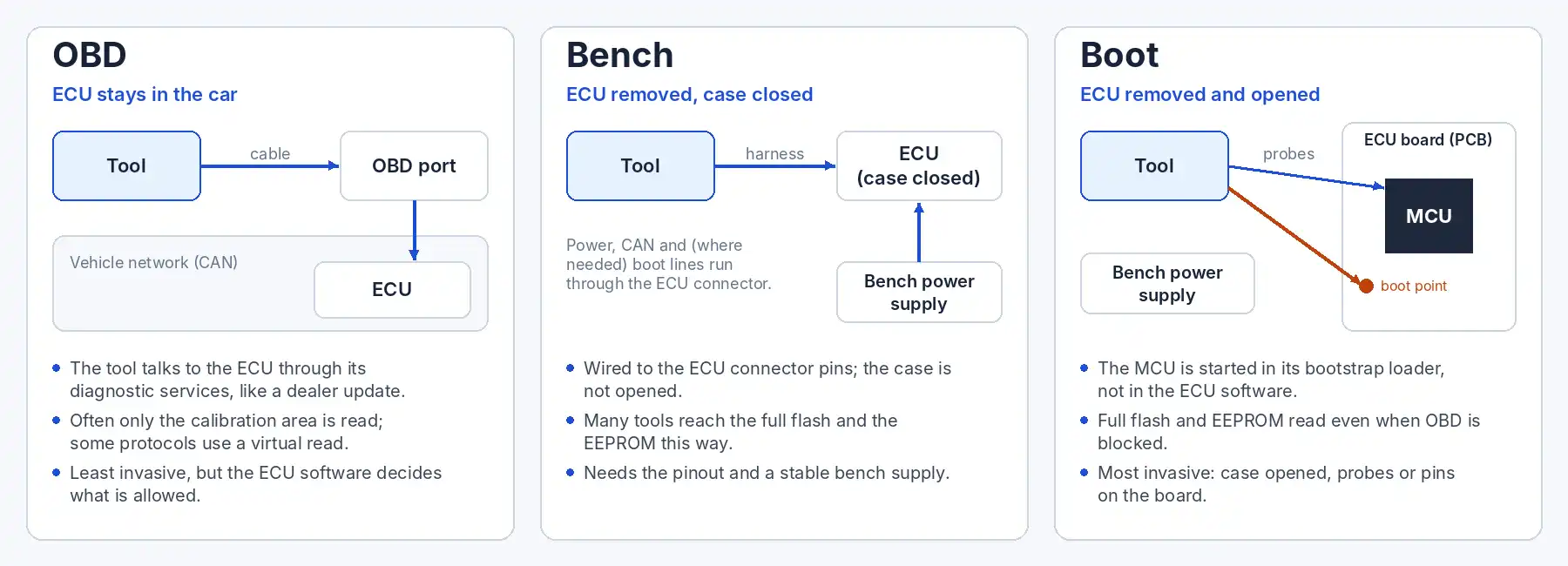
Table 7. OBD vs bench vs boot on ME17.
| Method | Access | What you usually get | When to use it on ME17 |
|---|---|---|---|
| OBD | Diagnostic port, ECU in the car | Calibration area, sometimes a virtual read | Supported variants such as ME17.0.3, ME17.9.11 and ME17.9.21, for quick Stage 1 work |
| Bench | ECU removed, case closed; connector pins | Often full flash and EEPROM, as the tool allows | Bench-only variants (ME17.2.1, ME17.5.24/26, ME17.9.52/53) and full backups |
| Boot | ECU opened; MCU started in its bootstrap loader | Full program flash and data flash (EEPROM) | Variants without OBD or bench support (ME17.3.0, ME17.8.8 on TC1728), recovery and cloning |
The definitions of bench and boot follow Autotuner's: bench "doesn't require to open the engine ECU" and connects on its outside plug, while boot "requires to open the engine ECU" and connects on the board [4]. The TC1796 data sheet shows why boot works: the chip has bootstrap loader modes over its serial (ASC0) and CAN pins, selected by hardware configuration inputs at start-up, so a tool can talk to the chip without running the ECU's own software [20]. Our ECU programmers guide and ECU cloning article cover the same methods across other ECU families.
Which programmers read Bosch ME17? Prices from lowest to highest
The table shows documented ME17 support only, and the cheapest published entry point we found for each tool. Prices are indicative, seen on 24 November 2026 on the page named, excluding VAT unless stated; they change often and vary by region and protocol package. Buy from the maker or an authorised reseller only.
Table 8. ME17-capable programmers, from lowest to highest entry price.
| Tool | Entry price seen | What else you need | Documented ME17 support | Sources |
|---|---|---|---|---|
| ChipSoft ChipLoaderNG | USD 50 base licence (ecutools.eu) | Module 54 (ME17.8.8 OBD2) bought separately; a J2534 adapter such as CHIPSOFT J2534, Tactrix OpenPort 2 or DrewTech Mongoose | ME17.8.8 over OBD: calibration area read/write, checksums, password extraction from firmware | [16][24] |
| Abrites AVDI EP001 | USD 499 (UHS Hardware) | An Abrites AVDI interface [confirm: not included] | Boot: ME17.5.22, .24, .26, ME17.8.8, ME17.9.5, ME17.9.6, ME17.9.21, ME17.9.21.1 | [25] |
| OBDSTAR DC706 (full) with P003 kit | USD 1,114.57 + USD 122.49 (UHS Hardware, reduced from USD 1,575.60 and 178.80) | Bench cables and boot accessories as supplied | The P003 kit adds "Bosch ME17XX reading and writing EEPROM, flash" | [26] |
| Magicmotorsport Flex | EUR 1,000 base + EUR 199 configuration (magicmotorsport.com) | TC17xx/TC2xx/TC3xx software, Master: EUR 1,800 + VAT (balticdiag.lt) | ME17.8.8 TC1728 boot: flash and EEPROM read/write, clone (Chery, Great Wall, Lifan); ME17.8.8 and ME17.9.21 listed for 1:1 cloning in bench and boot | [15][27] |
| Alientech KESS3 | About EUR 700 hardware (balticdiag.lt); from USD 800 in the CaracalTech tuning shop | Protocols: Master Car/LCV OBD GBP 2,690, Master Car/LCV bench-boot GBP 2,240 (Viezu) | ME17.9.55 bench (Honda Brio); ME(G)17.9.1x and ME17.9.21 OBD (Hyundai/Kia); ME17.9.21.1 and ME17.9.56 bench | [19][28] |
| AutoTuner Tool (Master) | EUR 4,900 (autotuner.com) | Cables included; Autotuner states no credits, per-flash fees or subscription | 30+ ME17 variants; methods per Table 4 | [4][29] |
Hardware-only prices for Flex and KESS3 do not include the software or protocol packages in the third column, which ME17 work needs. BitBox's MEDC17 bench module also covers most TC17xx-based ME17 units (Table 6) [5]. If you mainly work on Chinese ME17.8.8 cars, a low-cost OBD or boot module may be enough; if you handle many families, the higher-priced platforms cover more variants and methods with one tool. For a wider comparison see what KESS3 is, what Flex is and our top 10 ECU tuning tools.
Case study: boot read and write of a Bosch MED17.1 (TC1796) with an OBDSTAR tablet
This job is on an Audi A4 2.0 TFSI with a Bosch MED17.1, the direct-injection sibling of ME17. We include it because it uses the same TriCore family, the same boot principle and the same flash structure you will meet on TC17xx-based ME17 units. Everything below is read from the video frames; we did not hear the narration, and nothing is added from memory.
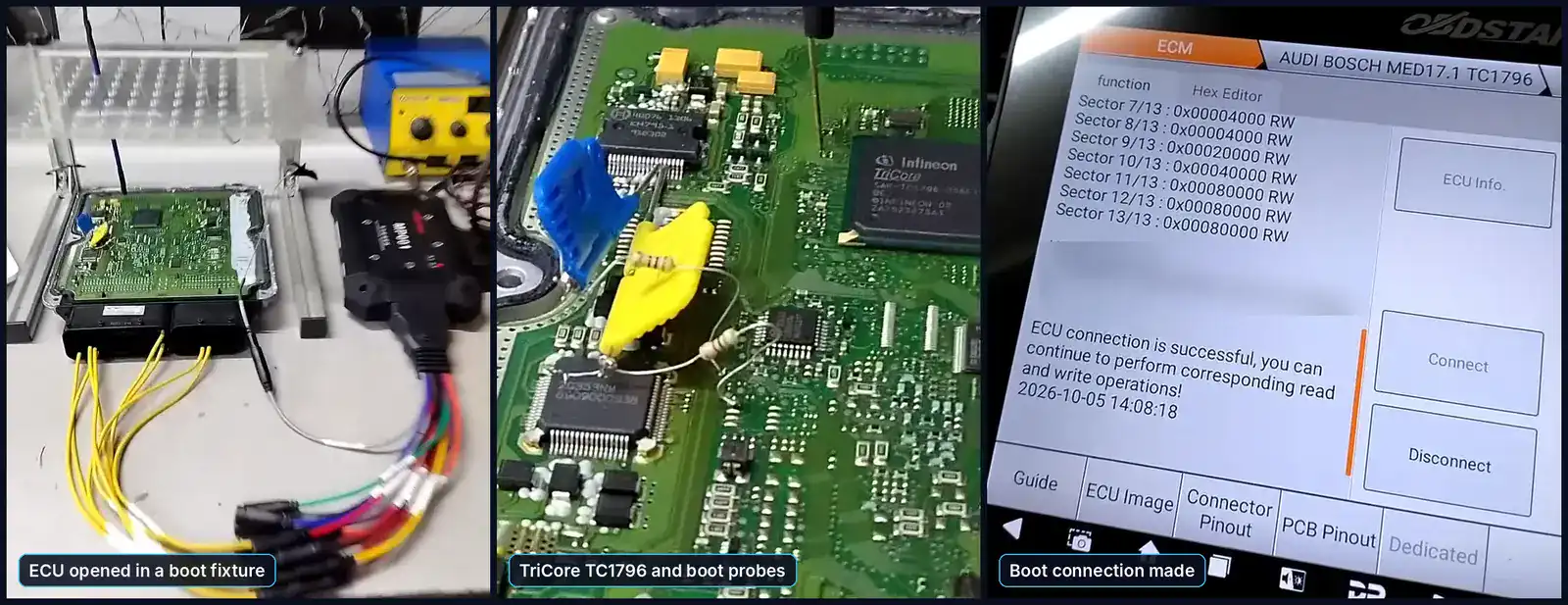
Table 9. The job frame by frame (video time, mm:ss).
| Time | What the frame shows | What it means |
|---|---|---|
| 00:00 to 00:02 | The ECU is out of the car with its lid removed, mounted under an acrylic fixture with spring probes; a harness runs from the ECU connector to the tool's adapter; a bench power supply sits next to it | Boot mode: the case must be opened, unlike bench mode |
| 00:03 to 00:05 | Close-up of the board: the Infineon TriCore marked SAK-TC1796, a spring probe on a test point next to it, and a yellow clip carrying a resistor lead on the board | The resistor and probes put the MCU into its bootstrap loader instead of the ECU software; exact pins come from the tool's wiring diagram |
| 00:08 to 00:11 | The tablet reads "AUDI BOSCH MED17.1 TC1796", lists flash sectors 7/13 to 13/13 (two of 0x4000, one of 0x20000, one of 0x40000, three of 0x80000 bytes, all marked RW), shows the MCU's unique ID, and reports "ECU connection is successful" at 2026-10-05 14:08:18 | The tool is talking directly to the TriCore; the sector map matches a 2 MB program flash |
| 00:08 to 01:04 | The bench supply display reads 14.18 to 14.19 V, with current around 1.05 to 1.12 A | A stable supply during reading and writing |
| 00:54 to 01:04 | "Reading INT EEPROM": sector 1/2 at address 0xAFE00000, then sector 2/2 at 0xAFE10000; the file is saved as a MED17.1 TC1796 EEPROM backup | Data flash (EEPROM emulation) is backed up before any write |
| 01:24 to 01:26 | The file list holds the original internal flash, the original EEPROM and a modified flash file whose name marks it as Stage 1 with checksum correction | Original read kept; the tuned file was prepared before writing |
| 01:28 to 01:42 | "Writing INT FLASH": the tool asks whether to verify the checksum, checks the data, skips sectors 1 to 4 and 7 to 9 ("data of sector in the file and in the FLASH is the same"), skips sectors 5 and 6 as "OTP sector (cannot be changed or cleared)", then erases and writes sector 10/13 at 0xA0040000 | Only the sector holding changed data is rewritten |
| 01:44 | Sectors 11 to 13 skipped as identical; "Write successfully! Done", 2026-10-05 15:21:42 | Write complete |
| 01:48 to 02:26 | The car, an Audi A4 Avant (B8 facelift body) with its number plate covered, is shown in the workshop | Back in the car after the write |
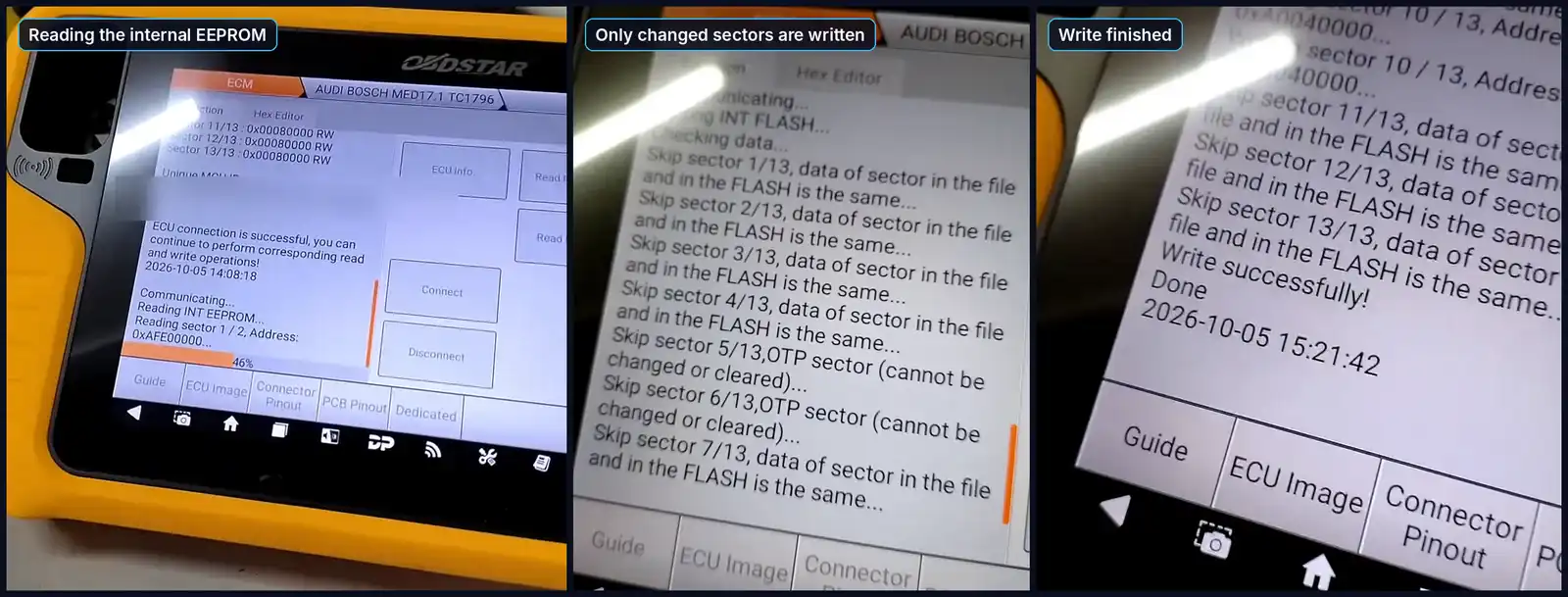
What the case study shows
- Boot gives a complete backup. Program flash and EEPROM were both read through the bootstrap loader, so the backup does not depend on what the ECU software allows over OBD.
- A differential write is gentler. Only sector 10, a 256 KB block at 0xA0040000, differed between the original and the Stage 1 file, so only that block was erased and written. On this file, all calibration changes sat inside that block; on another file the changed sector can differ.
- OTP sectors are left alone. The tool reported sectors 5 and 6 as one-time-programmable and never erased them. Writing another ECU's complete flash image into these areas is not possible, which matters when you clone or repair.
- Checksums before writing. The tool offered a checksum check before writing, and the file name shows the checksum had already been corrected. A file with wrong checksums is a common reason a freshly written ECU does not start.
- Not proof of a lock. The video does not show an OBD attempt being refused, so we do not claim this ECU was locked. It shows the boot route that works regardless of the protection in the ECU software.
What is tuned in an ME17 file
Because the software is torque-based, a sound ME17 calibration follows the chain in Image 1 rather than raising one map:
- Request side: the pedal maps (driver wish) and the torque limiters that cap the indexed torque.
- Air side: load or charge requests and limits; on turbocharged versions (for example ME17.3.0 in the Abarth 1.4 T-Jet, or ME17.8.8 on Chinese 1.5T engines) the boost targets and limits as well.
- Ignition side: spark advance within knock limits, checked with logging.
- Protection side: component protection, gearbox torque limits and the monitoring maps, which must stay consistent with the new torque and load.
The folder counts in four of our ME17 mappacks show how much of each file sits in each part of the chain, and how different the variants are.
Table 10. What is inside four CaracalTech ME17 mappacks (folder name and number of maps, checked 24 November 2026).
| Mappack | Maps / folders | Request and limits | Air and boost | Ignition and knock | Monitoring and protection |
|---|---|---|---|---|---|
| Hyundai/Kia ME17.9.11 | 147 / 19 | Engine torque request (15), engine torque limiters (1), throttle control (13) | Maximum air charge (14), variable intake camshaft (18), variable exhaust camshaft (16) | Ignition advance timing (5), corrections (5), knock control (9) | Torque monitoring (6), maximum RPM limiters (5) |
| Volkswagen ME17.5.24 (also SEAT and Skoda) | 199 / 16 | Engine torque request (13), engine torque limiters (24), throttle control (4) | Maximum air charge (6), variable intake camshaft (6) | Ignition advance timing (9), corrections (4), knock control (10) | Torque monitoring (19), gearbox protection (13), maximum RPM limiters (39) |
| Mercedes-Benz ME17.7.8 (also Maybach) | 758 / 21 | Engine torque request (10), engine torque limiters (62), throttle control (6) | Maximum air charge (42), boost pressure calculation (40), wastegate control (16), wastegate PID regulator (8) | Ignition advance timing (20), corrections (16), knock control (38) | Torque monitoring (128), maximum RPM limiters (94), gearbox protection (2) |
| Bentley ME17.1.6 | 648 / 22 | Engine torque request (42), engine torque limiters (44), throttle control (8) | Maximum air charge (12), boost pressure calculation (50) | Ignition advance timing (38), corrections (10), knock control (40) | Maximum RPM limiters (92), gearbox protection (26) |
Two patterns stand out. The naturally aspirated Hyundai/Kia file spends most of its maps on air and camshaft control, because there is no boost to raise; the gains come from the torque request, air charge and cam timing working together. The twin-turbo Mercedes-Benz and Bentley files carry large boost and knock sections and far more limiter and monitoring maps, which is where most of the calibration time goes on those engines.
Many ME17 units run small naturally aspirated engines, such as the Hyundai/Kia MPI engines, the Toyota and Peugeot 1.0 and the Suzuki 1.6. On those, a remap mainly sharpens throttle response and moves torque within what the engine can breathe; the larger gains are on the turbocharged applications. Results depend on the engine, fuel and condition, and every change should be confirmed by logging or on a dyno. See what stage tuning includes for how far each stage goes.
ME17 solutions in our catalogue
Four of our solution pages list ME17 versions by name (checked 24 November 2026). Pops and bangs covers the most ME17 versions by a wide margin.
Table 11. CaracalTech solutions that list Bosch ME17 versions.
| Solution | What it changes | ME17 versions listed | Brands named on the page |
|---|---|---|---|
| Pops and bangs | Overrun crackle from the exhaust | 24 ME17-family entries, including ME17.3.0, ME17.5.x, ME17.7 and ME17.7.8, ME17.8.8, ME17.8.31 to ME17.8.33, ME17.9.11, ME17.9.21, ME17.9.55, ME17.9.64 and Kefico MEG17.9.21 | 23 brands, from Volkswagen, Audi, Mercedes-Benz and McLaren to Hyundai, Kia, Honda, Suzuki, Geely and Lifan |
| Soft rev limiter | The lower rev limit applied in neutral and park | ME17.3.0, ME17.5.6, ME17.5.22, ME17.5.24, ME17.5.26, ME17.8.8, ME17.8.33, ME17.8.35, ME17.9.56, ME17.9.64 | Volkswagen, Audi, SEAT, Skoda, Fiat, Jeep, BAIC, McLaren, Honda, Suzuki, Hengtian |
| Exhaust flap | Holds the exhaust valve open | ME17.2, ME17.2.42, ME17.5.24, ME17.5.26, ME17.8.31, ME17.9.21, ME17.9.23 | Volkswagen, Audi, SEAT, Skoda, Aston Martin, BMW Motorrad, Renault and others |
| Start-stop | Automatic engine stop and start | ME17.5.26, ME17.9.11, ME17.9.20 | Volkswagen, Audi, SEAT, Skoda, Kia, Renault, smart |
Pops and bangs and an open exhaust flap make the car louder, and pops and bangs also put extra heat into the exhaust, the catalytic converter and the turbocharger. For off-road and motorsport use only. Each page lists the exact ECUs it supports, so check your variant there before ordering.
ME17 original files in our database
Our original files catalogue (updated 12 November 2026) holds 3,016 ME17-family files across 64 variant names. The largest groups show where ME17 work actually happens:
Table 12. The ten largest ME17 groups in CaracalTech's original files.
| ME17 variant | Original files | Typical application |
|---|---|---|
| ME17.9.11 | 483 | Hyundai/Kia, mostly 1.6 MPI |
| ME17.2.42 BMS-O | 348 | BMW Motorrad |
| ME17.2.4 BMS-MP | 307 | BMW Motorrad |
| ME17.9.21 | 267 | Hyundai/Kia 1.2 to 1.4 MPI |
| ME17.9.74 | 246 | Polaris powersports [5] |
| ME17.3.0 | 185 | Fiat, Abarth, Alfa Romeo and Jeep 1.4 T-Jet |
| ME17.2 BMSX | 182 | BMW Motorrad |
| ME17.5.6 | 127 | Volkswagen group |
| ME17.9.64 | 109 | Suzuki |
| ME17.8.8 and ME17.8.8.1 | 105 | Chinese brands |
Motorcycles and powersports make up a large share, so ME17 is as much a bike and ATV family as a car family. You can search the original files database by ECU part number, software number or calibration ID.
Learn ME17 calibration in WinOLS or ECM Titanium
CaracalTech teaches ME17 in both editors, so you can learn on the software you already use. WinOLS suits tuners who find and name maps themselves or work from a Damos or mappack; ECM Titanium works from drivers that already identify the main maps.
Table 13. CaracalTech courses with ME17 content.
| Course | Editor | Length | ME17 and related content |
|---|---|---|---|
| Bosch ME17.8.8 ECU tuning course (Chinese cars) | WinOLS | 2 videos, 16 min | The six key maps of ME17.8.8 in Chery, Changan, Haima and other Chinese cars |
| Petrol ECU tuning course with WinOLS | WinOLS | 39 videos, 12 h 24 min | A 21-minute Bosch ME17 lesson, plus Bosch ME7, ME9, MED17 and BMW MEVD17 lessons |
| ECM Titanium training course: petrol ECU remapping | ECM Titanium | 31 videos, about 10 h 46 min | A Bosch ME17 remap on a Polaris application, a MINI Cooper Bosch MEVD17 lesson and a three-part Mercedes-AMG C43 MED17.7.3 example |
The ME17.8.8 course is the quickest start for Chinese cars; the two full petrol courses place ME17 next to the other Bosch generations, which is where the torque structure in this guide makes the most sense.
Bosch ME17 FAQ
What is a Bosch ME17 ECU?
It is a Bosch Motronic petrol engine ECU with electronic throttle control from generation 17, built on an Infineon TriCore TC17xx microcontroller. The full name, such as ME17.9.21.1, identifies the exact type and decides the tool and read method.
What is the difference between ME17 and MED17?
The "D" in MED17 stands for direct injection [1]. ME17 units mostly run port-injection engines, while MED17 runs direct-injection engines with high-pressure fuel control. Both share the generation-17 platform and TriCore microcontrollers.
Which cars use the Bosch ME17.8.8?
Documented applications include Chery, Great Wall, Lifan, MG/SAIC (MG3 1.5) and BAIC (Senova X25, X35, BJ20) models, on TC1728 or TC1767 microcontrollers [15][5][18]. Check the MCU with your tool before choosing a module.
Can a Bosch ME17 be read through OBD?
Some can. Autotuner lists OBD for versions such as ME17.0.3, ME17.1.6, ME17.9.11 and ME17.9.21, while others such as ME17.3.0, ME17.5.24 and ME17.9.52 are bench or boot only [4]. OBD often reads only the calibration, so use bench or boot for a full backup.
Is the ME17 a torque-based ECU?
Yes. Every request on the engine is expressed as a torque, coordinated by priority, and turned into throttle, boost, ignition and injection commands [10][11]. That is why changes must be made along the whole torque chain.
What to do next
Whether you have an ME17 read on your laptop or are planning your first one, there are three routes:
1. Get an ME17 file built from your read
For tuners and workshops: send the original read and the car details, and our engineers build the file and correct the checksum.
Send my ME17 read →
2. Learn to calibrate ME17 yourself
For tuners who want to do the work: the Bosch ME17.8.8 course, the petrol course with WinOLS or the ECM Titanium petrol course.
3. Get the mappack for your ME17
For tuners who edit their own files: 23 ME17 WinOLS mappacks with every map named for the exact variant, from 126 maps (Mercedes-Benz ME17.7) to 758 maps (ME17.7.8).
How this guide was checked. Every version, microcontroller, method and price is tied to the numbered source next to it and was checked on 24 November 2026. CaracalTech's own figures (original files, mappacks, solutions and courses) come from our live catalogue pages on the same day [17][30][31]. Where sources disagree, as with the meaning of "G" in MEG17, both readings are given, and engineering explanations that go beyond a source are written as explanations, not as Bosch specifications.
Sources
- Autotuner, "Bosch ECU references: how to understand the logic ECU manufacturers use", 3 October 2023: https://www.autotuner.com/blogs/news/bosch-ecu-references
- Actronics, "Bosch ECU: these are the differences between the ME and EDC variations": https://www.actronics.co.uk/news/bosch-ecu-these-are-the-differences-between-the-me-and-edc-variations
- Autotuner, compatibility list PDF (export dated 28 October 2026): https://www.autotuner.com/cdn/shop/files/compatibility-list.pdf
- Autotuner ECU pages, "Available methods" for each ME17 version (checked 24 November 2026), e.g. https://www.autotuner.com/pages/ecu/bosch-me1730-tc1724 and https://www.autotuner.com/pages/ecu/bosch-me179211-tc1724
- BitBox, "Module Bosch MEDC17 BENCH [SM2/SM3 only]" (FID 407), supported ECU and MCU list (page in Russian): https://bitbox.ru/catalog/81
- Abrites ECU compatibility list, MINI entries (MEV17.2, MEV17.2.2, MEVD17.2.2, MEVD17.2.3): https://abrites.com/ecu_tables/index?page=1695 and https://abrites.com/ecu_tables/index?page=1715
- BitBox vehicle list (BMW N13 and N55 with Bosch MEVD17.2.x): https://archive.org/download/bitbox/bitbox.pdf
- Bosch Electronic Service repair catalogue, searchable by Bosch part number (https://www.bosch-repair-service.com/en/): ME17.5 0261S04613, ME17.5.20 0261S07502, ME17.5.6 0261S06509, ME17.7 0261S05964, ME17.9.7 0261S09033 and 0261S04050, ME17.9.20 0261S17834
- C. Hammel, H. Jessen, B. Boss, A. Traub, C. Tischer and H. Hönninger (Robert Bosch GmbH), "A Common Software Architecture for Diesel and Gasoline Engine Control Systems of the New Generation EDC/ME(D)17", SAE technical paper 2003-01-1048: https://saemobilus.sae.org/papers/a-common-software-architecture-diesel-gasoline-engine-control-systems-new-generation-edc-d-17-2003-01-1048
- Bosch Mobility, "Electronic engine control unit": https://www.bosch-mobility.com/en/solutions/control-units/engine-control-unit/
- J. Gerhardt, H. Hönninger and H. Bischof (Robert Bosch GmbH), "A New Approach to Functional and Software Structure for Engine Management Systems: Bosch ME7", SAE technical paper 980801, 1998
- Bosch ME7 Funktionsrahmen (translated), modules MDFAW 12.260 and MDKOG 14.70
- EGAS Workgroup (Audi, BMW, Daimler, Porsche, VW), "Standardized E-GAS Monitoring Concept for Gasoline and Diesel Engine Control Units", version 6.0, 13 July 2015, section 10.1.3
- Autotuner news releases: ME17.9.52 (https://www.autotuner.com/blogs/news/bosch-me17-9-52), ME17.8.33 (https://www.autotuner.com/blogs/news/bosch-me17-8-33), ME17.3.0 (https://www.autotuner.com/blogs/news/bosch-me17-3-0), ME17.9.21/21.1 (https://www.autotuner.com/blogs/news/bosch-me17-9-21-me17-9-21-1), ME17.1.6 (https://www.autotuner.com/blogs/news/bosch-me17-1-6), ME17.9.11-MEG17.9.12/13 (https://www.autotuner.com/blogs/news/bosch-me17-9-11-meg17-9-12-13), ME17.0.3 (https://www.autotuner.com/blogs/news/bosch-me17-0-3)
- Magicmotorsport: MAGPro2 X17 ver. 12.01.00 release note with ME17.8.8 and ME17.9.1 password read (copy on its Russian distributor's site): https://magpro2.ru/novosti/magpro2-x17-ver-12-01-00-released-new-services-accessories-available/; Flex 3.8.0.0 release, 22 July 2019 (via authorised reseller Tuning-Shop): https://tuning-shop.com/about-us/news/magic-motorsport-tool-update-flex-3800/; "Flex duplicable ECUs and TCUs": https://www.magicmotorsport.com/en/flex-duplicable-ecus-tcus/
- ChipSoft, ChipLoaderNG "Module [54] Bosch ME17.8.8 - OBD2", document version 19 March 2021: https://chipsoft.com.ua/download/docs/EN_Module_%5B54%5D_Bosch_ME1788_-_OBD2.pdf
- CaracalTech WinOLS mappacks catalogue (23 ME17 mappacks, including Hyundai/Kia ME17.9.11, Volkswagen group ME17.5.x, Mercedes-Benz and Maybach ME17.7 and ME17.7.8, Bentley ME17.1.1 and ME17.1.6), checked 24 November 2026: https://caracaltech.com/mappacks
- Abrites ECU compatibility list: Hyundai ME17.9.11 and ME17.9.21 (https://abrites.com/ecu_tables/index?page=992, https://abrites.com/ecu_tables/index?page=938), Suzuki ME17.9.61 (https://abrites.com/ecu_tables/index?page=2204), SAIC MG3 ME17.8.8 (https://abrites.com/ecu_tables/index?page=1956)
- Alientech news via authorised reseller Tuning-Shop: Upgrade 1.16 (ME17.9.55, 10 August 2022), Upgrade 1.49 (Hyundai/Kia ME(G)17.9.1x, ME17.9.21), Upgrade 1.88 (29 February 2024): https://tuning-shop.com/about-us/news/alientech-news-update-upgrade-116/, https://tuning-shop.com/about-us/news/alientech-news-update-upgrade-149/ and https://tuning-shop.com/about-us/news/alientech-news-update-upgrade-188/
- Infineon Technologies, TC1796 32-bit single-chip microcontroller data sheet, V1.0, April 2008 (copy hosted by Mouser): https://www.mouser.com/datasheet/2/196/Infineon_SAK_TC1796_256F150E_BE_DS_v01_00_EN-1732136.pdf
- ChipSoft, ChipLoaderNG "Module [51] Bosch MEDC17 - Bench", document version 19 June 2020: https://chipsoft.com.ua/download/docs/EN_Module_%5B51%5D_Bosch_MEDC17_-_Bench.pdf
- Autotuner, "Kefico MEG17.9.21", 5 March 2026: https://www.autotuner.com/blogs/news/kefico-meg17-9-21
- Autotuner, "Mail-in Unlock": https://www.autotuner.com/pages/mail-in-unlock
- ecutools.eu, ChipLoaderNG product page: https://ecutools.eu/chip-tuning/chiploaderNG/
- UHS Hardware, Abrites AVDI EP001 product page: https://www.uhs-hardware.com/products/abrites-avdi-ep001-bosch-edc17-med17-delphi-continental-simxx-others-by-boot-mode
- UHS Hardware, OBDSTAR DC706 full version and P003 kit product pages: https://www.uhs-hardware.com/products/obdstar-dc706-ecu-tool-full-version-for-car-motorcycle-ecm-tcm-body-clone-by-obd-or-bench and https://www.uhs-hardware.com/products/obdstar-p003-kit-for-dc706-immo-series-tablet-supports-reading-writing-and-calculating-data
- Magicmotorsport, Flex configuration and price: https://www.magicmotorsport.com/en/flex-gsap/; Balticdiag (formerly bds.lt), Flex configurator: https://balticdiag.lt/en/automotive-configurator-magicmotorsport-flex
- Balticdiag (formerly bds.lt), KESS3 configurator: https://balticdiag.lt/en/vehicle-configurator-kess3-master-alientech; Viezu, "Alientech KESS 3 price": https://viezu.com/blog/alientech-kess-3-price-best-place-to-buy/
- Autotuner, "AutoTuner Tool": https://www.autotuner.com/products/autotuner-tool; AutoTuner US, Ford coverage news (no credits, per-flash fees or subscription): https://us.autotuner.com/blogs/news/ford-coverages-expands-ranger-super-duty-3-0l-v6-diesel-now-supported-bosch-md1cp062
- CaracalTech solution pages listing ME17 versions, checked 24 November 2026: https://caracaltech.com/solutions/pops-and-bangs, https://caracaltech.com/solutions/soft-rev-limiter-off, https://caracaltech.com/solutions/exhaust-flap-off and https://caracaltech.com/solutions/start-stop-off
- CaracalTech course pages: Bosch ME17.8.8 course (https://caracaltech.com/course/61a1d8e47e3fbb2039015eb8), petrol course with WinOLS (https://caracaltech.com/course/6274b1e21a2cf1b57fb7e89f), ECM Titanium petrol course (https://caracaltech.com/course/62701e02c58ea935be683956), checked 24 November 2026
By Sina, Senior technical specialist, CaracalTech
Last updated: November 2026
Keywords: bosch me17, me17 ecu, me17.8.8, me17.9.21, me17 vs med17, tricore, obd bench boot, torque based ecu
Enjoyed the content? Add us as a preferred source to see more of it in Search.