
Mercedes SL500 V8 Remap and ECU Tuning

Mercedes SL500 V8 Remap and ECU Tuning
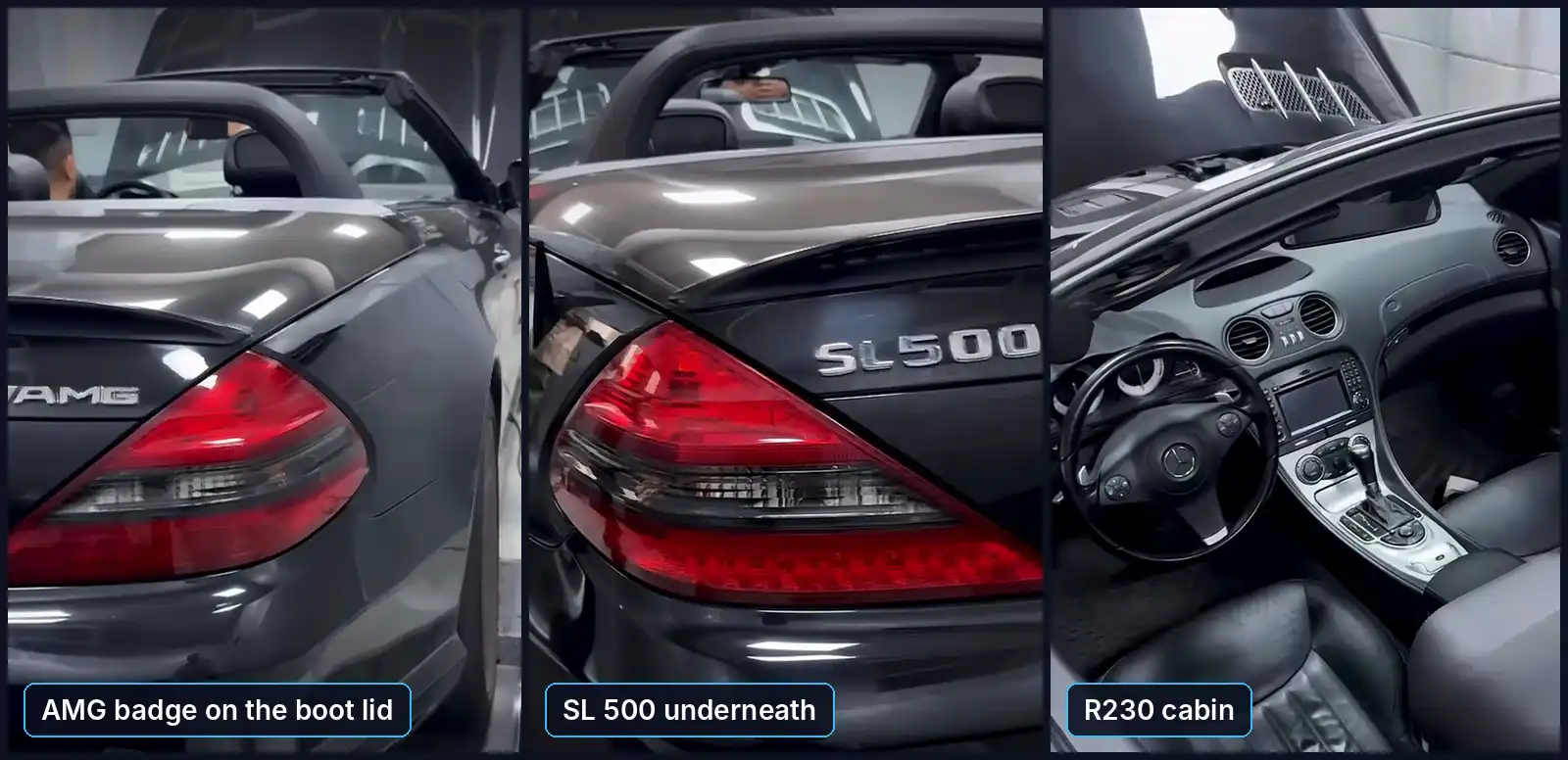
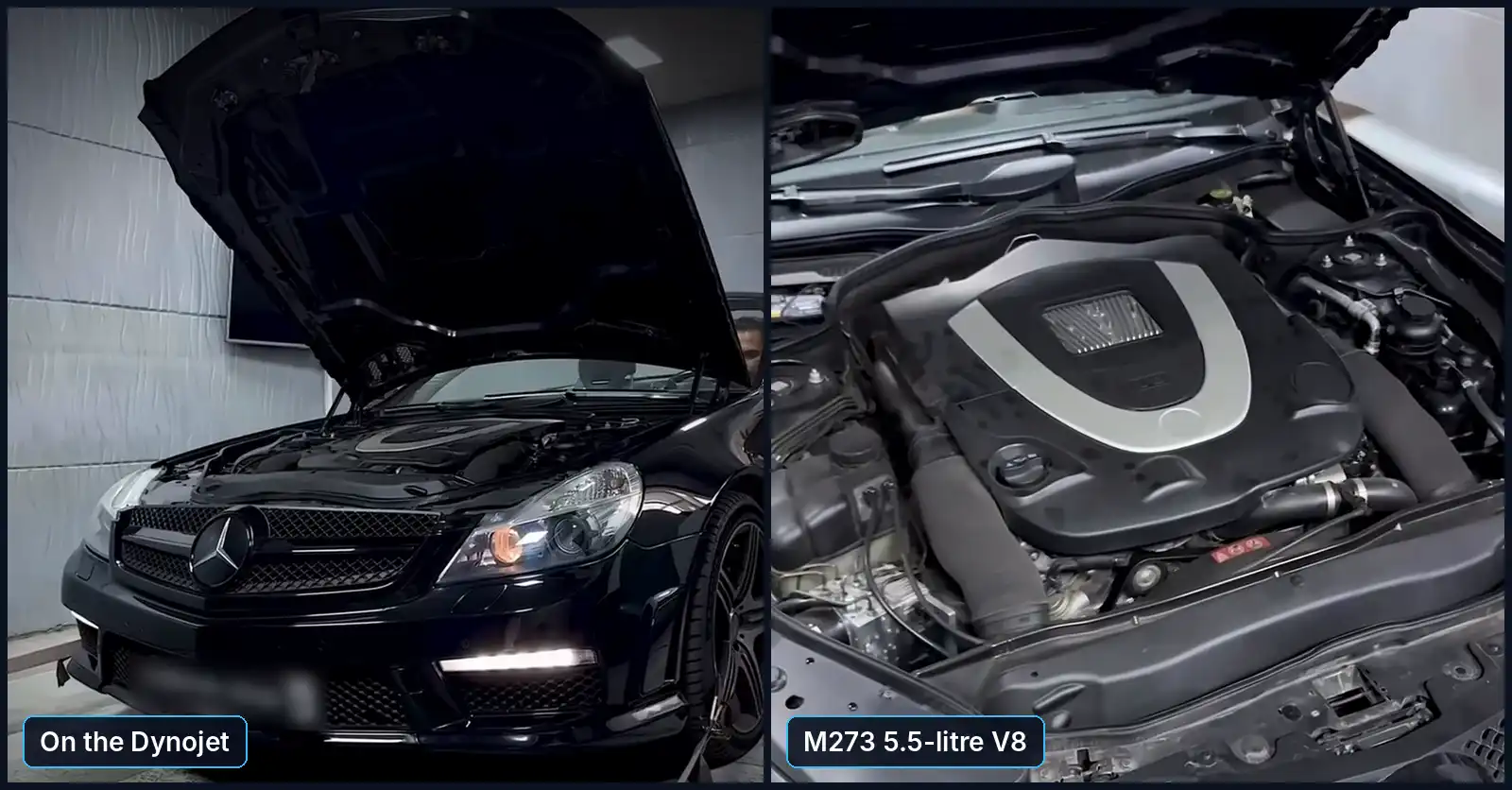
A black Mercedes-Benz SL 500 roadster (R230) came in with an AMG badge on one side of the boot lid and an SL 500 badge on the other. Under the bonnet is the M273 5.5-litre naturally aspirated V8, and the car had spent years running on fuel of lower quality than the Super (RON 95) it was rated on. The owner did not want a headline number. He wanted the safest calibration that fuel allows. We measured the car stock on our Dynojet, read and wrote its Bosch ME9.7 engine ECU with an Alientech KESS3 Master, and after the calibration it went from 296.65 to 310.53 PS and from 446.07 to 457.13 Nm, all measured at the wheels.
Short answer: on the same Dynojet, the same day and the same fuel, this M273 SL 500 gained +13.88 PS (+4.7%) and +11.06 Nm (+2.5%) at the wheels from an ECU calibration alone, with no hardware changes. On a naturally aspirated V8 tuned for lower-quality fuel, a modest gain is the expected result.
Fast View
- Car: Mercedes-Benz SL 500 (R230) roadster, 7G-TRONIC automatic, rear-wheel drive. AMG and SL 500 badges on the boot lid; the engine is the SL 500's V8.
- Engine: M273 KE55, 5,461 cc 90° V8, port injection, naturally aspirated, rated 285 kW / 388 PS and 530 Nm at the crank.
- Stock baseline (RunFile_0) on the Dynojet: 296.65 PS at 5,330 rpm and 446.07 Nm at 2,980 rpm, at the wheels.
- After the calibration (RunFile_7): 310.53 PS at 5,330 rpm and 457.13 Nm at 3,010 rpm, a gain of +13.88 PS (+4.7%) and +11.06 Nm (+2.5%).
- Test conditions on the live WinPEP 8 screen: 86.33 kPa barometric pressure, 40 °C and a correction factor of 1.24. All figures are corrected values.
- Engine ECU: Bosch ME9.7, read and written with an Alientech KESS3 Master. Alientech's own list includes this exact car with an OBD protocol and a BDM route.
Part 1: An AMG badge on an SL 500
The boot lid carries two badges: AMG on the left, SL500 on the right. The engine settles it: it is the 8-cylinder M273, and the AMG SL models of this generation used different engines. This is an SL 500 wearing AMG badging. As on our S350 W221 project, which wore S 500 badges over a V6, the first step is to identify the engine and the ECU from the car itself. A calibration has to match the hardware and software that are actually fitted, not the badges.
The M273 belongs to the same Mercedes-Benz engine generation as the M272 V6: a 90° aluminium block, four overhead camshafts, four valves per cylinder and continuously adjustable intake and exhaust camshafts. Fuel is delivered by sequential port injection, and a two-stage variable-length intake manifold helps fill the cylinders across the rev range. There is no turbo, so a remap cannot add boost. Every gain has to come from ignition timing, fuelling, the torque model and the limits around them, which is why naturally aspirated engines gain far less than turbo engines.
The model year was not recorded. That does not change the engine data: the SL 500 used the M273 5.5-litre V8 from the 2006 update of the R230, and the facelifted SL 500 sold from April 2008 kept the same 285 kW / 388 PS and 530 Nm rating. Either way, the car is at least 15 years old.
The car at a glance:
| Specification | Value |
|---|---|
| Vehicle | Mercedes-Benz SL 500 roadster (R230), rear-wheel drive |
| Engine | Mercedes-Benz M273 KE55 (engine code 273.965 in the facelifted SL 500) |
| Layout | 90° V8, aluminium block and heads, DOHC per bank, 32 valves |
| Displacement | 5,461 cc |
| Bore × stroke | 98.0 × 90.5 mm |
| Compression ratio | 10.7 : 1 |
| Fuel system | Sequential multi-point port injection |
| Aspiration | Naturally aspirated, two-stage variable-length intake manifold |
| Valve timing | Continuously variable on intake and exhaust camshafts |
| Rated power (factory, at the crank) | 285 kW / 388 PS @ 6,000 rpm |
| Rated torque (factory, at the crank) | 530 Nm @ 2,800 to 4,800 rpm |
| Transmission | 7G-TRONIC 7-speed torque-converter automatic |
| Suspension | Active Body Control (ABC), standard on the SL 500 |
| Factory performance | 0 to 100 km/h in 5.4 s, 250 km/h (limited) |
| Kerb weight (EU) | 1,910 kg |
| Fuel (factory) | Super, RON 95 |
| Engine ECU | Bosch ME9.7, MPC5xx-family microcontroller |
| Read / write | Alientech KESS3 Master |
| Dyno | Dynojet chassis dynamometer, WinPEP 8, corrected figures |
Factory figures are Mercedes-Benz data as published in the sources below. ECU, tool and dyno details are from this job.
Part 2: Years of lower-quality fuel, and what knock control does about it
The SL 500 is specified for Super (RON 95) petrol. This car has run for years on lower-quality local fuel. The engine copes because the Bosch ME9.7 watches for knock: when the knock sensors detect it, the ECU retards ignition on the affected cylinder and adapts its timing over time to the fuel it sees. The cost is power. An engine that is constantly pulling timing back runs hotter and makes less torque than its calibration intended.
The factory file is very precise for the fuel it was designed for. It was never built for the fuel this car actually runs. That set the brief for the job: the most power the engine can make while staying inside a safe knock margin on that fuel, not the biggest number on the screen. Our article on ECU remapping for low-octane fuel explains how a file is adapted to the fuel a car really uses.
Part 3: The baseline pull, and why the dyno shows 297 PS on a 388 PS car
Before touching the ECU, we made the baseline pull. The stock run, RunFile_0, the red traces in WinPEP 8, peaked at 296.65 PS at 5,330 rpm and 446.07 Nm at 2,980 rpm. If WinPEP overlays are new to you, our guide on how to read a dyno graph explains the traces and the legend.
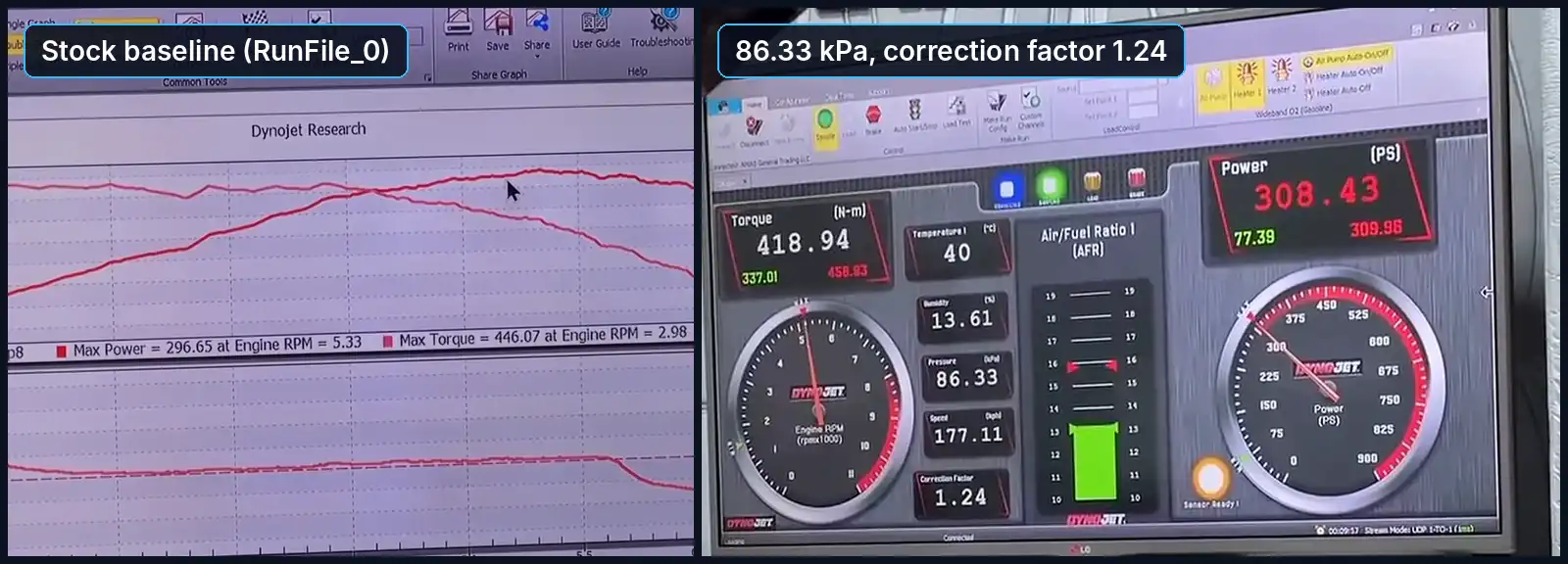
That is about 76% of the factory rating of 388 PS. Three things sit between the crank rating and this number.
Driveline losses. Mercedes-Benz rates the engine at the crankshaft. A chassis dyno measures at the rear wheels, after the torque converter, the 7G-TRONIC gearbox, the propshaft, the differential and the driveshafts. Dynojet also calculates torque from wheel power and engine speed, so its Nm figure includes those losses and cannot be compared directly with the 530 Nm rating. Our W221 S 350 with the same 7G-TRONIC and the same ECU family reached about 75% of its rating at the wheels, so this SL 500 sits where we would expect.
Air density. The live screen showed a barometric pressure of 86.33 kPa, roughly what the standard atmosphere gives at about 1,300 m elevation, and 40 °C. Thin, hot air means less oxygen per intake stroke, and a naturally aspirated engine has no turbo to make up for it. WinPEP 8 corrects every run to standard conditions, and here the correction factor was 1.24: the displayed figure is 24% above what the rollers measured. On that live frame, 308.43 PS corrected corresponds to about 249 PS as measured. The correction standard selected in WinPEP 8 is not visible in the footage, so we compare runs with each other, not with figures from other dynos.
Age and fuel history. The engine is at least 15 years old and has spent years on fuel it was not calibrated for. Without a compression or leak-down test we cannot put a number on its condition, so we do not.
How to read these numbers
Same car, same day, same fuel: Both runs were made on the same Dynojet in the same session, so the change between them is the meaningful figure.
Units: WinPEP 8 was set to metric horsepower (PS) for power and newton metres for torque. 1 PS is about 0.986 hp.
Correction: Both runs are corrected figures. At 86.33 kPa and 40 °C the factor was 1.24.
Dynojet torque: Torque is calculated from wheel power and engine speed, so it is a wheel figure, not a crank figure.
Part 4: The Bosch ME9.7 and the KESS3 Master read
The M273 is managed by a Bosch ME9.7 engine ECU, the same family that controls the M272 V6 and the M156 AMG V8 of this period. It uses a microcontroller from the MPC5xx family; Autotuner's list gives it as an MPC563.
We read and wrote the ECU with an Alientech KESS3 Master. The Master version matters for calibration work: it reads the original software as an open, unencrypted file that can be edited in-house, while a Slave tool reads encrypted files that only its paired Master can open. Our article What is KESS3? covers the tool, its OBD, Bench and Boot modes, and the Master and Slave versions.
Alientech's own vehicle list (K-Suite 2.32) has a row for this exact car: SL 500 R230, M273KE55, 285 kW, Bosch ME9.7. It gives an OBD protocol and, as an alternative, a BDM connection on the MPC5xx with the ECU on the bench. A 2024 workshop report on KESS3 describes an ME9.7 that could not be read over OBD and was read and written over BDM instead, with a slow write. The first job after any read is to archive the original file.
| Item | Detail |
|---|---|
| ECU | Bosch ME9.7 (engine) |
| Microcontroller | MPC5xx family; MPC563 per Autotuner |
| Engine applications | Mercedes-Benz M272 V6, M273 V8 and M156 V8 petrol engines |
| Tool used on this car | Alientech KESS3 Master (open, unencrypted files) |
| Alientech list entry | SL 500 R230, M273KE55, 285 kW, Bosch ME9.7: KESSv2 OBD protocol 312, K-TAG BDM (MPC5xx) protocol 102 |
| Other tools that list this ECU | PCMflash module 69 (M156/M272/M273, ME9.7: read, write, checksum); Autotuner (OBD read and write) |
| Gearbox controller | Separate 7G-TRONIC TCU; Autotuner lists the VGS-NAG2 family for OBD read and write |
Confirm the ECU hardware and software number on the car before reading, and choose the connection method from that, not from the model name. For a wider view of the hardware, see our comparison of the best ECU tuning tools and programmers.
Part 5: What the calibration works on
The ME9.7 is a torque-based ECU: the accelerator pedal becomes a torque request, and the ECU turns that request into throttle opening, ignition timing and fuel. Our article on the torque-based ECU structure explains this chain, and the first step in it is the driver wish map.
Ignition timing: On a naturally aspirated engine, timing is where most of the gain is found, and fuel quality sets the limit. Timing can only be added where the engine still has knock margin on the fuel it runs, and knock control stays fully active. Our guide to spark advance and timing maps covers how timing is read and logged.
Fuelling: The full-load mixture has to protect the engine at full throttle on this fuel, in hot conditions like the 40 °C on the dyno day. The basics of petrol calibration are covered in our petrol tuning fundamentals.
Torque model and limits: The ECU's torque model and limits have to agree with what the engine now makes, or the ECU trims the extra torque back. On a car with a torque-converter automatic, the torque the gearbox is told it receives also matters.
The calibrated file was written back with the KESS3 Master, and the car went back on the rollers. To build files like this yourself, start with the CaracalTech ECU Remapping Course.
Part 6: Back on the Dynojet
The tuned run, RunFile_7, is the blue trace. It peaked at 310.53 PS at 5,330 rpm and 457.13 Nm at 3,010 rpm. Against the stock run that is +13.88 PS and +11.06 Nm.
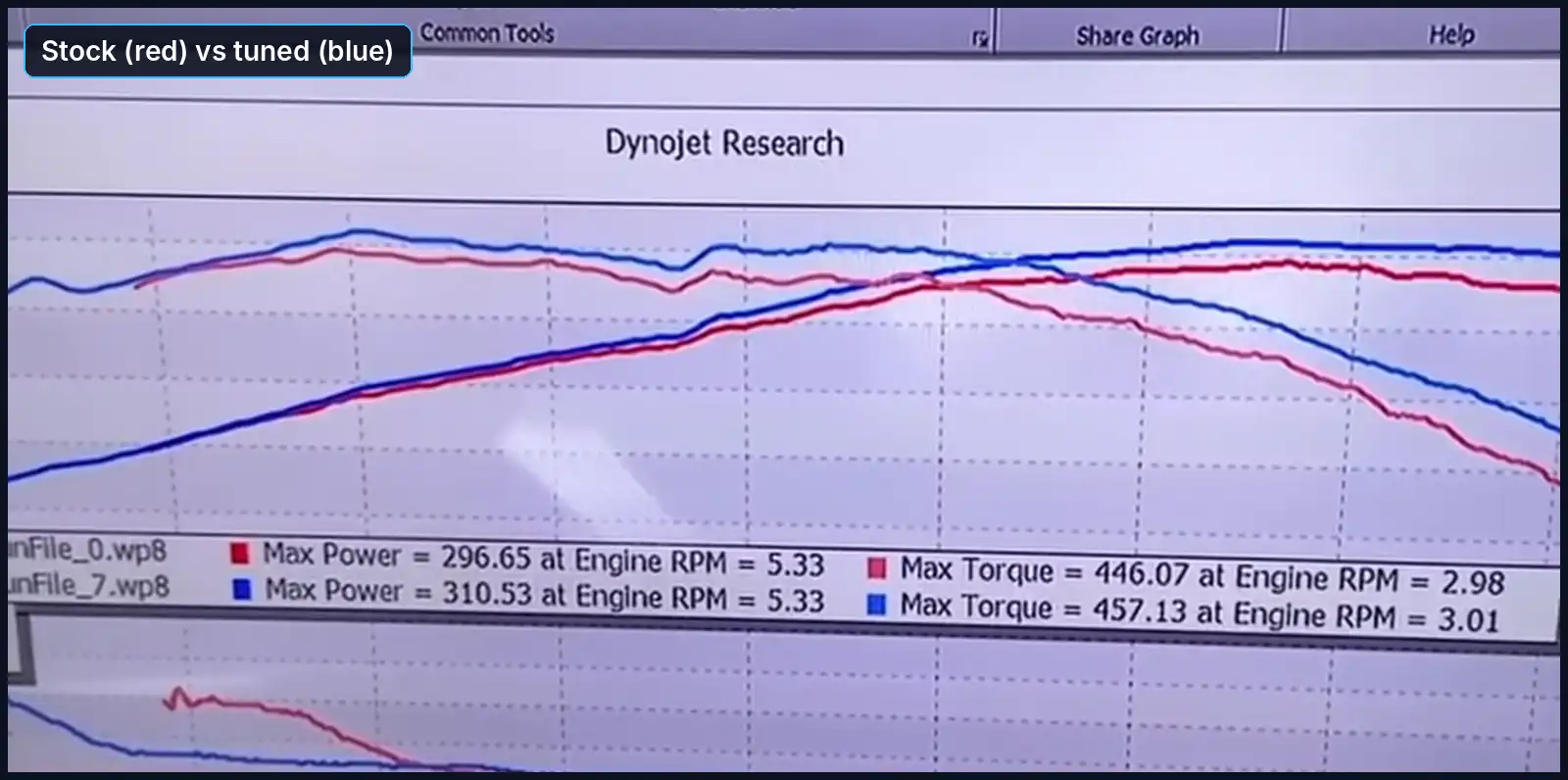
The shape of the curves says more than the peaks. The tuned torque trace sits above stock through most of the rev range, and the power traces separate in the upper half of the rev range, with the gap widening towards 6,000 rpm, where the stock run falls away faster. Peak power arrives at the same 5,330 rpm on both runs, and peak torque moves only from 2,980 to 3,010 rpm, so the engine keeps its character: the calibration adds where the factory file was holding back on this fuel, without moving the power band.
| Run | Peak power | Peak torque | Change vs stock |
|---|---|---|---|
| RunFile_0 (stock) | 296.65 PS @ 5,330 rpm | 446.07 Nm @ 2,980 rpm | Baseline |
| RunFile_7 (tuned) | 310.53 PS @ 5,330 rpm | 457.13 Nm @ 3,010 rpm | +13.88 PS (+4.7%), +11.06 Nm (+2.5%) |
Values as read from the WinPEP 8 legend. Dynojet chassis dynamometer, corrected figures (correction factor 1.24 on the live screen), measured at the wheels.
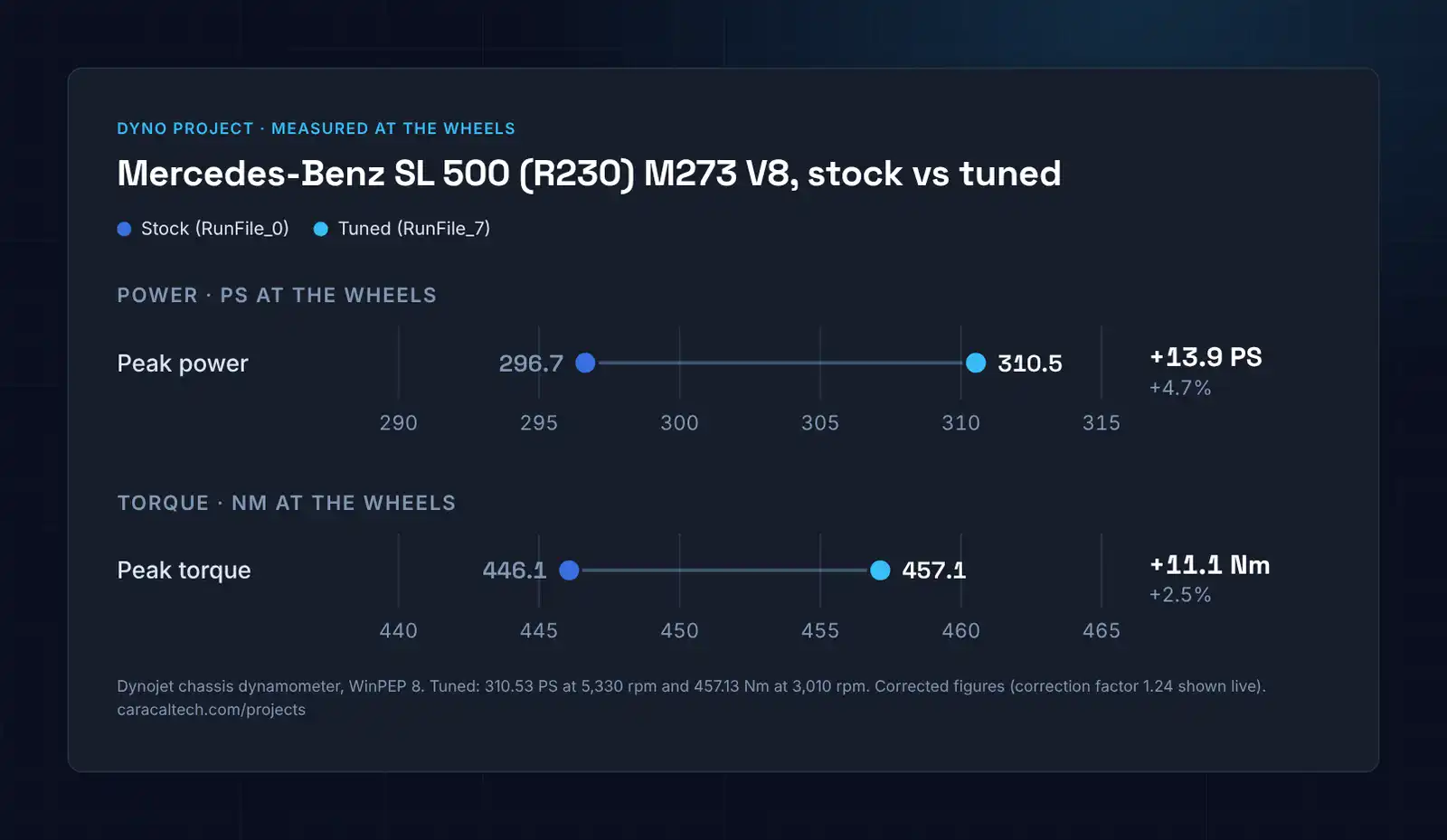
Calibration gain: +13.88 PS and +11.06 Nm at the wheels, a 4.7% power increase and a 2.5% torque increase, on the same fuel as the stock run.
For comparison, our M272 S350 W221 remap, on the same ECU family, gained 9.4% in power, and our Mazda 3 SkyActiv-G Stage 1 remap is another naturally aspirated engine on the Dynojet. Turbo engines such as the Renault Talisman 1.6 TCe gain much more because the file can also raise boost.
Part 7: What it means on the road
A 2.5% torque gain is not something a driver feels as a shove in the back. What the owner gets is an engine whose file was built for the fuel in its tank, with the extra power concentrated at the top of the rev range where the stock file was falling away. The 7G-TRONIC has a little more to work with on a kick-down overtake, and the engine can be driven hard without the ECU spending the pull fighting knock.
The gearbox side of a car like this is handled separately; our overview of gearbox (TCU) tuning tools and software explains how. To see what changes when hardware upgrades come into the plan, read Stage 1 vs Stage 2 vs Stage 3 tuning, with real dyno results for each stage.
Checks for an R230 SL 500 (M273)
- Identify the engine first. Badges can be changed. Check the engine, the engine code and the ECU before choosing a file.
- Read the fault memory. Early M273 engines are covered by a Mercedes-Benz technical bulletin on timing-drive wear: a guide (idler) gear that wears and lets the camshaft timing drift. It shows up as camshaft-to-crankshaft correlation faults, P0016 and P0017 on a generic scanner (Mercedes-Benz codes 1200 and 1208). Mercedes changed the gear material on M273 engines after serial number 2739..30 088611. A calibration cannot fix this, so check before any dyno pull.
- Read the ECU, archive the original. Confirm the Bosch ME9.7 hardware and software number, read the original file and keep it with the car's identification.
- Software version. A file has to be built on the car's own read. Never write a file copied from another vehicle.
- Fuel. Build the calibration for the fuel the car will actually run, and keep knock control fully active.
- Heat and altitude. Compare runs made in the same session and conditions. Intake air temperature rises between pulls, so allow cool-down.
- Logging. Check the file on the road with a datalog; see what an ECU data logger records.
- Legal and warranty. ECU modifications can affect warranty and may not be permitted for road use in every jurisdiction. Check local rules before tuning.
FAQ
How much horsepower does a Mercedes SL500 R230 make at the wheels?
On our Dynojet, this stock M273 SL 500 made 296.65 PS (about 293 hp) and 446.07 Nm at the wheels, corrected to standard conditions. The factory rating of 285 kW / 388 PS is measured at the crankshaft, before the 7G-TRONIC and the rest of the driveline.
Which engine is in the R230 SL 500?
From the 2006 update, the M273 KE55: a 5,461 cc naturally aspirated 90° V8 with port injection, 98.0 × 90.5 mm bore and stroke and 10.7 : 1 compression, rated at 285 kW / 388 PS at 6,000 rpm and 530 Nm from 2,800 to 4,800 rpm. Earlier R230 SL 500 models used the M113 5.0-litre V8 with a Bosch ME2.8 ECU.
Which ECU does the M273 SL 500 use?
A Bosch ME9.7 engine ECU with an MPC5xx-family microcontroller, the same family as the M272 V6.
Can KESS3 read and write the Mercedes ME9.7?
Yes. We used a KESS3 Master on this car. Alientech's list shows an OBD protocol and a BDM route on the bench for the SL 500 R230 with the M273. PCMflash (module 69) and Autotuner also list the ME9.7.
How much did the remap add?
Peak power went from 296.65 to 310.53 PS (+13.88 PS, +4.7%) and peak torque from 446.07 to 457.13 Nm (+11.06 Nm, +2.5%), measured at the wheels on the same Dynojet, the same day and the same fuel.
Why is the gain smaller than on a turbo engine?
A naturally aspirated engine has no boost to raise, so the gain comes from timing, fuelling and torque limits. On lower-quality fuel the knock margin limits timing as well, and this calibration was built to stay inside that margin.
What does the correction factor of 1.24 mean?
WinPEP 8 converts what the rollers measure to standard atmospheric conditions. At 86.33 kPa and 40 °C the factor was 1.24, so the displayed figure is 24% above the measured one. Both the stock and the tuned figures are corrected values.
Sources
- Mercedes-Benz Classic archive: 230 series SL Roadsters 2006 to 2008: SL 500 with the new M 273 5.5-litre V8, 285 kW, 0 to 100 km/h in 5.4 s, 7G-TRONIC, ABC standard on the SL 500
- ADAC: Mercedes-Benz SL 500 7G-TRONIC (04/08 to 04/09): engine code 273965, 5,461 cc, 285 kW (388 PS) at 6,000 rpm, 530 Nm, 1,910 kg, Super, Euro 4
- Mercedes-Benz USA: 2010 E-Class technical data: 5,461 cc V8, 98.0 × 90.5 mm, 10.7 : 1
- Wikipedia: Mercedes-Benz M273 engine: 90° V8, aluminium block, sequential port injection, dual-length variable intake manifold, 530 Nm at 2,800 to 4,800 rpm
- Mercedes-Benz Canada media: new-generation V8: intake and exhaust valve timing adjustment, four-valve V6 and V8 family
- Alientech K-Suite 2.32 supported vehicle list (PDF): SL 500 R230, M273KE55, Bosch ME9.7, KESSv2 protocol 312, K-TAG BDM (MPC5xx) protocol 102
- Viezu: KESS3 Master and Slave: Master reads unencrypted files; Slave files are encrypted and tied to a Master
- OBDII365: KESS3 and Mercedes ME9.7, OBD or BDM: user report of a BDM read and write on an ME9.7
- PCMflash module list (PDF): module 69, Mercedes-Benz, M156/M272/M273 (ME9.7) read, write and checksum
- Autotuner: Bosch ME9.7 (MPC563)
- Autotuner: Continental and Siemens VGS-NAG2 (7G-TRONIC) TCUs, OBD read/write
- Mercedes-Benz service bulletin copy: M272 balance shaft and M273 guide (idler) gear: M273 up to serial number 2739..30 088611
- YOUCANIC: M272 and M273 timing drive: bulletin S-B-03.30/08i, Mercedes-Benz codes 1200 and 1208
More petrol dyno projects
- Mercedes S350 W221 M272 remap: the V6 on the same Bosch ME9.7 family
- Renault Talisman 1.6 TCe remap and ECU tuning: a turbo petrol on the Dynojet
- Mazda 3 SkyActiv-G Stage 1 ECU remap: a naturally aspirated engine on the same type of dyno
- All CaracalTech dyno projects
Tuning a Mercedes-Benz M273 or M272?
Send the original read from your ECU through File Service, or ask the calibration team about your car on WhatsApp +36 70 604 8339.
Want to build files like this yourself?
Learn ECU remapping with the CaracalTech ECU Remapping Course, or compare the options first in our guide to the best ECU remapping courses.
How this report was put together
- Source material: the workshop video of this job, the WinPEP 8 graph for the stock and tuned runs, and the live WinPEP 8 screen during a tuned pull.
- Numbers: every power and torque figure is read from the WinPEP 8 legend; gains and percentages are calculated from those values. The uncorrected 249 PS figure is 308.43 PS divided by the 1.24 factor shown on the same frame.
- Specifications: engine and vehicle data come from the Mercedes-Benz and reference sources listed above; tool support comes from the tool makers' own lists.
- Not shown in the footage, so not reported: the model year and mileage, the ECU hardware and software numbers, the fault memory, whether the read was over OBD or BDM, and the correction standard selected in WinPEP 8.
- Images: the dyno room is darkened and cropped and the number plate is hidden; the car, the dyno and the screen data are not otherwise edited.
Author: CaracalTech Calibration Team
Last Updated: November 2026
Keywords:m273 tune-m273 tuning-mercedes sl500 tuning-sl500 r230 remap-r230 tuning-sl500 horsepower-bosch me9.7 kess3-mercedes sl500 ecu remap
Enjoyed the content? Add us as a preferred source to see more of it in Search.