
Renault Talisman 1.6 TCe Remap & ECU Tuning: +23 WHP, +46 Nm

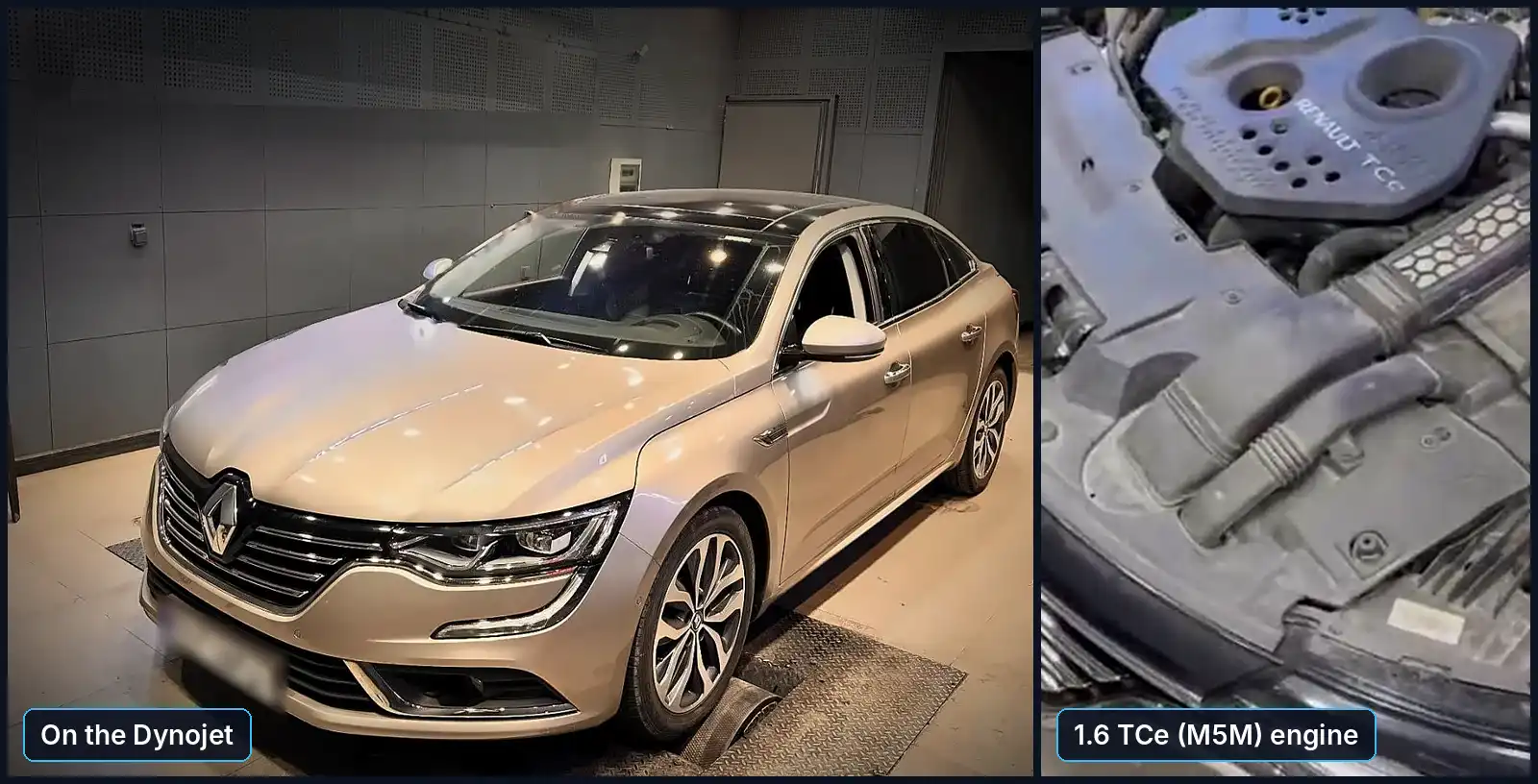
Renault Talisman 1.6 TCe Remap & ECU Tuning: +23 WHP, +46 Nm on the Dynojet
A Renault Talisman with the 1.6 TCe turbo petrol engine and the 7-speed EDC gearbox came in for an ECU remap. We measured it stock on our Dynojet, read and wrote its Hitachi engine ECU with Autotuner, and measured it again on the same rollers. Peak power went from 166.94 to 189.99 WHP and peak torque from 234.18 to 280.50 Nm, all measured at the wheels.
Fast View
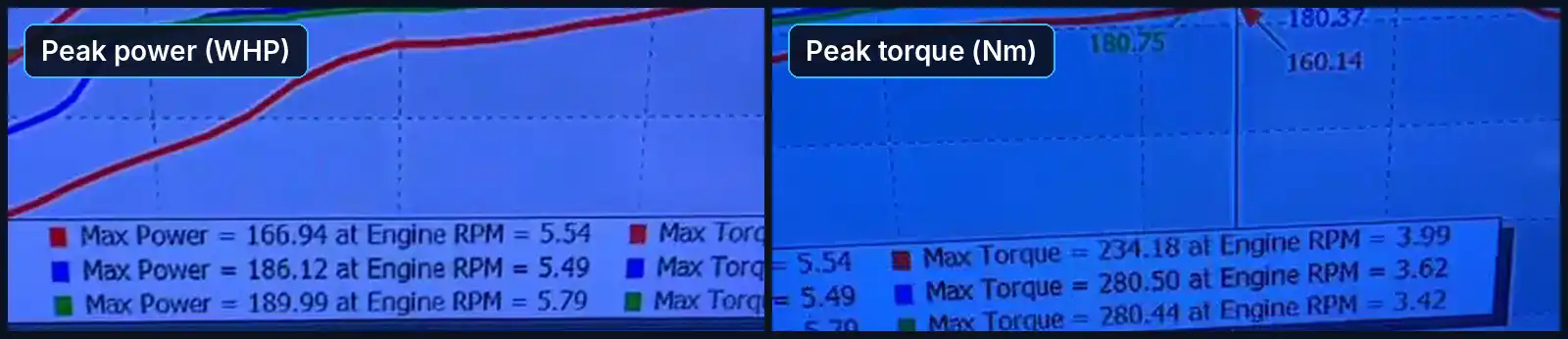
- Stock baseline (Run 0) on the Dynojet: 166.94 WHP at 5,540 rpm and 234.18 Nm at 3,990 rpm.
- After the remap: 189.99 WHP at 5,790 rpm (Run 3) and 280.50 Nm at 3,620 rpm (Run 2), a gain of +23.05 WHP (+13.8%) and +46.32 Nm (+19.8%).
- The two tuned pulls agree on torque within 0.06 Nm: 280.50 Nm (Run 2) and 280.44 Nm (Run 3).
- Engine: Renault 1.6 TCe 200, engine code M5M (Nissan MR16DDT), 1,618 cc, direct injection, turbocharged.
- Engine ECU: Hitachi BED434, read and written with Autotuner, which supports this ECU for OBD read and write.
Part 1: The car and the 1.6 TCe engine
The car is a Renault Talisman saloon with the 1.6 TCe petrol engine and Renault's EDC dual-clutch automatic. Renault sold this engine in the Talisman in two outputs, 150 PS and 200 PS. The stock dyno pull tells us which one this is: 166.94 WHP at the wheels is more than the 150 PS version makes at the crankshaft, so this is the TCe 200.
The engine is Renault's M5M, the Renault name for the Nissan MR16DDT (DIG-T) that Renault and Nissan share. It is an aluminium 1.6-litre four-cylinder with gasoline direct injection, a turbocharger with an intercooler, and variable timing on both the intake and the exhaust camshaft. Because it is turbocharged, most of what a remap changes on this engine is the load the ECU allows the turbo to build, and the ignition and fuel that go with it.
The car at a glance:
| Specification | Value |
|---|---|
| Vehicle | Renault Talisman saloon, 1.6 TCe 200 EDC, front-wheel drive |
| Engine | Renault 1.6 TCe, engine code M5M (M5M 450), Nissan MR16DDT family |
| Layout | Inline 4-cylinder, DOHC 16-valve, aluminium block and head |
| Displacement | 1,618 cc |
| Bore × stroke | 79.7 × 81.1 mm |
| Compression ratio | 9.5 : 1 to 10.0 : 1 (sources differ) |
| Fuel system | Gasoline direct injection |
| Aspiration | Turbocharged, intercooled |
| Valve timing | Variable timing on intake and exhaust camshafts (twin CVTC) |
| Rated power (factory, at the crank) | 147 kW / 200 PS @ 6,000 rpm |
| Rated torque (factory, at the crank) | 260 Nm @ 2,000 rpm (some sources list 2,500 rpm) |
| Emission standard | Euro 6 |
| Transmission | EDC 7-speed wet dual-clutch automatic (Getrag 7DCT300), designed for up to 300 Nm |
| Factory performance | 0 to 100 km/h in 7.6 s, 237 km/h, 1,430 kg (saloon) |
| Engine ECU | Hitachi BED434, Renesas SH72533 microcontroller |
| Read / write | Autotuner |
| Dyno | Dynojet chassis dynamometer, WinPEP 8 |
Factory figures are Renault data as published in the sources below. ECU, tool and dyno details are from this job.
Part 2: The baseline pull
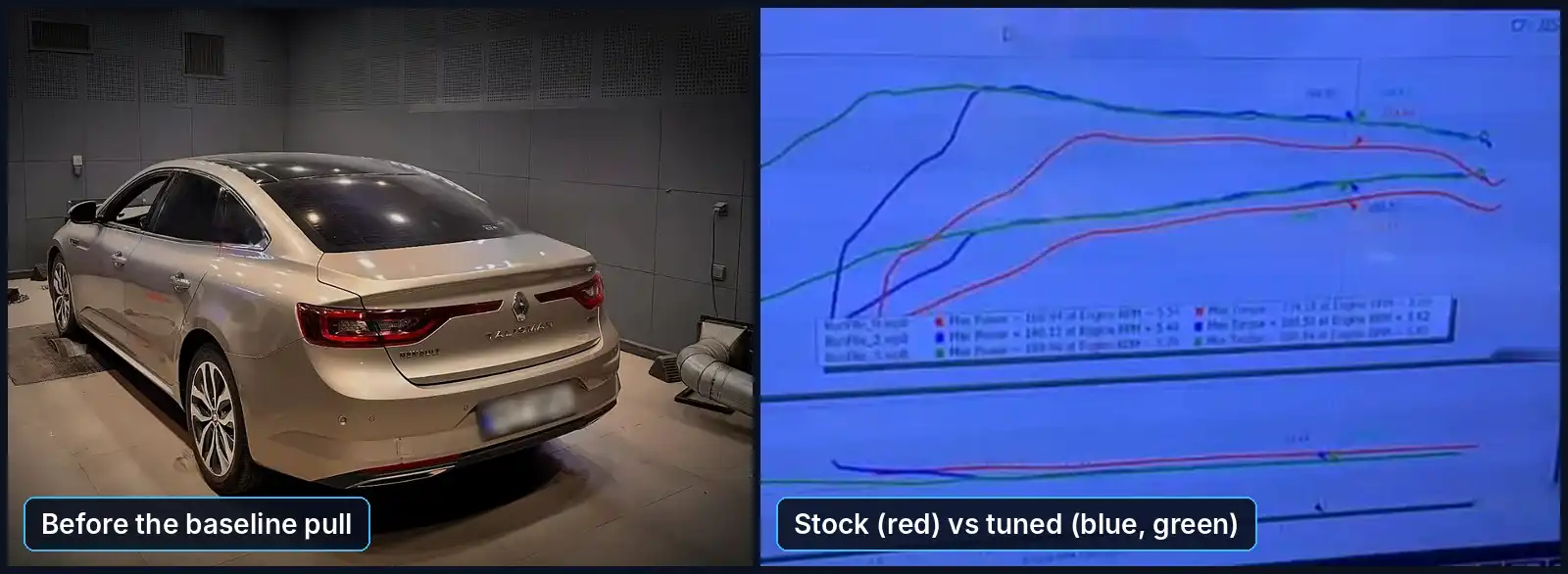
Before touching the ECU, we made the baseline pull on the Dynojet. Run 0, the red traces in WinPEP 8, peaked at 166.94 WHP at 5,540 rpm and 234.18 Nm at 3,990 rpm.
The gap to the 200 PS rating is normal for a front-wheel-drive car with a dual-clutch gearbox. The rating is measured at the crankshaft, and the dyno measures at the wheels, after the clutches, the gears, the final drive and the driveshafts. On this car the wheel figure is about 85% of the crank rating. If WinPEP overlays are new to you, our guide on how to read a dyno graph explains the traces and the legend.
Why the wheel figures sit below the factory rating
Crank vs wheels: 200 PS and 260 Nm are crankshaft ratings, measured on an engine dyno under standard test conditions.
Driveline losses: A chassis dyno measures after the dual-clutch gearbox, the final drive and the driveshafts, so part of the crank output never reaches the rollers.
Dynojet torque: Dynojet calculates torque from wheel power and engine speed, so its Nm figure includes those losses and cannot be compared directly with the 260 Nm crank rating.
Test conditions: Air temperature, fuel quality and the dyno's correction factor all move the result. Compare runs made on the same dyno on the same day, which is how these runs are meant to be read.
Part 3: The Hitachi BED434 and the Autotuner read
The 1.6 TCe in the Talisman is managed by a Hitachi BED434 engine ECU. The same ECU family appears on other Renault and Nissan applications of this engine, such as the Clio RS 200, the Espace 1.6 TCe and the Mégane GT 1.6 TCe. Autotuner's compatibility list gives its microcontroller as a Renesas SH72533.
We read and wrote the ECU with Autotuner. Autotuner lists the Hitachi BED434 for OBD read and OBD write, so the ECU can stay in the car, and it also offers Renault-specific datalogging on this ECU, which uses Renault's own measurement codes instead of generic OBD-II values. Logging is how a tuner checks the file on the road; our article on what an ECU data logger is covers the basics. The first job after the read was to archive the original file.
| Item | Detail |
|---|---|
| ECU | Hitachi BED434 (engine) |
| Microcontroller | Renesas SH72533 |
| Engine applications | Renault 1.6 TCe (M5M) and Nissan 1.6 DIG-T (MR16DDT), including Talisman, Espace, Clio RS and Mégane GT |
| Tool used on this car | Autotuner |
| Autotuner support | OBD read, OBD write, Renault-specific datalogging |
| Other tools that list this ECU | Alientech KESS3 (OBD and boot), Magic Motorsport Flex (OBD, Talisman 1.6 TCe 200 listed) |
| Gearbox controller | Separate Getrag 7DCT300 TCU, listed by Autotuner on a Renesas SH72549 |
Some other Renault 1.6 TCe applications, such as the 220 PS Clio RS Trophy, use a Continental EMS3155 instead of the Hitachi unit. Identify the ECU on the car before choosing a tool and a protocol. For a wider view of the hardware, see our comparison of the best ECU tuning tools and programmers, and our explainers on what KESS3 is and what Magic Motorsport Flex does.
Part 4: What the calibration works on
On a modern turbo petrol ECU such as the BED434, the pedal position becomes a load or torque request, and the ECU turns that request into throttle opening, boost, ignition timing and fuel. A remap on this engine has to change those steps together. Our article on the torque-based ECU structure explains this chain in more detail.
Torque request and limiters: The requested torque, the torque limits and the load limits have to agree with the new targets, or the ECU trims the extra torque back. The pedal-to-torque step is the driver wish map. On a car with a dual-clutch gearbox, the limits that protect the gearbox matter as much as the engine's own.
Load and boost: Most of the gain on a turbocharged engine comes from letting it build more air load. The boost target and the turbo control have to deliver that load smoothly and stay inside the turbo's limits; see how turbocharger tables are laid out.
Ignition timing: More load brings the engine closer to knock. Timing has to suit the fuel the car actually runs, and knock control stays fully active. Our guide to spark advance and timing maps covers how timing is read and logged.
Full-load fuelling: The air-fuel target at full load sets combustion and exhaust temperatures. The lower panel of the dyno graph shows the tuned runs running a richer mixture than stock at full load.
With the file finished, we wrote it back with Autotuner and the car went back on the rollers.
Learn this workflow: To build files like this yourself, start with the CaracalTech ECU Remapping Course.
Part 5: Back on the Dynojet
Same car, same Dynojet, tuned file loaded. We made two pulls, Run 2 (blue) and Run 3 (green). Run 3 made the highest power, 189.99 WHP at 5,790 rpm, and Run 2 the highest torque, 280.50 Nm at 3,620 rpm. Against the stock run that is +23.05 WHP and +46.32 Nm.
The two tuned pulls agree closely on torque, 280.50 and 280.44 Nm, and Run 3 made 3.87 WHP more at the top of the rev range. Peak torque also arrives earlier: at 3,990 rpm stock, at 3,620 rpm on Run 2 and at 3,420 rpm on Run 3.
| Measurement | Stock (Run 0) | Tuned (Run 2) | Tuned (Run 3) | Best change vs stock |
|---|---|---|---|---|
| Peak power | 166.94 WHP @ 5,540 rpm | 186.12 WHP @ 5,490 rpm | 189.99 WHP @ 5,790 rpm | +23.05 WHP (+13.8%) |
| Peak torque | 234.18 Nm @ 3,990 rpm | 280.50 Nm @ 3,620 rpm | 280.44 Nm @ 3,420 rpm | +46.32 Nm (+19.8%) |
Values as read from the WinPEP 8 legend. Dynojet chassis dynamometer, figures at the wheels.
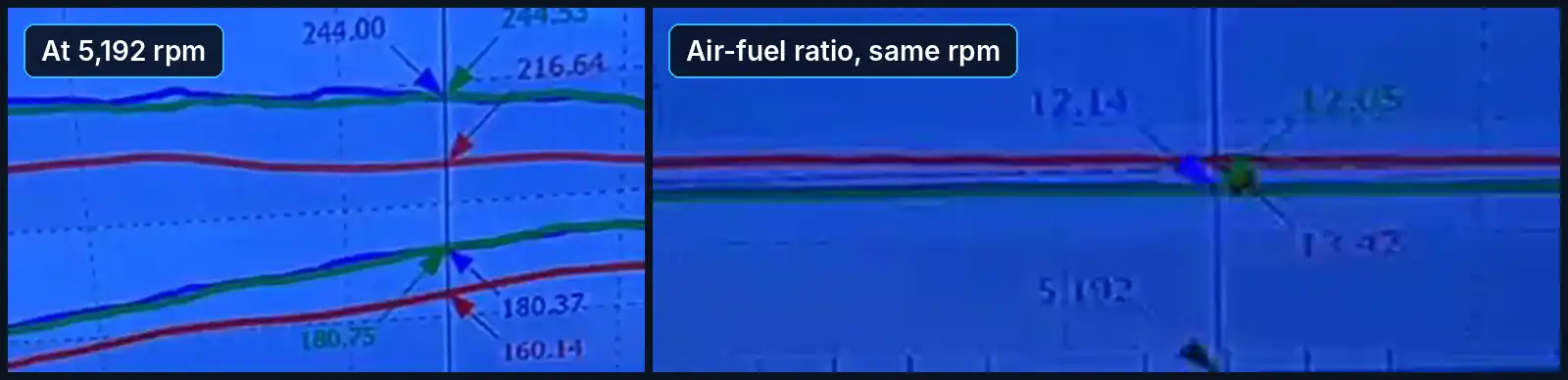
The cursor in WinPEP 8 shows how the gain holds in the upper mid-range. At 5,192 rpm, all three runs read:
| At 5,192 rpm | Stock (Run 0) | Tuned (Run 2) | Tuned (Run 3) |
|---|---|---|---|
| Power | 160.14 WHP | 180.37 WHP | 180.75 WHP |
| Torque | 216.64 Nm | 244.00 Nm | 244.53 Nm |
| Air-fuel ratio | 13.42 | 12.14 | 12.05 |
That is about +20 WHP and +27 Nm at the same rpm, with the mixture richer by 1.3 to 1.4 air-fuel ratio points on the tuned runs. To convert these figures to lambda, use our AFR vs lambda chart; on a dyno, AFR is normally measured with a wideband oxygen sensor.
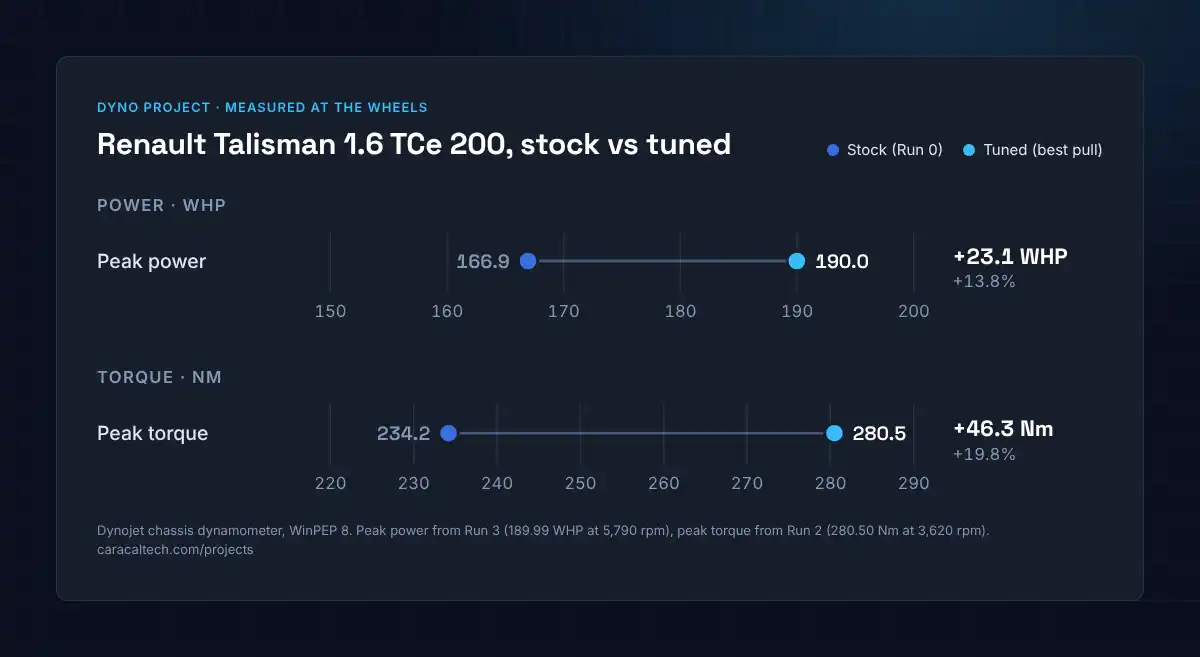
Remap gain: +23.05 WHP and +46.32 Nm at the wheels, a 13.8% power increase and a 19.8% torque increase, with both tuned pulls in close agreement on torque.
The result depends on the stock calibration, the fuel and the conditions on the day, so another Talisman 1.6 TCe on different fuel or a different software version can land elsewhere.
Part 6: What it means on the road
The torque gain is the part a driver feels. Peak torque is up by more than 46 Nm at the wheels and arrives several hundred rpm earlier, so the EDC gearbox has more to work with when it shifts up and when it kicks down for an overtake.
It also puts more load through the gearbox. Getrag designed the 7DCT300 for up to 300 Nm, and engine torque is higher than the 280.50 Nm the dyno reads at the wheels, because the dyno figure is after driveline losses. That is why the torque limits in the calibration, the condition of the clutches and the gearbox's own torque limits matter on this car. Our overview of gearbox (TCU) tuning tools and software explains how the gearbox side is handled.
This project compares the car stock and after an ECU remap. To see what changes when hardware upgrades come into the plan, read Stage 1 vs Stage 2 vs Stage 3 tuning, with real dyno results for each stage.
Checks for a Talisman 1.6 TCe
- Identify the ECU first. The Talisman 1.6 TCe uses the Hitachi BED434. Other 1.6 TCe applications use a Continental EMS3155. Confirm the ECU and its software version on the car before reading.
- Archive the original. Read and save the original file before any change, and keep it with the car's identification.
- Software version. A file has to be built on the car's own read. Never write a file copied from another vehicle.
- Gearbox. The 7-speed EDC (Getrag 7DCT300) is designed for up to 300 Nm. Check clutch condition and shift quality before tuning, and respect the gearbox torque limits in the calibration.
- Fuel. A turbocharged direct-injection engine is sensitive to fuel quality. On poor fuel, knock control pulls timing and the gain shrinks with it; see ECU remapping for low-octane fuel.
- Heat. Intake air temperature rises quickly on a turbo petrol between pulls. Allow cool-down and compare runs made under the same conditions.
- Mechanical health. A remap does not fix existing faults. Clear stored fault codes and check spark plugs, coils, boost hoses and the intercooler for leaks before tuning.
- Legal and warranty. ECU modifications can affect the manufacturer's warranty and may not be permitted for road use in every jurisdiction. Check local rules before tuning.
FAQ
Which engine is in the Renault Talisman 1.6 TCe?
The M5M, a 1,618 cc turbocharged direct-injection four-cylinder that Renault shares with Nissan as the MR16DDT. In the Talisman it was sold with 150 PS or 200 PS; the TCe 200 is rated at 147 kW and 260 Nm.
Which ECU does the Talisman 1.6 TCe use?
A Hitachi BED434 engine ECU with a Renesas SH72533 microcontroller. Some other Renault 1.6 TCe applications use a Continental EMS3155, so check the car before choosing a tool.
Can Autotuner read the Talisman 1.6 TCe ECU?
Yes. Autotuner lists the Hitachi BED434 for OBD read and OBD write, and we read and wrote this car with Autotuner.
How much did the remap add?
On our Dynojet, peak power went from 166.94 to 189.99 WHP (+23.05 WHP) and peak torque from 234.18 to 280.50 Nm (+46.32 Nm), measured at the wheels.
Why are there two tuned runs?
Run 2 and Run 3 are two pulls after the write. They agree on peak torque within 0.06 Nm; Run 3 made 3.87 WHP more at the top of the rev range.
Is the EDC gearbox a limit when tuning the 1.6 TCe?
It is a factor to respect. Getrag designed the 7DCT300 for up to 300 Nm, so the calibration's torque limits and the clutch condition need care on a tuned car.
Sources
- Auto-Data: Renault Talisman 1.6 Energy TCe 200 EDC: engine code M5M, 1,618 cc, bore and stroke 79.7 × 81.1 mm, 200 hp at 6,000 rpm
- L'Argus: Renault Talisman TCe 200 EDC7 test and data sheet: 200 PS at 6,000 rpm, 260 Nm at 2,000 rpm, 7-speed EDC, 1,430 kg, 7.6 s, 237 km/h
- km77: Renault Talisman Energy TCe 200 EDC data: 147 kW, 260 Nm at 2,000 rpm, direct injection, turbo and intercooler
- Wikipedia: Nissan MR engine: MR16DDT (Renault M5M), 79.7 × 81.1 mm, twin variable valve timing, Talisman TCe application
- HP Tuners: supported vehicles: Talisman M5M 450 1.6 TCe 150/200 with the BED434 ECU
- Autotuner: Hitachi BED434, OBD read/write
- Autotuner: Renault Mégane 1.6 TCe GT, Hitachi BED434: OBD read and OBD write
- Autotuner: compatibility list (PDF): Hitachi BED434 on SH72533, Getrag 7DCT300 on SH72549
- Autotuner: Renault Group specific datalogging: Hitachi BED434 listed
- Alientech: Hitachi BED434: KESS3 OBD and boot, Renault 1.6 TCe applications
- Magic Motorsport Flex 6.37 update: Hitachi BED434 OBD, Renault Talisman 1.6 TCe 200 PS listed
- Getrag 7DCT300 launch: dual-clutch transmission designed for a maximum torque of 300 Nm
- Planète Renault: EDC transmissions: 7-speed wet-clutch EDC rated at 300 Nm, used with petrol engines
More turbo petrol dyno projects
- OMODA 5 1.6 TGDi Stage 1 ECU remap: another 1.6-litre turbo direct-injection engine on the dyno
- Nissan Terra 2.0 TGDI Stage 1 ECU remap: a Nissan-family turbo petrol, read over OBD
- Mazda 3 SkyActiv-G Stage 1 ECU remap: a naturally aspirated comparison on the same type of Dynojet
- All CaracalTech dyno projects
Tuning a Renault 1.6 TCe or a Nissan 1.6 DIG-T?
Send the original read from your ECU through File Service, or ask the calibration team about your car on WhatsApp +36 70 604 8339.
Want to build files like this yourself?
Learn ECU remapping with the CaracalTech ECU Remapping Course, or compare the options first in our guide to the best ECU remapping courses.
Author: CaracalTech Calibration Team
Last Updated: November 2026
Keywords:renault talisman remap-renault talisman ecu tuning-renault talisman 1.6 tce remap-talisman tce 200 tuning-renault talisman chiptuning-renault m5m ecu remap-hitachi bed434 autotuner-renault 1.6 tce dyno
Enjoyed the content? Add us as a preferred source to see more of it in Search.